
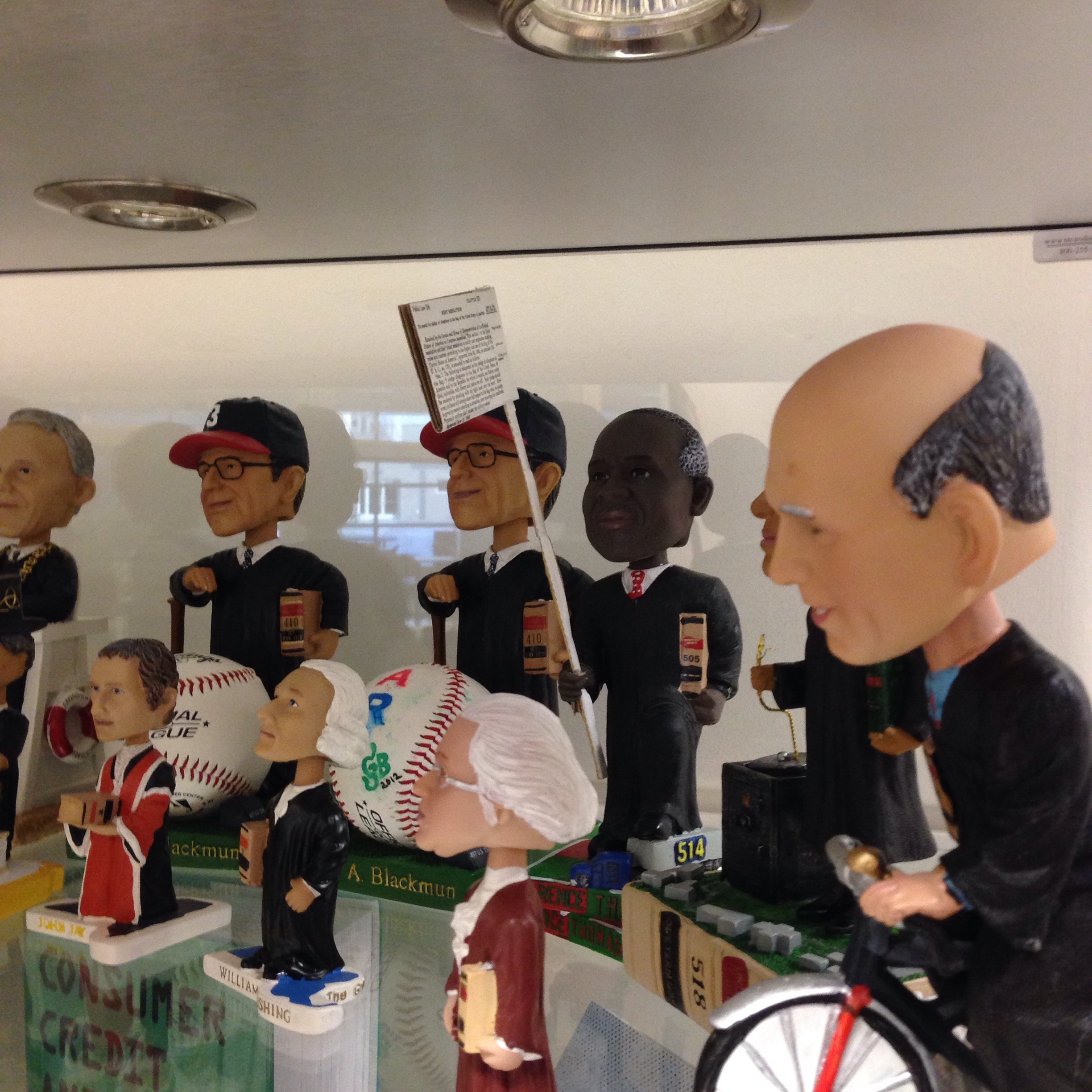
The law library of George Mason University has a wonderful collection of bobblehead dolls of our Supreme Court Justices and other historical jurists.
 Credit:


Creative Commons
Blogs I Follow





The law library of George Mason University has a wonderful collection of bobblehead dolls of our Supreme Court Justices and other historical jurists.
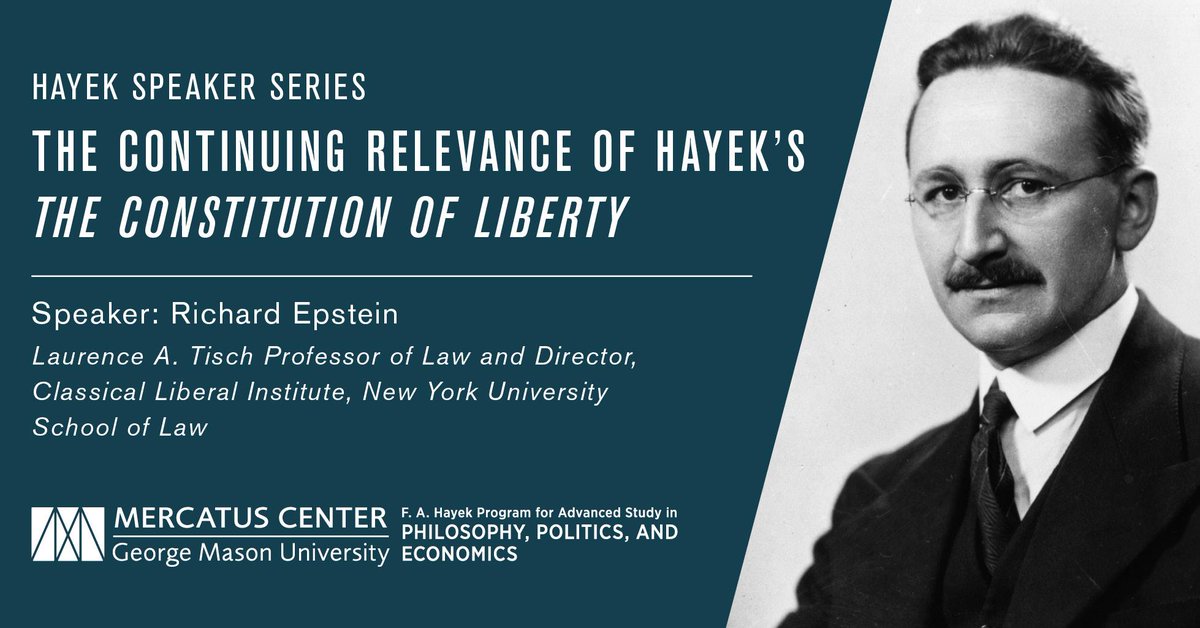
We will be attending a public lecture later today (10/8) by NYU law professor Richard Epstein on “The Continuing Relevance of Hayek’s The Constitution of Liberty.” If you are in the metro DC area, please join us. The lecture is scheduled for four o’clock in the afternoon at the Founders Hall Auditorium of the Arlington Campus of George Mason University–within walking distance of the GMU/Virginia Square Metro Station. (The lecture will also be followed by a reception at 5:30 pm, and Professor Epstein will be available to sign copies of his important new book, The Classical Liberal Constitution: The Uncertain Quest for Limited Government.) Addendum (10/12): we blogged about Professor Epstein’s lecture on 10/10 (twice) and 10/12.
Thus far this semester, we have been reading about the historic events that occurred in Harvard College in late 2003-early 2004 and in Silicon Valley during the summer 2004 leading up to the launching and subsequent explosive growth of Facebook (or “thefacebook,” as it was then called) and using these events to explore many different fields of business law, including such areas as contracts, unfair competition, and intellectual property. Now, for our last lesson, let’s fast-forward to January 2012, when our friends at Facebook conducted a massive (and secret) social psychology experiment on 700,000 English-language Facebook users without their consent. (Update: The scientific journal that published Facebook’s research later published an Expression of Concern but did not retract the article or impose any sanctions on the authors of the paper. By the way, for what it’s worth, one Facebook user took matters into his own hands and conducted a “reverse-Facebook experiment.”) So, was Facebook’s secret psych experiment an ethical one?

Were you in the control group or in the treatment group?
Last week, we published a short letter in the journal Science in which we proposed extending the intentional tort of fraudulent misrepresentation to the most egregious cases of research fraud. After all, why should alleged academic fraudsters like Michael LaCour (political science) or James Hunton (accounting) be held to a different legal standard than businesses or ordinary persons? Yet many cases of alleged research fraud often involve “innocent” co-authors. To what extent might such co-authors themselves be legally liable for the primary author’s alleged research fraud? The answer to this question will depend on the scope of a co-author’s legal duty to independently investigate or verify the integrity or genuineness of the primary author’s research data. Specifically, a co-author might be liable for a primary author’s research fraud under the well-established common law doctrine of negligent misrepresentation. Broadly speaking, a negligent misrepresentation (as opposed to a “fraudulent” one) can occur when a person carelessly makes a false statement of material fact–including a misrepresentation that he honestly believes to be true but which he should have known was false. This theory of liability could thus apply to an “innocent” co-author who adds his or her name to a paper with fake data but does not make any reasonable efforts to verify the integrity of the primary author’s data. There is much more to the tort of negligent misrepresentation, however–and we are currently researching and writing up a formal law review article on this subject (legal liability for research fraud), so we will have more to say about this problem soon …

/cdn0.vox-cdn.com/uploads/chorus_asset/file/4094468/Screen%20Shot%202015-09-24%20at%204.04.02%20PM.png)
Credit: Martin Varnic (via kottke).
Can you spot the difference between a “fashionista” and a “trumpanista,” or this is a false choice, a distinction without a difference? The Urban Dictionary defines a fashionista as “a person devoted to fashion clothing, particularily [sic] unique or high fashion.” We would argue that a trumpanista, by contrast, is someone who purposely wears outmoded articles of clothing, like the now-iconic hat worn (and sold) by businessman-extraordinaire and presidential candidate Donald Trump. Or as Ashley Parker, writing for the N.Y. Times, explains (edited by us for clarity): Continue reading


Hopefully It’s Interesting.
In Conversation with Legal and Moral Philosophers
PhD, Jagiellonian University
Books, papers, and other jurisprudential things
Ramblings of a retiree in France
BY GRACE THROUGH FAITH
Natalia's space
hoping we know we're living the dream
Lover of math. Bad at drawing.
We hike, bike, and discover Central Florida and beyond
Making it big in business after age 40
Reasoning about reasoning, mathematically.
I don't mean to sound critical, but I am; so that's how it comes across
remember the good old days...
"Let me live, love and say it well in good sentences." - Sylvia Plath
a personal view of the theory of computation
Submitted For Your Perusal is a weblog wherein Matt Thomas shares and writes about things he thinks are interesting.
Logic at Columbia University
Just like the Thesis Whisperer - but with more money
the sky is no longer the limit
Technology, Culture, and Ethics
Just like the horse whisperer - but with more pages
Poetry, Other Words, and Cats

 prior probability