Why won’t Richard Epstein update his priors?

In our previous two posts (part 1 and part 2), we summarized Professor Richard Epstein’s critique of the great F. A. Hayek. It is now time to assess Epstein’s criticisms of Hayek–to critique the critique, so to speak. It pains us to say this, but either Epstein is not a very good reader or he is not a good Bayesian. On page 136 of “The Constitution of Liberty,” Hayek specifically anticipates Epstein’s monopoly problem and concedes that “a monopolist could exercise true coercion … if he were, say, the owner of a spring in an oasis.” In addition, Hayek writes (ibid.):

It is worth pointing out … that whenever there is a danger of a monopolist’s acquiring coercive power, the most expedient and effective method of preventing this is probably to require him to treat all customers alike, i.e., to insist that his prices be the same for all and to prohibit all discrimination on his part.

In other words, Hayek’s solution to the monopoly problem anticipates the exact same argument that Professor Epstein makes in his critique of Hayek. We not only suspect, however, that Professor Epstein is a careless reader; we also suspect that his inability to give Hayek credit where credit is due might be the result of Epstein’s general skepticism about philosophy’s ability to contribute to our understanding of the law. Simply put, Professor Epstein has a particular view of the world. Fine, we all do. In Epstein’s case, his view is that modern philosophy has little to offer legal theory. (See, for example, his thoughtful 1999 Dunbar Lecture published in volume 68 the Mississippi Law Review under the title “Life Boats, Desert Islands, and the Poverty of Modern Jurisprudence.“) Given these priors about philosophy, Epstein must have reasoned thus: Since Hayek, at bottom, is really a philosopher, then Hayek must have little to offer legal theory. But had Epstein read Hayek more carefully, he would not have been so quick to dismiss Hayek’s contributions to law.

Posted in Uncategorized | Leave a comment

Epstein’s Critique of Hayek (Part 2)

In our previous post, we identified (via the loquacious Professor Richard Epstein) a potential contradiction in Hayek’s influential theory of “spontaneous order.” Briefly, decentralized markets are a good example of a spontaneous order, but markets require a set of rules or a legal framework in which contracts and property rights are enforced, and this framework itself is often (though not always) the product of human design. (See also Regis Servant’s thoughtful comment in our previous post.) But aside from this mismatch, Epstein identifies another major blind spot in Hayek’s work. Specifically, Epstein asks, what happens when there is a breakdown of spontaneous order? Continue reading

Posted in Economics, Law, Philosophy | 4 Comments

Epstein’s Critique of Hayek (Part 1)

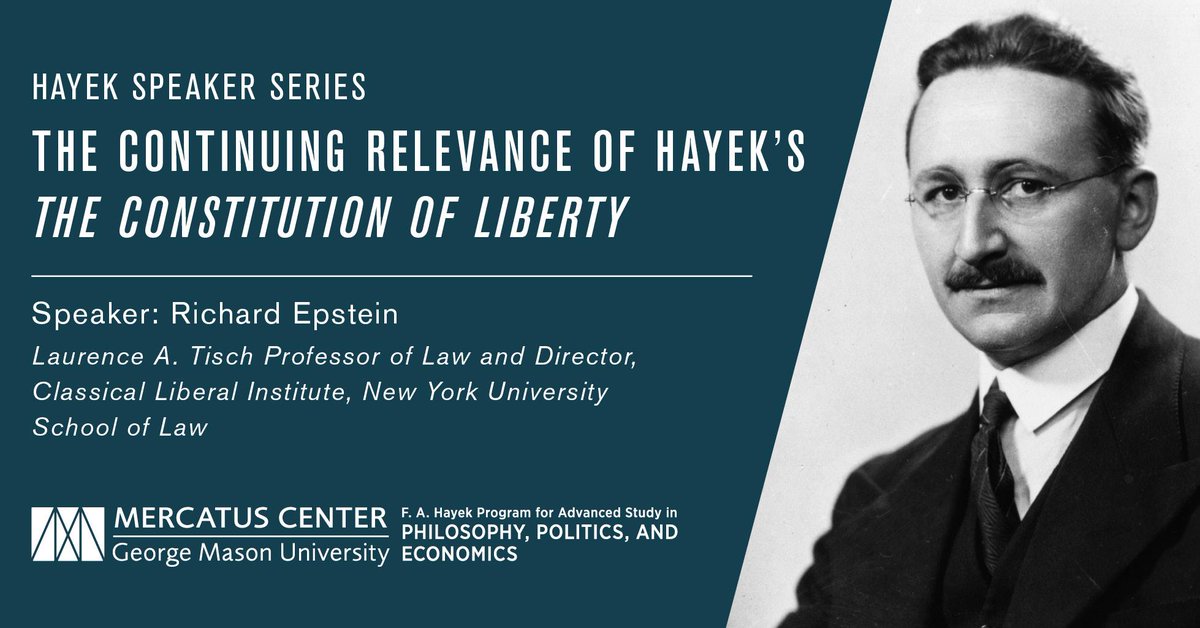
We recently attended Richard Epstein’s lecture at George Mason University on “The Continuing Relevance of Hayek’s The Constitution of Liberty.” (Disclosure: we are big fans of Epstein’s book “Simple Rules for a Complex World.”) In his lecture, Epstein delivered several devastating blows against Hayek’s body of work. Among other things, Epstein spotted an internal inconsistency in Hayek’s thinking. Let’s start with Hayek’s greatest contribution to the field of political economy: his counter-intuitive notion of “spontaneous order.” In his famous paper on “The Use of Knowledge in Society,” for example, Hayek explains why decentralized markets produce greater levels of peace and prosperity than centralized “command-and-control” systems do. Simply put, when people are free to decide for themselves what things to buy and sell, their choices spontaneously generate high levels of social coordination without any intentional design or central planning. In Hayek’s own words: “The continuous flow of goods and services is maintained by constant deliberate adjustments, by new dispositions made every day in the light of circumstances not known the day before, by B stepping in at once when A fails to deliver.” (Hayek, 1945, p. 522.) Hayek’s main point is that all these “deliberate adjustments” and “new dispositions” are made voluntarily by millions of individuals and firms acting independently of each other, and yet, in spite of the lack of centralized control, this chaotic process produces a wide array of complex goods and services that people want to buy. So, where’s the inconsistency? Continue reading

Posted in Economics, Law, Philosophy | 7 Comments

Oyez! Oyez! Oyez! 

  
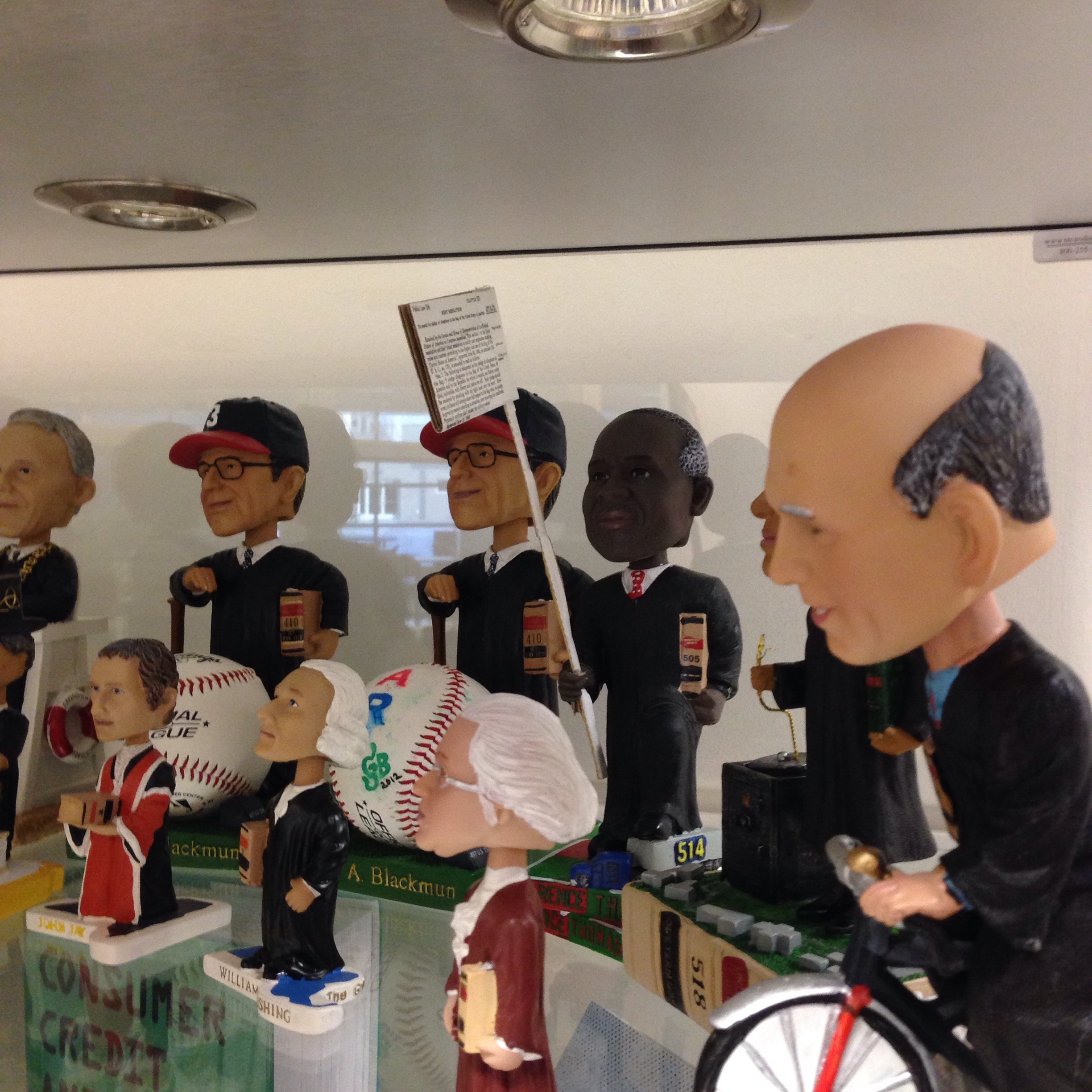
The law library of George Mason University has a wonderful collection of bobblehead dolls of our Supreme Court Justices and other historical jurists.

Posted in Culture, Law | Leave a comment

Epstein on Hayek on Liberty

We will be attending a public lecture later today (10/8) by NYU law professor Richard Epstein on “The Continuing Relevance of Hayek’s The Constitution of Liberty.” If you are in the metro DC area, please join us. The lecture is scheduled for four o’clock in the afternoon at the Founders Hall Auditorium of the Arlington Campus of George Mason University–within walking distance of the GMU/Virginia Square Metro Station. (The lecture will also be followed by a reception at 5:30 pm, and Professor Epstein will be available to sign copies of his important new book, The Classical Liberal Constitution: The Uncertain Quest for Limited Government.) Addendum (10/12): we blogged about Professor Epstein’s lecture on 10/10 (twice) and 10/12.

Posted in Uncategorized | Leave a comment

“Facebook Ethics” (A/B testing edition)

Thus far this semester, we have been reading about the historic events that occurred in Harvard College in late 2003-early 2004 and in Silicon Valley during the summer 2004 leading up to the launching and subsequent explosive growth of Facebook (or “thefacebook,” as it was then called) and using these events to explore many different fields of business law, including such areas as contracts, unfair competition, and intellectual property. Now, for our last lesson, let’s fast-forward to January 2012, when our friends at Facebook conducted a massive (and secret) social psychology experiment on 700,000 English-language Facebook users without their consent. (Update: The scientific journal that published Facebook’s research later published an Expression of Concern but did not retract the article or impose any sanctions on the authors of the paper. By the way, for what it’s worth, one Facebook user took matters into his own hands and conducted a “reverse-Facebook experiment.”) So, was Facebook’s secret psych experiment an ethical one?

Were you in the control group or in the treatment group?

Posted in Ethics, Law, Web/Tech | Leave a comment

Scoreboard Symmetry

Credit: goregyle (via reddit)

Posted in Sports | 1 Comment

Caribbean Europe

Hat tip: u/zurthen, via Reddit

Posted in Uncategorized | Leave a comment

Legal liability of “innocent” co-authors for research fraud

Last week, we published a short letter in the journal Science in which we proposed extending the intentional tort of fraudulent misrepresentation to the most egregious cases of research fraud. After all, why should alleged academic fraudsters like Michael LaCour (political science) or James Hunton (accounting) be held to a different legal standard than businesses or ordinary persons? Yet many cases of alleged research fraud often involve “innocent” co-authors. To what extent might such co-authors themselves be legally liable for the primary author’s alleged research fraud? The answer to this question will depend on the scope of a co-author’s legal duty to independently investigate or verify the integrity or genuineness of the primary author’s research data. Specifically, a co-author might be liable for a primary author’s research fraud under the well-established common law doctrine of negligent misrepresentation. Broadly speaking, a negligent misrepresentation (as opposed to a “fraudulent” one) can occur when a person carelessly makes a false statement of material fact–including a misrepresentation that he honestly believes to be true but which he should have known was false. This theory of liability could thus apply to an “innocent” co-author who adds his or her name to a paper with fake data but does not make any reasonable efforts to verify the integrity of the primary author’s data. There is much more to the tort of negligent misrepresentation, however–and we are currently researching and writing up a formal law review article on this subject (legal liability for research fraud), so we will have more to say about this problem soon …

Posted in Academia, Law | Leave a comment

Mapping the writers and the works of “the lost generation”

Credit: Martin Varnic (via kottke).

Posted in Culture, Language | Leave a comment