Infinite regress in law (a theoretical critique of the Hand formula)

Adjudication is the process of making decisions in law, but decision-making is a costly activity. For simplicity, we can model the process of adjudication (and decision-making generally) as a function consisting of two costly inputs: (i) RESEARCH or information-gathering and (ii) DELIBERATION or information-processing.

Consider, for example, the so-called Hand formula or “calculus of negligence” in tort law. In summary, the Hand calculus is a simple economic decision rule for finding the optimal level of care x*, or B = P*L in the standard formulation of the Hand test. But this simple decision rule imposes non-trivial research and deliberation costs on judges and jurors (assuming, of course, that jurors actually use this formula). That is, finding the optimal level of care under the Hand formula is a first-order decision problem with costly inputs: in order to find the optimal level of care x*, the decision-maker must not only be aware of the Hand formula, he must also go out and collect sufficient data in order to find the actual or approximate values for B, P, and L (the main variables in the Hand formula) and he must then “crunch the numbers” and solve for x*. But how much data should the decision-maker collect? And how much time should he or she spend crunching the numbers? These simple questions pose a second-order decision problem, a new problem with non-trivial information and deliberation costs, just like the original, first-order decision problem (i.e. finding the level of optimal care). This second-order problem, in turn, produces a new, third-order problem, and so on …

Furthermore, because information and deliberation are costly inputs, notice that the regress problem does not just apply to the Hand formula in tort law. It applies to any decision rule requiring the collection of information and deliberation! In the words of Holly Smith in her essay “Deciding how to decide“: It begins to appear that the use of decision guides in decision-making is threatened with some form of infinite regress. To decide how to act, one must first decide how to decide to act. But to decide this, we must first decide how to decide how to decide how to act. But to decide this, we must first decide … ad infinitum. So, does this regress problem have a solution, or is it merely an academic or purely theoretical problem? (Quick acknowledgement: I owe this critique of the Hand formula to Prof. Oren Perez.)

 This is what an infinite regress looks like …

Posted in Uncategorized | Tagged , , , | Leave a comment

Don’t freak out …

Steven Levitt and Stephen Dubner’s third (and possibly last) “Freakonomics” book — Think like a freak — is out. It’s a breezy though entertaining mish-mash of assorted anecdotes and sundry stories … and an excellent graduation gift for any 6th graders you may know. Our favorite part of their book was Chapter 2 (“The three hardest words in the English language”), about the advantages of keeping an open mind and of testing one’s intuitions through experiments. We can also recommend Chapter 5 (“Think like a child”), about the advantages of thinking small (i.e. incrementally or at the margin) and of having fun in life (note to the economics profession: that’s what you more empirically-minded guys and gals should be measuring — not “happiness” but rather “fun”). All in all, we enjoyed reading their latest tome (though not as much as the first two Freakonomics books), but alas, we didn’t really learn anything new this time around …

Light and tasty … but not very nutritious

Posted in Uncategorized | Tagged , , , | 2 Comments

The self-reference test …

Can your favorite academic theory pass the self-reference test? What is the self-reference test, you ask? It’s a little test we devised after unintentionally stumbling upon (yet again) this perceptive quotation, which appears on page 776 of Gunther Teubner’s essay with the pompous-sounding title “The King’s Many Bodies: The Self-Deconstruction of Law’s Hierarchy,” published in volume 31 of The Law & Society Review: “It is interesting to note how deconstructivism explicitly avoids self-application. It refuses to apply its operations to its own core distinctions …” Although Teubner’s essay reads like a stereotypical parody of bad academic writing, he does make a valid point about theorizing in general. A theory is invented to explain some aspect of the world, but what happens when we self-apply a theory to itself? Does the theory still make any sense? That is, does the theory pass the self-reference test? (Consider, by way of example, Thomas Kuhn’s influential theory of the role of paradigm shifts in the day-to-day practice of science. What happens when we self-apply Kuhn’s theory of paradigms to itself? That is, what deeper paradigm underlies Kuhn’s own theory of paradigm shift? Do you now detect a fatal flaw with Kuhn’s theory?)

Bonus quote: We can’t resist sharing another great Teubner quote on the (over-)use of dialectics by academics: “… whenever dialectics is invoked, it covers a blatant lack of analysis.” (From page 204 of “Breaking Frames: Economic Globalization and the Emergence of Lex Mercatoria,” published in volume 5 of The European Journal of Social Theory.)

Posted in Uncategorized | Tagged , , , , | 1 Comment

Probability 101 (independent events)

We recently stumbled upon this wonderful little quotation on page 107 of the book Chances Are … Adventures in Probability by Ellen Kaplan and her son Michael Kaplan (Viking Penguin, 2006):

“Consider the sequence of independent events a1, a2 … an” : as basic a phrase in probability as “Construct triangle ABC” is in geometry. As with all the best magic tricks and confidence games, the hook has been cast and swallowed in the first sentence. “Independent events” – how difficult they are to imagine, let alone consider!

Posted in Uncategorized | Tagged , | Leave a comment

In defense of intellectual agnosticism …

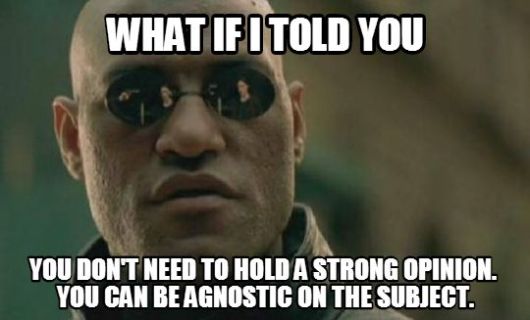
We are reposting this cool meme in defense of intellectual agnosticism (i.e. the ability to update one’s priors). You can check out the entire series of “epistemic rationality memes” here. (double hat tip: Tyler Cowen & Michael Wiebe)

Image

Please don’t forget to update your priors …

Posted in Uncategorized | Tagged , , | 3 Comments

“Information hypocrisy” in law

Futurist Robin Hanson has written up another astute blog post on the subject of information hypocrisy. By way of example, Hanson points out the existence of such hypocrisy in law:

We say court proceedings are to get information to decide guilt, but then rules of evidence cut out [relevant] information.

From our perspective, the rules of hearsay and the attorney-client privilege, just to name a couple of obvious examples, quickly come to mind. In his blog post, Hanson makes a larger point about the ubiquity of information hypocrisy in general. He also writes:

When we endorse a policy, we often point out how it may tend to encourage information to be generated, spread, or aggregated. After all, who could be against more information? But the details of the policies we endorse often belie that appearance, as we pick details that reduce and discourage information. Because we have other agendas.

In the case of law (our main academic domain), what are these “other agendas” that could possibly justify the exclusion of relevant evidence from juries? Of course, more information is not always better. But, then, how do we decide what the optimal amount of information disclosure is? Furthermore, while we are on this subject, what’s wrong with a little hypocrisy now and then? Like other economic “bads” such as pollution, noise, etc., couldn’t we argue that there is an optimal amount of hypocrisy, especially in social settings? (Hat Tip: Tyler Cowen, Master of the Internet.)

What’s the optimal level?

Posted in Uncategorized | Tagged , , | Leave a comment

The limits of law: an update on San Francisco’s tour bus ban

A flat-out legal prohibition (e.g. “thou shalt not …”) represents a coercive, non-market approach to a given social problem. So, why aren’t legal bans always effective? Consider, for example, the tour bus ban approved last November by San Francisco’s Municipal Transportation Agency, which voted late last year to ban all sightseeing buses from a 25-square-block around Alamo Square Park—including the picturesque Steiner Street (pictured below), which appears on the opening credits of the TV series “Full House”–after many residents of this scenic and historic neighborhood complained of the buses and lobbied for a bus ban. According to this report by Evan Sernoffsky of the San Francisco Chronicle, many tour bus drivers are simply ignoring the ban: “With only a small chance of getting caught and cited, some bus drivers are flouting the ban and continuing to chauffeur groups close to the famed Victorian homes on Steiner Street …” The SF Chronicle’s report also notes that “San Francisco police officials are aware that some buses are breaking the new rules but say writing $100 tickets to drivers doesn’t rank high on the department’s priority list.” In other words, compliance with a law is not a given but rather a function of many factors, such as the severity of the penalty and the risk of getting caught.

File:Alamo Square with Painted Ladies, SF, CA, jjron 26.03.2012.jpg

By the way, instead of a draconian ban, why isn’t there room for a mutually-beneficial Coasean bargain between the tour bus operators and the neighbors? (Photo Credit: Wikipedia)

Posted in Uncategorized | Tagged , , | Leave a comment

“The Pervasive Effect of Priors”

That is the title of this informative four-part series of blog posts in which Claire Hill discusses and illustrates various aspects of people’s prior beliefs (aka “priors”). Here is an excerpt from part one of the series:

They (people’s priors) help explain why there are so many debates that never get anywhere.  Both sides might have terrific arguments, yet nobody is persuaded. And people keep on making the same sorts of arguments, even knowing this. Sometimes they wonder why more people aren’t persuaded. It’s a bit like the old joke about the person who goes to a foreign country and doesn’t know the language, so he tries to communicate in his own language and, when he’s not understood, he just tries again, repeating what he said . . . but louder.

How often, if ever, do you update your priors?

Posted in Uncategorized | Tagged | Leave a comment

Is the USA less free than Putin’s Russia or Communist China?

Read the full report by Ernest Drucker here (pp. 61-69).

Posted in Uncategorized | Tagged , | 1 Comment

What are Fractals and why should I care?

Hey! We are reblogging George Dallas’s fascinating post on the logic of fractals (see below). Notice the role that randomness plays in the geometry of fractals, but please enjoy responsibly …

checkdetector's avatarGeorge Dallas

Fractal geometry is a field of maths born in the 1970’s and mainly developed by Benoit Mandelbrot. If you’ve already heard of fractals, you’ve probably seen the picture below. It’s called the Mandelbrot Set and is an example of a fractal shape.

mandelbrot

The geometry that you learnt in school was about how to make shapes; fractal geometry is no different. While the shapes that you learnt in classical geometry were ‘smooth’, such as a circle or a triangle, the shapes that come out of fractal geometry are ‘rough’ and infinitely complex. However fractal geometry is still about making shapes, measuring shapes and defining shapes, just like school.

There are two reasons why you should care about fractal geometry:

1. The process by which shapes are made in fractal geometry is amazingly simple yet completely different to classical geometry. While classical geometry uses formulas to define a shape, fractal geometry uses iteration. It…

View original post 2,097 more words

Posted in Uncategorized | Leave a comment