The Bayesian approach to sports

Consider the following image from ESPN Stats & Info (via Twitter):
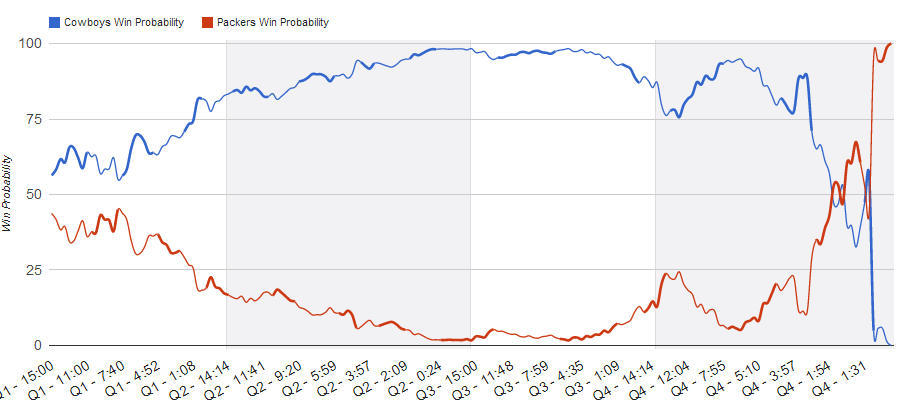
This past Sunday afternoon, the overrated Dallas Cowboys led the venerable and tenacious Green Bay Packers by a score of 26-3 at halftime, yet the Cowboys somehow blew their large lead and lost the game. So what is the probability that the Packers would make such a comeback?

Easy. The visual image above presents a Bayesian time progression of both teams’ respective “win probabilities.” Notice the Bayesian nature of this graph–the win probability of the Dallas Cowboys increases as their lead over their opponent increases and then rapidly plummets to zero towards the end of the game. That is, the image above is Bayesian because, starting with 50/50 priors, it then proceeds to update the win probabilities of the teams as the game is played in real time and as the score changes. Now, try figuring out the win probabilities of the teams using standard statistical or Fisherian methods and see how far that takes you. You can’t, really, because each game in sports is a unique event, played  only once.
Posted in Uncategorized | Tagged , | Leave a comment

Earth Wind Map

prior probability enjoys collecting maps of various kinds, especially during our foreign travels. Our quirky and eclectic collection includes maps of the Amazon, the Moscow Metro, and the Berlin Wall, among many others. But we recently discovered (through digg.com) the most beautiful and ephemeral map we have ever seen, an “Earth wind map.” The picture included in this post does not do justice to the actual map, which is available at http://earth.nullschool.net (and at the link a few lines above), since the snapshot of the map (see picture above) is static while the real-time map on the “earth.nullschool.net” website is fluid and dynamic, constantly in motion, like the Earth herself …

Posted in Uncategorized | Tagged , , | 2 Comments

Why don’t more people play “credit card roulette”?

Credit Card Roulette or CCR is “a way of gambling for bills, usually played for the purpose of settling restaurant checks, by randomly drawing one participant’s credit card.” The website pokerterms.com (from which my definition of CCR is borrowed) offers the following illustration of the “elimination method” of playing this game:

For instance, after a meal involving 6 poker players, each person will place his card in a pile, the cards will be scrambled, and a number between 1-6 will be randomly generated by another participant. The card corresponding to this number will be taken out of the running and so on, until there is just one card left and that cardholder is the loser, responsible for paying for the entire meal. The less fun and less exciting method involves presenting all the cards in play to the server at the restaurant and letting him or her choose a card at random.

So why don’t more people play this game? One possibility is that CCR operates as a negative lottery. That is, if six friends are sharing drinks at a bar and they each end up ordering, say, $20 dollar’s worth of drinks, then each individual player has a 5/6th probability of “winning” the equivalent of $20’s worth of drinks (i.e. the amount of his or her individual tab) but has a 1/6th probability of losing $100 (i.e. the combined bar tab of the other five players). Although it is more probable that each individual will “win” a small amount (i.e. avoid having to pay his or her share of the tab), the small probability of having to pay a large amount (the entire tab) might dissuade all but the most risk-loving persons from wanting to play this game.

Bonus question: what is the legal status of CCR? Does this game violate any US gambling laws?

Hat tip: Ian Ayres (freakonomics.com)

Posted in Uncategorized | Tagged , , , | 1 Comment

Are chairs overrated?

Posted in Uncategorized | Tagged | Leave a comment

We lost a good man today

My mentor and friend Stan Talcott left us last night. I have so many fond memories of Stan, I don’t know where to begin. He was the quintessential “open door” man, always willing to share his time and good counsel with me. I especially loved his willingness to question the highfalutin theories of his fellow academics (including my own!), and I am particularly grateful to him for introducing me to one of his favorite meals, kartoffelknoedel, a heavy Russian peasant dish made from potatoes and noodle dough. God bless you and your beautiful family, Stan. Your colleagues and friends will never forget you.

Stanley M. Talcott (1942-2013)

Posted in Uncategorized | Tagged , , | 1 Comment

Are “swing voters” good Bayesians?

I was trying to explain Bayesian probability to my eldest daughter Adela Luisa the other day. (She is only 13, but she is super smart.) In the process of explaining Bayes’ theorem to her, however, I realized that many areas of life seem to be largely immune from the process of Bayesian updating.

Consider politics, for example. Why are otherwise sensible and fair-minded people so dogmatic or closed-minded when it comes to their political beliefs? That is, why do so many people refuse to update their “political priors” no matter how much new evidence they receive from the media or other sources of information?

One possible answer is to compare political beliefs to “aesthetics” (or value judgments about art and beauty). If politics is just as subjective or personal as art and beauty, then it’s not clear how one would go about “updating” one’s political priors or one’s definition of beauty. This answer, however, poses a deeper and more difficult question: what is the relation between truth and beauty? Stated formally, are our personal preferences about art and beauty immune from Bayesian methods?

Posted in Uncategorized | Tagged , | Leave a comment

“It’s not that I’m so smart …

… it’s just that I stay with problems longer.” ~ Albert Einstein

Aside from this beautiful quote from a beautiful mind, here are some concrete exam tips for my Torts class. First and foremost, remember that Torts is ultimately about solving practical problems that occur in the world, so don’t forget your common sense on the day of your exam. Specifically, read the facts and ask yourself, “What’s the problem I am trying solve?” Do this in three logical steps:

1. What went wrong? Who was harmed and how was he or she harmed?

2. Who did what? That is, who could potentially be legally liable for what went wrong?

3. Last but not least, remember to explain in your own words the specific reasons why a given party is, or is not, liable …

Remember, you are now experts in Negligence Law, so use your knowledge of this general area of law to solve whatever problem is before you.

Posted in Uncategorized | Tagged , | Leave a comment

Does the Prisoner’s Dilemma falsify the Coase Theorem?

The Coase Theorem is an idea in law and economics that states that private bargaining will lead to an optimal allocation of resources when two conditions are met: when property rights are well-defined, and when there are no obstacles to voluntary bargaining. This simple and somewhat counterintuitive idea is the foundation of the economic approach to law, but how strong or secure is this foundation?

prior probability will explain why the Prisoner’s Dilemma falsifies the Coase Theorem this Saturday at the University of Puerto Rico. Our talk, which is titled The Parable of the Prisoners, is scheduled to take place at 11:30 am in Room 301 of the UPR Law Library, and Professor Taja-Nia Henderson of Rutgers University will be serving as the paper’s commentator. All are welcome to attend …

prisoner-1

Posted in Uncategorized | Tagged , , | Leave a comment

Should drones be regulated?

Some people say “not yet.” Eli Dourado, for example, argues thus:

It’s true that opening up U.S. airspace to commercial drones will have some important privacy implications to consider. But it’s even more important that we consider the effect of too-early, heavy-handed regulation on future innovation. Like the internet, airspace is a platform for commercial and social innovation. As a permissionless, open platform, the internet allowed – still allows — entrepreneurs to try new business models and offer new services without having to seek the approval of regulators beforehand. *** Regulation at this juncture requires our over-speculating about which types of privacy violations might arise. Since many of these harms may never materialize, pre-emptive regulation is likely to overprotect privacy at the expense of innovation.

Is this argument a sound one, or is it just a pretext for no regulation? Also, is the Internet really a “regulation-free” or Hobbesian environment? Doesn’t the common law still apply to the World Wide Web? Also, if you agree with Mr Dourado that it is still too early to regulate drones, then how will we ever know when is the “right time” for regulation?

For our part, prior probability would take a different approach to drones. Since invasion of privacy is already a well-established tort, why not apply common law rules and principles to drones, that is, why not allow courts to develop the law in this area on a case-by-case basis?

Posted in Uncategorized | Tagged , , , | 1 Comment

Why do jury verdicts have to be unanimous?

And why do verdicts have to be binary–i.e. either “guilty” or “not guilty”? What if jurors were allowed instead to rate or score the plaintiff’s case, just like people rate movies or restaurants. In our most recent working paper, Why don’t juries try ‘range voting’? (pun intended), we propose just that: a simple “range voting” method for juries in which jurors would rate or score on a scale of zero to ten (or some other specified scale) the evidence presented by the parties at trial. The jury’s verdict would then consist of a numerical value, either the average or the sum total of all the individual scores. A plaintiff would prove his case only if the average value or sum total of the jury’s collective score exceeded some critical threshold. Since the jury’s numerical verdict would then be a function of this range voting procedure, we refer to such a numerical verdict as a range verdict. (By the way, we also discuss how range voting improves jury accuracy AND solves several problems endemic to juries, including holdouts, strategic jurors, and ignorant jurors.)

Our little paper is still a very rough proof of concept, so your critical comments and suggestions, especially destructive criticisms, are much appreciated by prior probability.

Posted in Uncategorized | Tagged , , , , , , | 2 Comments