
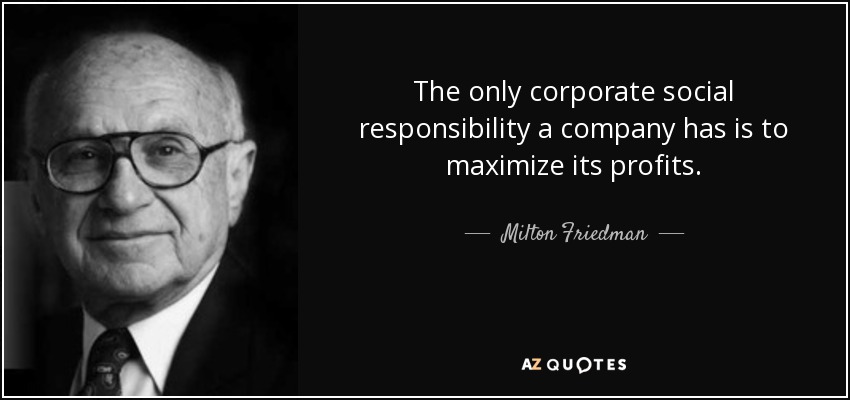
Did the late Milton Friedman betray the ideals of Adam Smith when he concluded in his now-famous 1970 New York Times Magazine essay that a business firm’s only ethical obligation to society is to maximize its profits as long as no laws are being broken, or is the great Professor Friedman Smith’s true intellectual heir? In honor of the upcoming ten-year anniversary of this blog (5 July 2023), I am reposting my epic 13-part series from 2018 on Friedman’s now-classic essay on corporate social responsibility:
- Review of Milton Friedman (part 1)
- Friedman on business ethics (part 2)
- Friedman’s critique of CSR (part 3)
- Review of Friedman (part 4): corporate managers vs. sole proprietors
- Review of Friedman (part 5): interlude
- Review of Friedman (part 6): theory choice
- Milton Friedman’s fallacy (part 7)
- Friedman and the art of sophistry (part 8)
- Review of Friedman (part 9): ethics and epistemology
- Review of Friedman (part 10): markets versus politics
- Review of Friedman (part 11): do motives matter?
- Review of Friedman (penultimate post): politics versus markets redux
- Review of Friedman (last post)







 prior probability
It’s interesting how the question you pose above dovetails to the current controversy surrounding ESG & DEI.
This past week Cato had a great podcast on the topic.
https://www.cato.org/multimedia/cato-daily-podcast/esg-fans-opponents-cant-seem-agree-esg-means
As someone who works in corporate office environment (granted in entry-level customer service), I am impacted by these corporate governance policies. I would say these policies are compatible with both Friedman’s Maximization Doctrine and the social obligations outlined by Smith. But not out of true altruism; the butcher, the baker and the brewer are not running a charity.
The implementation of ESG and DEI policies are effectively forms of rent-seeking. The firm is able to yield more sales through product differentiation by leaning company values rather than improved products and services. Skipping the costly R&D, Testing, new product marketing and so on. It makes shareholders happy because they feel like a socially responsible image protects their investment. The more naive stakeholders believe the sophistry of executive management.
But the firm fails it’s one true duty (one that Friedman was hasty to ignore) providing the consumer with quality products. Granted, if company is producing crap, market forces will eventually catch up with them. Appearing to be “ethical” is new, cheaper, and lazier way for firms to maximize profits. It is simply putting lipstick on a pig. Same product just with more disingenuous marketing.
Excellent observations! I will digest them and report back soon…