Southern Horrors

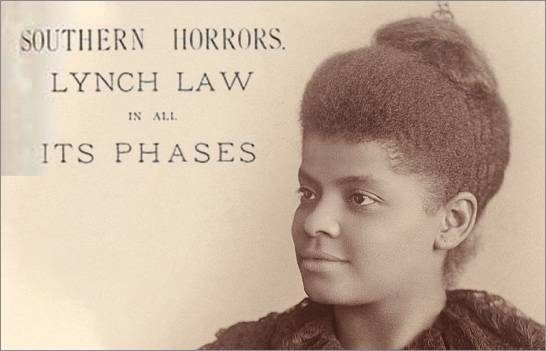
That is the title of this haunting exposé (subtitled “Lynch Law in All Its Phases“) written by Ida B. Wells (pictured below), who was posthumously awarded a Pulitzer Prize “for her outstanding and courageous reporting on the horrific and vicious violence against [people of color] during the era of lynching.” This landmark work, which is also available here (via Project Gutenberg), was first published in New York City on this day (26 October) in 1892. According to this report (University of Missouri-Kansas City School of Law), nearly 3,500 Blacks (and 1,300 whites) were lynched in the United States from 1882 to 1968. One of the last reported lynchings in the U.S. took place in Mobile, Alabama on 21 March 1981.

Posted in Uncategorized | 1 Comment

This day in international legal history

On this day (25 October) in 1971, the General Assembly of the United Nations approved Resolution 2758, which recognized the People’s Republic of China (PRC) as “the only legitimate representative of China to the United Nations.” Alas, Communist China continues to be ruled by murderous dictators and should thus be expelled from the U.N., along with Saudi Arabia, Cuba, Iran, North Korea, and Russia. At the very least, Taiwan should be allowed to rejoin the U.N. table without further delay. Change my mind! (I say “rejoin” because the Republic of China or ROC, which relocated to Taiwan in 1949, had represented China at the United Nations since 1945, the year the U.N. was founded. Taiwan, however, continues to be excluded from the U.N. table to this day. For additional information about the legal and political status of Taiwan, see here.)

Taiwan Communique no.72
Posted in Uncategorized | Leave a comment

Music Monday: Tacones Rojos

I dedicate this beautiful song to my wife Sydjia!

Posted in Uncategorized | Leave a comment

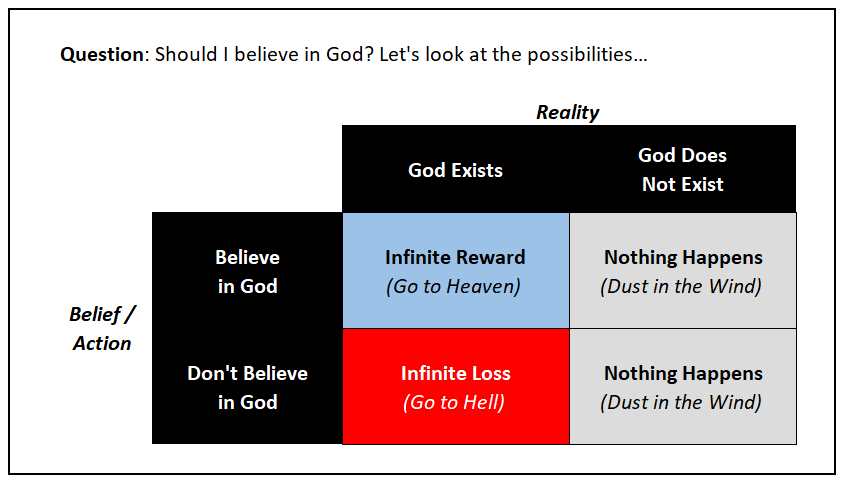
Pascal’s Wager revisited

Check out this new paper by Saul Smilansky, who turns the tables on Pascal’s Wager (see also here and image below). In brief, Professor Smilansky’s argument is that God will be more upset at people who accept the wager (i.e. belief in God) but still commit moral transgressions than at atheists who reject the wager but live good moral lives. Although I am not buying Smilansky’s argument (since we are all sinners), it is worth reading and thinking about. Hat tip: Brian Leiter.

Posted in Uncategorized | 7 Comments

The Case of the Missing Lottery Number

That is the title of this 2001 paper by mathematician W. D. Kaigh, who revisits the “Arizona Pick 3 incident” in which a flawed random digit generator severely compromised the Arizona Lottery Pick 3 in the summer of 1998. (I discovered Kaigh’s intriguing paper when I was reading Stephen Stigler’s new book “Casanova’s Lottery.”) On a related note, check out this excellent essay by Kathryn Schulz, who surveys the history, politics, and economics of State lotteries. Schulz’s work was published in the latest issue of The New Yorker.

Secure random number generation in JAVA | Infosec Resources
Posted in Uncategorized | Leave a comment

Ezequiel Monti: Enabling Legal Obligation

I recently discovered in my WordPress feed a legal philosophy blog edited by Lucas Miotto and Martin David Kelly. Their excellent blog, which is called “Legal-Phi”, contains in-depth interviews with many young legal and moral philosophers. Today, I am re-blogging their most recent interview: Ezequiel Monti (see below). Among other things, Professor Monti explains his take on Mark Greenberg’s influential “Moral Impact Theory of Law.” What role, for example, do “moral facts” play in law? How is a legal obligation similar to or different from a moral obligation? These are fascinating questions, but I won’t go into the technical details of Greenberg’s theory (or Monti’s take on that theory), except to point out an important omission that bedevils this never-ending legal-philosophical debate: the problem of “immoral promises” (see here, for instance). To borrow Professor Monti’s own example, “Suppose I promise you to wash your car. In virtue of my promise, I now have an obligation to wash your car.” Now consider a different example: A promises B to steal C’s car. Doesn’t A now have an obligation to steal C’s car? If not, why not? (Please, no answers with circular reasoning in them.)

Lucas M's avatarLegal-Phi

It is a pleasure to have Ezequiel Monti as our third interviewee of 2022. Ezequiel obtained his PhD in Legal Philosophy at King’s College London in 2019. He is currently an Assistant Professor at Torcuato Di Tella University, School of Lawand a María Zambrano Fellow at Pompeu Fabra University. Ezequiel works primarily on topics within general jurisprudence, in particular questions about legal obligations, authority, and the grounds of legal facts.

Welcome to Legal-Phi, Ezequiel. Can you tell us about what led you to law and then to legal philosophy?

I’m not sure what my real motivation to study law was. The story I tell myself about the reasons underlying my decision has changed over time. My current guess is that it was kind of a compromise with my parents. After finishing high school, I was mostly interested in literature and films, and I flirted with the idea of…

View original post 8,050 more words

Posted in Uncategorized | Leave a comment

Hans Niemann versus Magnus Carlsen

Chess prodigy Hans Niemann (pictured below, right) has just sued grandmaster Magnus Carlsen in Missouri for defamation. Here is a copy of the 44-page complaint, and here is the first paragraph: “Niemann is a 19-year-old, self-taught chess prodigy. He brings this action to recover from the devastating damages that [Magnus Carlsen and others] have inflicted upon his reputation, career, and life by egregiously defaming him and unlawfully colluding to blacklist him from the profession to which he has dedicated his life.” Crazy, right? (Hat tip: Eugene Volokh.)

My take: Truth is a complete defense to a claim of defamation, so we might find out once and for all whether Niemann was cheating when he defeated Magnus in chess earlier this year.

Posted in Uncategorized | Leave a comment

Happy Louisiana Purchase Day?

On this day (20 October) in 1803, the United States Senate ratified the Louisiana Purchase treaty by a vote of 24 to 7. (More details here, via Wikipedia.)

F. E. Guerra-Pujol's avatarprior probability

On this day (July 4) in 1803, the terms of the treaty between the United States and France for the purchase and sale of Louisiana — the Vente de la Louisiane or “Louisiana Purchase“, a treaty that quite possibly changed the course of world history — are announced to the public: $15 million for 828,000 square miles west of the Mississippi River.

File:Aquired Lands of the US.svg

View original post

Posted in Uncategorized | Leave a comment

Is Twitter worth $44 Billion?

Put another way, now that the Twitter deal is apparently back on (see here, for example), is Elon Musk about to make the biggest and costliest mistake of his storied business career? According to this Hudson Institute report, Twitter’s total revenues for 2021 were roughly $5 billion, but at the same time Twitter’s estimated “enterprise value” is $36.51 billion. (See also this May 2022 report via Forbes.)

Everything you wanted to know about Elon Musk and Twitter (but didn't want  to ask) | TechCrunch
Image Credit: Bryce Durbin via TechCrunch
Posted in Uncategorized | Leave a comment

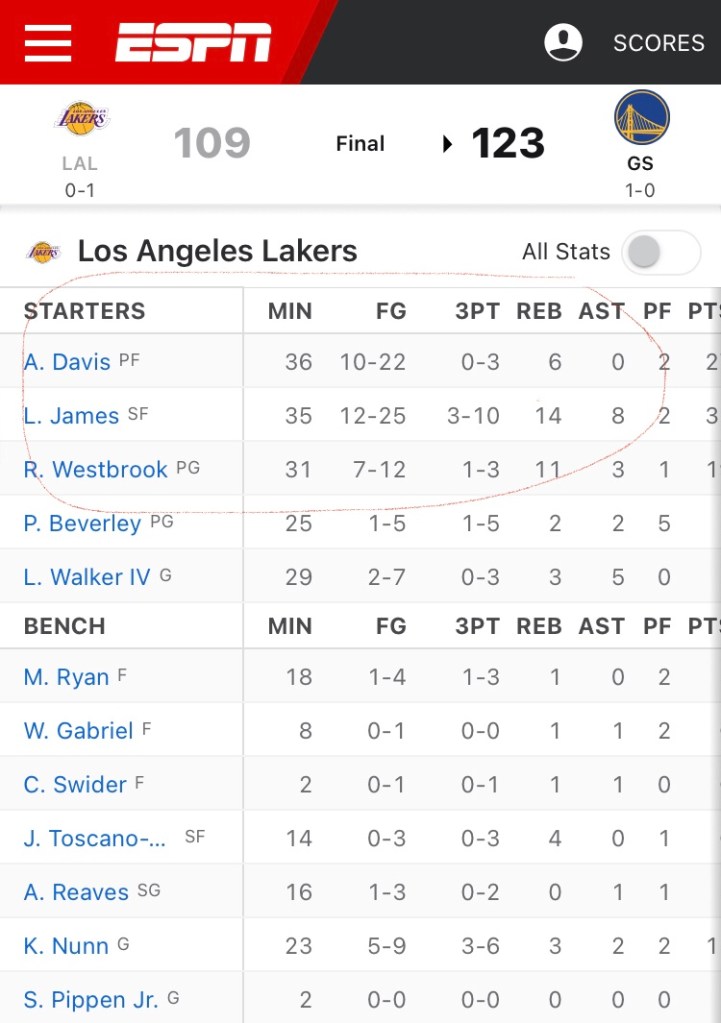
Westbrook > Davis

Below are the L.A. Lakers’ stats from last night’s NBA season opener against the Golden State Warriors. I readily concede that this is a small sample size (one game), but combined with last year’s statistics, maybe it’s Anthony Davis–and not Russell Westbrook–who should be traded? (At the very least, Westbrook is less injury-prone and thus a more reliable overall athlete than AD.) Change my mind!

Posted in Uncategorized | 12 Comments