Horace Walpole’s journal entries for Thursday, March 13 and Saturday, March 15 both refer to Adam Smith and to the Scots College in Paris:
March 13: “Dr Smith and Gordon, Principal of the Scotch College came.”[1]
March 15: “With Dr Smith to the Scots College.”[2]
So, what in the Devil were Horace Walpole and Adam Smith doing at a Catholic seminary in Paris, a place that had historically been “a nest of intrigue for Jacobite schemes”?[3] After all, Smith had no sympathy for the now-lost Jacobite cause,[4] and Walpole was an Englishman. Neither man was openly religious.
As Walpole notes, the director of the Scots College at the time was named Gordon. His full name was John Gordon, and he was Principal of the college from 1752 until his death in 1777.[5] What Gordon, a Catholic priest, and Smith, a former professor of moral philosophy, may have thought of each other is anyone’s guess, but the venerable college Gordon led, the Collegium Scoticum (Latin) or Collège des Écossais (French), had been legally recognized by an Act of the Parlement of Paris on July 8, 1333.[6]
At that time, the college was housed in the rue des Amandiers (now Rue Laplace).[7] After 1665, the Scots College was located in the rue des Fossés-Saint-Victor (now Rue du Cardinal-Lemoine), close to the Sorbonne and almost two kilometers away from the rue du Colombier, where Smith and Walpole were lodging.[8] Brian Michael Halloran describes the façade of the Scots seminary thus: “It has a very impressive facade, being four storeys high, with five windows, each side of the main door, and eleven windows on each of the other floors.”[9]
According to Brian Michael Halloran, “The Scots College Paris has been an enigma to Scottish Catholic historians, sometimes being seen as extremely beneficial to the Scottish Catholic Mission, and at other times regarded as the source of a lot of woes.”[10] Either way, what was Adam Smith doing there? Perhaps Smith just wanted to visit the place in Paris where one of his closest friends and confidants in France had come of age, for the Scots College was the school where Seignelay Colbert of Castlehill, l’Abbé Colbert (1736-1813), had attended.[11] Colbert had entered the college in 1747 at the age of 11 and completed his studies in September of 1761,[12] and Colbert and Smith became close friends during Smith’s 18-month sojourn in Toulouse (1764-65), but I will have much more to say about l’Abbé Colbert in a future blog post.
Horace Walpole’s journal entry for Saturday, March 8 reads: “Ditto. Mme Geoffrin, Mr Smith, Mme du Deffand, Lord and Lady George came.”[1] That is, in addition to Adam Smith, Lord George Lennox, and Lord George’s wife Lady Louisa Kerr, Walpole’s entry for that day mentions two of the most famous Parisian salonnières of the time: “Mme Geoffrin” and “Mme du Deffand.”[2]
As it happens, Walpole spent a considerable amount of time at the salons of these leading ladies during his visit to Paris, and he became an especially close friend of du Deffand. In fact, upon her death in 1780, she left her papers, and her dog Tonton, to Walpole, and her correspondence to Walpole (4 vols.) was first published at Walpole’s Strawberry Hill printing press in 1810.[3]
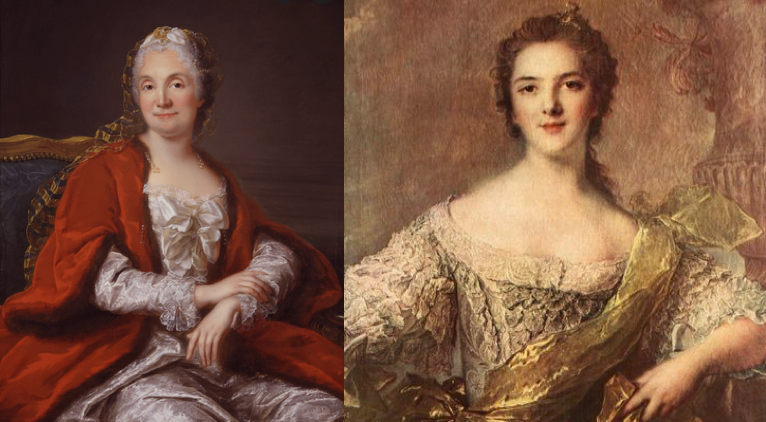
Marie Anne de Vichy-Chamrond, marquise du Deffand (1696?–1780), whose portrait is pictured below (bottom right), was not only a leading salonnière and patroness of the arts; she was a remarkable woman of letters in her own right. In its heyday, her salon, which was located on the rue Saint-Dominique (now the Boulevard Saint-Germain) in her apartments in the Convent of Saint-Joseph, attracted famous diplomats, great ladies, philosophes, and prominent politicians, at least until 1764, when her protégé Jeanne Julie Éléonore de Lespinasse (1732–1776) opened a competing salon of her own just down the street on the rue Saint-Dominique.
Marie Thérèse Rodet Geoffrin (née Rodet; 1699–1777), whose portrait is also pictured below (bottom left), was du Deffand’s great rival in the rarefied world of the Paris salons and was one of the leading female figures and salonnières of the French Enlightenment.[4] From 1750 until her death in 1777, Madame Geoffrin hosted many of the most influential philosophes and Encyclopédistes of her time at her salon on the Rue Saint-Honoré.[5] Among other things, her famed salon was decorated with the large mirrors and glass wares of her family business, the Saint-Gobain company, a glass and mirror manufactory that had obtained a royal privilege to produce mirror and glass goods.[6] In fact, Geoffrin’s family firm was one of the largest companies in Europe, employing twelve hundred workers, and had amassed a working capital of 14 million livres by the 1760s, with annual sales ranging between two and three million livres.[7]
There are, however, two competing views of these famous salons. On the one hand, some scholars emphasize the leading role the salons played in Europe’s literary and intellectual life. In her classic study of the salons of Paris, Dena Goodman writes:
“Geoffrin, who acted as a mentor and model for other salonnières, was responsible for two innovations that set Enlightenment salons apart from their predecessors and from other social and literacy gatherings of the day. She invented the Enlightenment salon. First, she made the one-o’clock dinner rather than the traditional late-night supper the sociable meal of the day, and thus she opened up the whole afternoon for talk. Second, she regulated these dinners, fixing a specific day of the week for them. After Geoffrin launched her weekly dinners, the Parisian salon took on the form that made it the social base of the Enlightenment Republic of Letters: a regular and regulated formal gathering hosted by a woman in her own home which served as a forum and locus of intellectual activity.”[8]
At the same time, other scholars paint a more stuffy and mundane picture of the Paris salons. On this view, the salons were, above all, the social space of Parisian high society, or le monde,[9] and hostesses like Madame Geoffrin and the marquise du Deffand–and presumably their guests as well–would be surprised, if not astonished, to learn that they were participating in an important cultural and literary institution.[10] According to one source, for example, Madame Geoffrin herself “vigoroursly avoided any learned pretensions and aspired above all to be acknowledged by polite society and to conform to the norms of female honnêteté. For her … to receive well-known writers [like, say, Adam Smith or Horace Walpole] constituted one step in the process of entering high society; her salon thus became a fashionable place, a necessary destination for aristocrats who wished to acquire a reputation as men of wit.”[11] If this picture of the Paris salons is accurate, their appeal to such a simple and austere man as Adam Smith is questionable at best.
Which of these opposing pictures of the salons is the correct one? Perhaps both. Maybe most of the salons of Paris were the stuffy and sultry social spaces of le monde, while some of the salons, at least some of the time, were home to the most enlightened and avant-garde intellectual and literary discussions of the Age of Reason. Although there are no references to these salons in The Wealth of Nations, Adam Smith most likely visited Madame Geoffrin’s famed salon, as well as those of the marquise du Deffand and mademoiselle Lespinasse, at some point during his 1766 sojourn in Paris.[12] After all, Smith’s first great work, The Theory of Moral Sentiments, had been well-received in France, and he was thus a minor intellectual celebrity in France at the time–minor, that is, in comparison to David Hume. The leading philosophes, artists, and the salonnières of the Enlightenment were no doubt eager to meet him–and perhaps to hear what he had to say. But even so, the question posed by my “Smith in the City” series is still left unanswered. When did Smith’s transformation from a moral philosopher to a political economist take place? I will address this key question in future blog posts.
Horace Walpole’s journal entry for Monday, March 3 reads: “King [Louis XV] went suddenly to the [Paris] Parliament–packing up and writing letters till late in the evening. Dr Smith and Baron d’Holbach came. To the Temple.”[1]
This pithy entry poses two key questions. Why did Louis XV make a rare appearance in the French capital that day? And what was the nature of the relationship between Adam Smith, a Scottish moral philosopher, and the German-born Baron d’Holbach, an open atheist? [I will focus on the first question here and address Smith’s relationship to d’Holbach later in this series.]
Since 1682, when Louis XIV had moved the seat of his court and government to the Palace of Versailles, making Versailles the de facto capital of France,[2] Paris had become “The Kingless Capital of Enlightenment.”[3] So, the King’s sudden and dramatic appearance in Paris has to be one of the most memorable, and perhaps the most contentious, moments of his long reign.
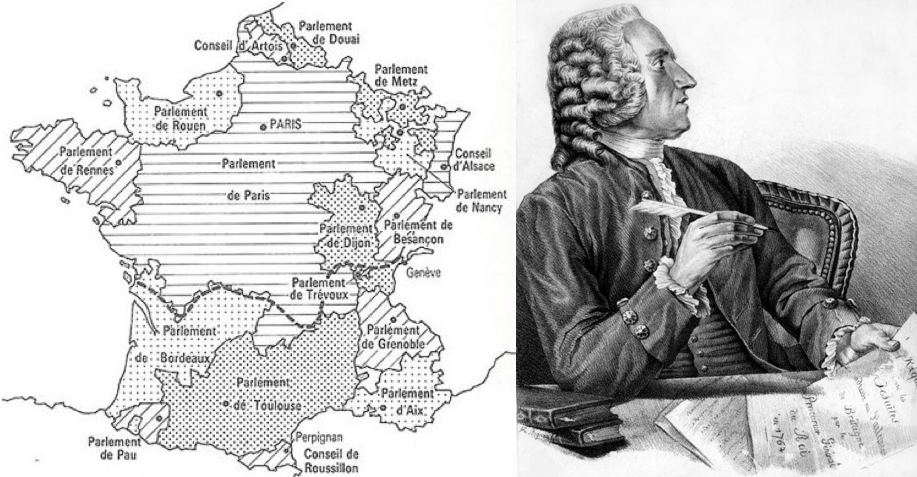
As it happens, the King’s appearance in the French capital on Monday, March 3, 1766 was just one move–a dramatic one to be sure–in a much larger and longer-running power struggle between the crown and the courts known as “the Brittany Affair,” a constitutional and political cause célèbre that, in hindsight, give the Revolution the appearance of inevitability. At the time, the courts of the kingdom were called parlements, and there were 13 such courts in all, one for each region in France. [See map pictured below.] The magistrates of these courts not only had the power to try civil and criminal cases; they also had the authority to register royal edicts.
In theory, a parlement could veto a royal edict by refusing to register it; in reality, however, recalcitrant magistrates ran the risk of imprisonment or exile. Louis XV, for example, had previously exiled the Parlement of Paris on two occasions, in 1732 and in 1753.[4] For France did not have a written constitution and no system of checks and balances, or in the words of one scholar, “The king consulted his ministers and advisers and determined what was best for the kingdom, his agents applied and his judges enforced his decrees throughout the realm, and his subjects obeyed.”[5]
In brief, in November of 1765, just a few weeks before Smith’s arrival in Paris, Louis XV had ordered the arrest of six Breton magistrates–including Louis-René de Caradeuc de La Chalotais (pictured below, right), the procureur général of the Parlement of Brittany–accusing them of conspiracy against the crown. He had also escalated the controversy by appointing a special royal commission to try the six magistrates instead of allowing the judges of the regional court, the Parlement of Brittany, to try their six fellow magistrates. This move, however, constituted a direct attack on the legal rights and privileges of judicial magistrates, who could only be tried by their parliamentary peers, not by an ad hoc royal commission.[6] Furthermore, on February 11, 1766, a few weeks prior to the King’s appearance in the French capital, the Parlement of Paris had unanimously condemned the King’s arrest of the Breton magistrates and declared his royal commission invalid.[7]
The decision of the Parlement of Paris, the most important of the regional courts, to intervene on behalf of the six Breton magistrates, and the appearance of Louis XV in Paris on March 3 thus tested the outer limits of the powers of the courts and converted the Brittany Affair into a high-stakes constitutional controversy, a direct confrontation between the King and the largest and most important of the royal courts. Without prior warning, Louis XV, along with five of his ministers, showed up in person to the Paris Parlement to reaffirm his royal authority and deliver a stinging rebuke of the Paris magistrates.
This improptu session of the parlement became known as le Séance de Flagellation or “the Session of the Scourging” because Louis XV verbally “lashed out” at the magistrates for defying his authority to try the six Breton magistrates. The opening words of his prepared remarks left no room for interpretation: “What happened in my Parlements of Pau and Rennes is of no concern of my other parlements. I have acted with regard to these two courts as my authority required, and I owe an explanation to no one.” After his full reply was read aloud, his ministers ordered the parlement’s condemnation of the King of February 11 to be physically removed from the register of the court.
Given the gravity of this constitutional confrontation and the King’s dramatic appearance on March 3, 1766, Adam Smith must have taken notice of this great political and judicial controversy. Horace Walpole, for example, was following the Brittany Affair quite closely. He mentions or describes this conflict in his travel journal and in his private correspondence on multiple occasions. Could this constitutional conflict have also helped spark Smith’s interest in political economy?
Putting aside the specific constitutional issue at stake in the Brittany Affair–i.e. who judges the judges?–this controversy also presents two competing views of the rule of law and the justification of royal authority. Specifically, was the King more like a benevolent father, a paternal figure responsible for harmonizing the various social groups of his kingdom into a congruous and unified whole, or was he more like a disinterested referee, a neutral umpire responsible for mediating the disparate interests of the different estates of his kingdom?[8] In other words, what kind of body politic should a monarchy try to promote? A paternalistic or organic one, i.e. a hierarchical and stable social order composed of individuals of different ranks and social stations, all of whom are under the crown’s benelovent protection, or a commercial or dynamic society, one “whose members have very few social bonds with one another, where … each man looks only to his particular and exclusive interest ….”[9]
Whatever Smith may have thought about these larger questions, he must have overheard his French hosts discuss the Brittany Affair at length at the famed salons of Paris. I shall turn to the salons in my next few blog posts …
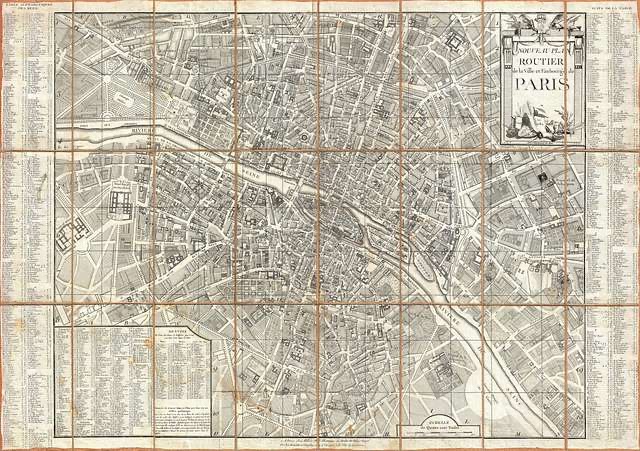
Although this beautiful pocket map of prerevolutionary Paris was produced in 1780 by the famed cartographers Jacques Esnauts and Michel Rapilly, several years after Adam Smith’s residency in the City of Lights in 1766, it gives us some idea of the extent and scale of the French metropolis during Smith’s sojourn.
Via GetArchive (see here): “An extraordinary map of pre-Haussmann pre-Revolutionary Paris and the early Faubourgs (suburbs) issued in 1780, during the final decade of the French Monarchy. Covers Paris on both sides of the Seine from the Ecole Militaire to the Hospital de la Roquette, extends north as far as Montmartre and south roughly to Les Gobelins. Produced at the height of French dominance of the cartographic arts, this map is a masterpiece of the engraver’s art. Individual buildings, fields, streets, hills, valleys, orchards, and public gardens are revealed in breathtaking detail. We can even see the incomplete state of the northern wing of the Louvre Palace. There is an elaborate street index on either side of the map. An allegorical neoclassical title cartouche featuring war trophies appears in the upper right quadrant. This type of map, known as a pocket or case map, is designed with the traveler in mind and while it displays beautifully unfolded, is designed to fold and fit in a vest or coat pocket.”
In my previous post I described Adam Smith’s first visit to the Théâtre-Italien in Paris, which took place on a Sunday (March 2, 1766). As it happens, Smith has quite a few things to say about the theater–and about actors, singers, and dancers as well–in The Wealth of Nations. For example, in Chapter 3 of Book II of his magnum opus, in the subsection titled “Of the Accumulation of Capital, or of Productive and Unproductive Labour,” Smith writes:
The labour of some of the most respectable orders in the society is, like that of menial servants, unproductive of any value, and does not fix or realize itself in any permanent subject; or vendible commodity, which endures after that labour is past, and for which an equal quantity of labour could afterwards be procured. The sovereign, for example, with all the officers both of justice and war who serve under him, the whole army and navy, are unproductive labourers. They are the servants of the public, and are maintained by a part of the annual produce of the industry of other people. Their service, how honourable, how useful, or how necessary soever, produces nothing for which an equal quantity of service can afterwards be procured. The protection, security, and defence of the commonwealth, the effect of their labour this year will not purchase its protection, security, and defence for the year to come. In the same class must be ranked, some both of the gravest and most important, and some of the most frivolous professions: churchmen, lawyers, physicians, men of letters of all kinds; players, buffoons, musicians, opera-singers, opera-dancers, etc. The labour of the meanest of these has a certain value, regulated by the very same principles which regulate that of every other sort of labour; and that of the noblest and most useful, produces nothing which could afterwards purchase or procure an equal quantity of labour. Like the declamation of the actor, the harangue of the orator, or the tune of the musician, the work of all of them perishes in the very instant of its production.[1]
This passage may sound quaint or even outdated today, when performances are routinely recorded on film and music artists record their songs on vinyl or digitally. (As an aside, it is intriguing to ask, if Smith were alive today, what would he say about Hollywood or about contemporary music stars like Beyoncé or Taylor Swift or about the decline of opera relative to popular music and movies?) But this passage also provides a clue about Smith’s transformation from a moral philosopher into a political economist, a transformation that most likely occurred during his sojourn in Paris, for at the time Smith was writing this passage, he was reacting not just to statist or mercantilist theories; he was also reacting to one of the most influential and innovative economic works of his time, the Tableau économique, the first modern “macro” model of the economy.[2]
Among other things, the Tableau économique classified economic activity into productive and “sterile” classes of labor, i.e. between positive-sum activities that generate create new value and zero-sum activities that merely rearrange existing wealth. This fundamental distinction between productive/positive-sum activities and sterile/zero-sum ones can thus be traced to the work of François Quesnay (1694–1774), who is considered the father of the so-called “Physiocrats,” the leading alternative theory to mercantilism at the time.[3] So, when Smith is writing about “unproductive labour” and comparing the “most frivolous professions” (like musicians, opera-singers, and opera-dancers) with “the gravest and most important” ones (like lawyers, physicians, and men of letters), he is attempting to explain one of the leading economic theories of his day.
But Smith does not just explain why the opera-singers and opera-dancers are “unproductive” or engaged in zero-sum activities (a view that is clearly wrong, by the way), in Part 1 of Chapter 10 of Book I of The Wealth of Nations, Adam Smith also compares their profession to the world’s oldest:
There are some very agreeable and beautiful talents of which the possession commands a certain sort of admiration; but of which the exercise for the sake of gain is considered, whether from reason or prejudice, as a sort of public prostitution. The pecuniary recompense, therefore, of those who exercise them in this manner must be sufficient, not only to pay for the time, labour, and expense of acquiring the talents, but for the discredit which attends the employment of them as the means of subsistence. The exorbitant rewards of players [actors and actresses], opera-singers, opera-dancers, etc., are founded upon those two principles; the rarity and beauty of the talents, and the discredit of employing them in this manner. It seems absurd at first sight that we should despise their persons and yet reward their talents with the most profuse liberality. While we do the one, however, we must of necessity do the other. Should the public opinion or prejudice ever alter with regard to such occupations, their pecuniary recompense would quickly diminish. More people would apply to them, and the competition would quickly reduce the price of their labour. Such talents, though far from being common, are by no means so rare as is imagined. Many people possess them in great perfection, who disdain to make this use of them; and many more are capable of acquiring them, if anything could be made honourably by them.[4]
This crude comparison might appear shocking to us today, but Smith may have ample reason for making it. As we shall see, Smith’s night at the opera with Walpole on Sunday, March 2 was most likely the first of many visits Smith made to the theater houses of Paris during his nine-month sojourn there, and as it happens, the French theater scene was the center of an elite Parisian sexual marketplace, the famed dames entretenues or “kept women” of French high society.[5] The theater district of the French capital was not only teeming with high-end brothels and places of ill-repute,[6] the actresses and dancers on the stage were among the most highly-sought after women of pleasure in all Europe.
Famous for their talent, glamour, and beauty, these femmes galantes earned their living by engaging in long-term sexual and often companionate relationships with men from the financial, political, and social elites, known as le monde (high society),[7] and this sultry sexual scene overlapped directly with the world of the theater.[8] According to historian Nina Kushner, the world of theater was the center of this high-end sex market because “being on the stage greatly increased … ‘sexual capital,’ the desirability of a mistress and hence the prices she could command for her services.”[9] Moreover, although not all theater women were kept mistresses or femmes galantes, “It was widely understood that any woman in the Opéra, and to a lesser degree the other theater companies, was a dame entretenue, or at least wanted to be.”[10] Although there is no evidence to indicate that Smith himself partook of any such transactions, how could he not have noticed what was really going on?
Either way, what Smith would not have failed to notice was Louis XV’s dramatic and unexpected visit to the French capital the next day, Monday, March 3. (I will resume my “Smith in the City” on Monday, May, 16.)
During his nine-month sojourn in Paris in 1766, Adam Smith most likely found time to enjoy many of the famed diversions of the metropolis, including the royal gardens of Paris and the fair of Saint-Germain.[1] Among other things, we know that Smith attended a comic opera on Sunday, March 2, 1766, the first of many. Walpole’s journal entry for that day reads: “To Italian play with Lord and Lady G. Lennox, Duke of Buccleuch, Dr Smith, Sir H. Echlin and Captain Jones, Tom Jones.”[2]
Adam Smith not only attended a play on this day (Sunday, March 2); his theater party included an impressive assemblage of English-speaking individuals, such as Horace Walpole, one of England’s leading literary lights, and Lord George Lennox (1737–1805), a colonel in the British Army and a member of the House of Commons from 1761 to 1790. At the time, Lord Lennox was serving as the Secretary to the British Embassy at Paris.[3] In addition to Walpole and Lord Lennox, the other members of this Sunday soirée included Lord Lennox’s wife, Lady Louisa Kerr (1739–1830),[4] and Smith’s pupil Duke Henry (1746–1812), the 3rd Duke of Buccleuch. Although I am not certain who the reference to “Captain Jones” in Walpole’s entry is, “Sir H.Echlin” most likely refers to an Irishman, Sir Henry Echlin, the 3rd Baronet (1740–1799) of the Echlin Baronetcy.[5]
The “Italian play” in Walpole’s journal entry refers to the theater company where this work was performed, the Théâtre-Italien, one of three royally-privileged theater houses in Paris.[6] The Théâtre-Italien held a royal privilege for the performance of opera with spoken dialogue, known as opéra-comique.[7] (At the time, the most prestigious of all French theatrical institutions was the Opéra, whose formal name was the Academie Royale de Musique.[8] The Opéra had enjoyed a royal monopoly on musical theater of all kinds since the reign of XIV; so no other company wishing to employ music could do so without having bought or leased the privilege from the nation’s first stage.[9])
In 1766, the Théâtre-Italien or Comédie-Italienne, as it was also known, was housed in the Hotel de Bourgogne (pictured below), which was located on the old rue Mauconseil, not far from the Jardin du Palais-Royal and the Louvre. (The rue Mauconseil is now the rue Étienne Marcel, which runs across the 1st and 2nd arrondissements of Paris. See Hillairet 1964.) The Hotel de Bourgogne on the rue Mauconseil was located about two kilometers from the Hotel du Parc-Royal on the Rue du Colombier, where Adam Smith and Horace Walpole, and presumably the other members of Smith’s party, were staying at the time. Given the size of their party–eight, if we include Duke Henry’s younger brother–it is likely they hired separate carriages and rode across the historic Pont Neuf to reach the theater that afternoon.
Nicole Wild and David Charlton have published a comprehensive catalogue of the complete repertory of the Comédie-Italienne,[10] and their catalogue confirms that Tom Jones was indeed playing at the Hotel de Bourgogne at the time of Smith’s visit to Paris.[11]Tom Jones was a French-language comédie-lyrique in three acts. The musical score was composed by the famed François-André Danican Philidor (1726–1795),[12] and the libretto (the words accompanying Philidor’s music), which was written by Antoine-Alexandre-Henri Poisenet and Bertin Davesne, is loosely based on Henry Fielding’s 1749 novel of the same name.[13] At the time of Smith’s visit, Philidor was not only among the leading composers in France;[14] he was also considered the strongest chess player in the world.[15]
As an aside, Tom Jones had originally premiered at the Comédie-Italienne on February 17, 1765, but it was a flop.[16] Philidor then commissioned Michel-Jean Sedaine to revise the libretto, and Tom Jones re-opened at the Comédie-Italienne on January 30, 1766, this time to great acclaim.[17] In fact, the revised production proved to be one of the most popular opéras comiques of the late 18th century; it was later staged in several other countries and was translated into German, Swedish, and Russian.[18]
Alas, we don’t know what Adam Smith thought of this particular production, but we do know that Tom Jones was one of many theatrical performances Smith attended during his stay in Paris, many of these in the company of Madame Riccoboni, an accomplished actress and novelist in her own right, who Smith will meet for the first time in May of 1766.[19] Smith writes about opera and music in his extended essay on the imitative arts, an essay that was first published after his death, and he also makes two substantive references to “players, opera-singers, opera-dancers, etc.” in The Wealth of Nations. I shall revisit those passages in my next post.
Note: I am now ready to resume my “Smith in the City” series on Adam Smith’s fateful year in Paris (1766). Enjoy!
* * *
Another aspect of Paris that must have caught Adam Smith’s attention was the market in luxury goods, a growing market with political and moral implications. [See generally Jennings 2007.] By way of example, the word “luxury” appears only six times in Smith’s 1759 treatise The Theory of Moral Sentiments; by contrast, “luxury” or “luxuries” appear over 60 times in his 1776 magnum opus The Wealth of Nations.
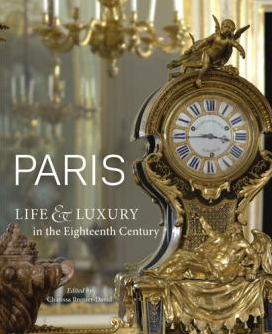
In summary, in 18th-century France a small number of workshops enjoyed royal monopolies to produce jewelry, snuff boxes, watches, porcelain, carpets, silverware, mirrors, tapestries, furniture, and other luxury goods. The crown also directly oversaw several royal manufacturers, including those of tapestries (Gobelins and Beauvais) and carpets (Savonnerie manufactory), and Louis XV had established a royal workshop to make fine dishes at the Manufacture nationale de Sèvres in the 1750s.[Louis XV would also established the first annual exhibition of porcelain at Versailles beginning in 1769, three years after Smith’s departure from Paris. See Antoine 1989, p. 566.] In addition to these luxury goods, clocks and watches became the newest luxury items. Designers such as André Charles Boulle made a specialty of gilded clock cases topped with Cupid, the god of desire, triumphing over a recumbent Father Time (see image below), and wealthy Parisians liked to be painted at their tasks with their elegant timepieces. [See generally Bremer-David 2011.]
Moreover, these luxury goods were not the exclusive domain of the royal family or the upper echelon of the French nobility, Les Grands. The chair-makers, upholsterers, wood carvers, and foundries of Paris were kept busy making luxury furnishings, statues, gates, door knobs, ceilings, and architectural ornament for the royal palaces and for the new town-houses or hôtels particulier of the nobility. Eighteenth-century Paris thus became the capital of luxury, and the epi-center of this bygone world were the hôtels particulier of the faubourg St Germain, where Smith resided during his time in Paris.
A typical day in the life of an 18th-century St Germain town-house was recreated at the Getty Museum in Los Angeles in 2011 as part of an art exhibition “Paris: Life and Luxury in the 18th Century.” [The exhibition opened at the Getty on April 26, 2011 and ended on August 7, 2011. SeeBremer-David2011. See also Vanpée 2013.]The curator of the exhibition,Charissa Bremer-David, attempted to recapture a world subsequently overshadowed by the tumultuous history of the French Revolution. These hôtels particulier or stand-alone mansions were surrounded by gardens and contained many architectural innovations. Lofty rooms for formal receptions, the appartements de parade, were supplemented by intimate rooms for informal relaxation, appartements de commodité, where the rich exercised their politesse and turned their savoir vivre into a performance art. [To recreate a world when only firelight and candlelight illuminated a room, the lights in the last gallery of the exhibition were dimmed. In the exhibition book Paris: Life and Luxury, Mimi Hellman, a professor of art history, evokes “limited circles of flickering brightness surrounded by encroaching gloom.” Glittering enchantment was created by precious metals, gilding on furniture and china, iridescent threads on clothes and jewels on the body. Brilliant cut gemstones came to life in candlelight, spot-lighting the face of the wearer, accentuating what one commentator called “the sparkling fire of the eyes.” Quoted in Vickery 2011.]
This was the bygone world of prerevolutionary Paris that Adam Smith found himself in 1766.
In addition to the letters of Horace Walpole and Madame Riccoboni, I am also reading the following texts as part of my researches into Adam Smith’s life in Paris:
James Bonar, editor, A Catalogue of the Library of Adam Smith (1894), available here.
Charissa Bremer-David, editor, Paris: Life & Luxury in the Eighteenth Century (2011), available here. This book was part of an exhibition of 18th-century luxury goods and objets d’art at the Getty Museum in Los Angeles from April 26, 2011 to August 7, 2011.
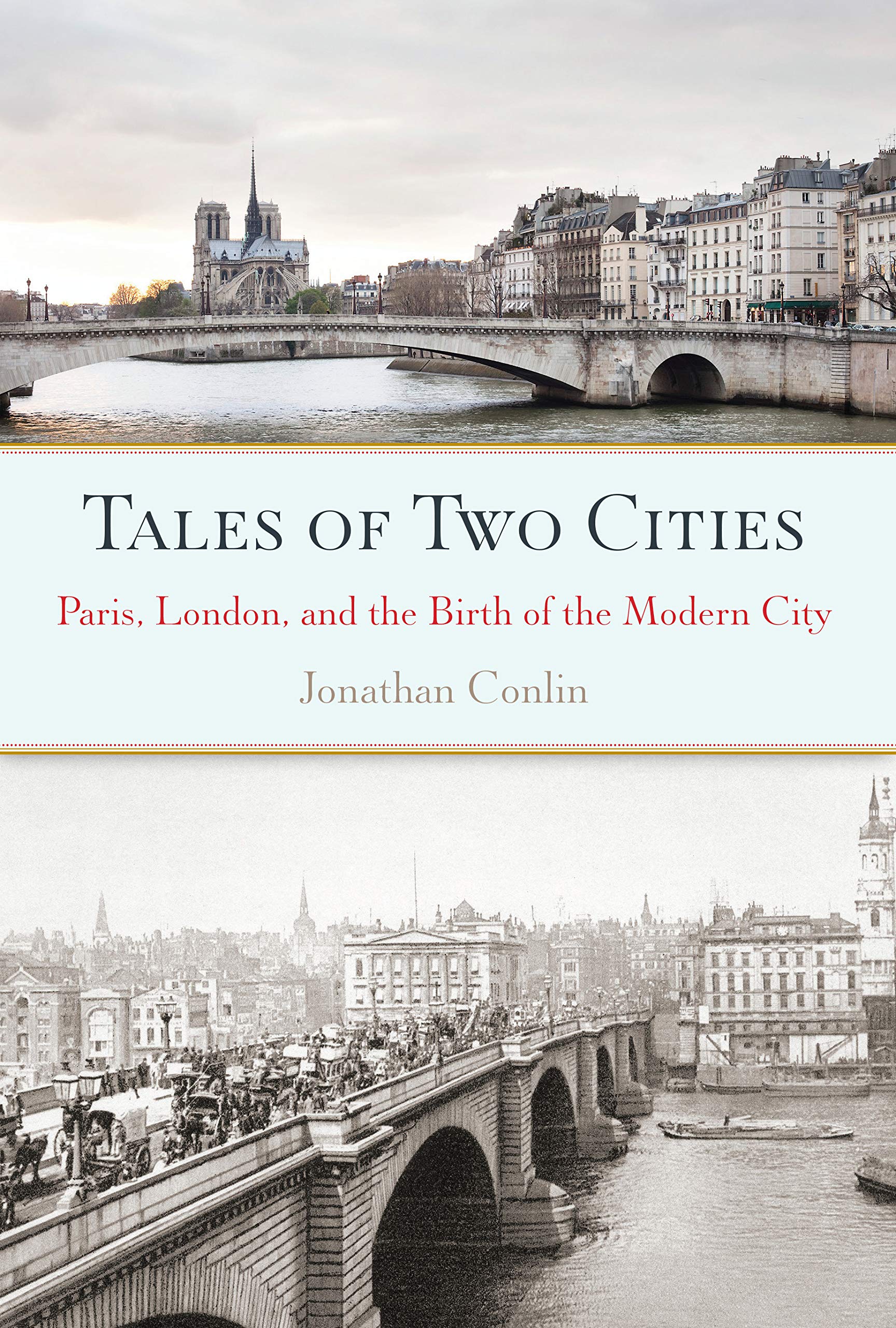
Jonathan Conlin, Tales of Two Cities: Paris, London and the Birth of the Modern City (2013), available here, the cover of which is pictured below.
C. R. Fay, Adam Smith and the Scotland of his Day (1956), available here, especially Chapter 11 on “Smith, Toulouse, and Turgot,”
Jacques Hillairet, Dictionnaire historique des rues de Paris (1963). I am using this general reference book to pinpoint the street numbers of the townhouses and other places in Paris that Adam Smith most likely visited.
Journal Politique Pour l’Année 1766, multiple issues, available here. I am using this primary source to get some sense of what educated people in Paris were talking about at the time.
Sarah Maza, Private Lives and Public Affairs: The Causes Célèbres of Prerevolutionary France (1993), available here.
Ronald L. Meek, The Economics of Physiocracy: Essays & Translations (1963), available here. Although the term “physiocracy” to describe the ideas of the French economistes was not coined until after Adam Smith’s 1766 sojourn in Paris, this classic reference book has proven to be invaluable.
Adam Smith, “Of the nature of that imitation which takes place in what are called the imitative arts” (1795). This fascinating essay by Smith was published after his death.
Julian Swann, Politics and the Parlement of Paris under Louis XV, 1754–1774 (1995), available here, especially Chapter 9 on La Chalotais and the Brittany Affair.
I have been reading the correspondence of Horace Walpole for the years 1765/66 as part of my researches into Adam Smith’s life in Paris. (Walpole’s first visit to Paris coincided with Smith’s second.) Walpole, a prolific and witty letter writer, was a fascinating character in his own right, and I will have more to say about his relationship to Adam Smith during their time in Paris. In the meantime, however, below are three of my favorite quotes from his letters:
“… next to successful enemies, I dread triumphant friends.” (Letter 1034)
“Our ancestors were rogues, and so will our posterity be.” (Letter 1040)
“… though I have little to write, I have a great deal to say.” (Letter 1045)
“Preaching has not failed [to rid the world of sin] …, not because inadequate to the disease, but because the disease is incurable.” (Letter 1047)
“The less I esteem folks the less I would quarrel with them.” (Letter 1048)
“Tranquility bounds my ambition.” (Letter 1050)
“I have always sighed for thundering revolutions, but have been … content with changes of ministers.” (Letter 1058)
















 prior probability