Smith’s Faubourg Saint-Germain (part 3 of 3)

Alternative Title: The Street Lamps of the City of Lights

The Faubourg Saint-Germain, the quarter of Paris where Adam Smith resided for most of 1766, not only enjoyed a daily system of garbage collection (see my previous post), this neighborhood was also a well-lit one. In fact, Paris was nicknamed La Ville-Lumière (“The City of Lights”) because she was one of the first European cities to adopt comprehensive street lighting. An ordinance of Louis XIV in 1667 increased the number of lamps in the streets of the metropolis and ordered that they should be lit even in moonlight from November 1 until March 1.[1] Initially, the lamps were hung from ropes that stretched across the cobblestone streets and were contained in iron-framed glass boxes with tallow candles.[2] The cost of lighting the city eventually became a part of the police budget in 1704, and soon thereafter, the police of Paris installed lanterns on almost every main street.

At the time of Adam Smith’s stay in Paris in 1766, over 6,500 lanterns hung above the streets of the French capital.[3] In order that the entire city might be wholly illuminated within half an hour, each individual lamplighter had charge of no more than fifteen lanterns, and given this limitation on the work of a single lamplighter, it must have taken a corps consisting of over 400 men to light Paris in 1766.[4] The lighting of Paris, like her system of daily garbage collection, was thus a major logistical operation, one that also poses a fascinating problem of political economy, a theoretical question that Smith himself addresses in The Wealth of Nations: who should pay for these public works, the people of France as a whole or the people of Paris locally, who, after all, are the direct beneficiaries of these police services?

Specifically, in Chapter 1 of Book V of The Wealth of Nations, in the subsection titled “Of the Expense of Public Works and Public Institutions,” Smith poses the broader question of whether local public works–i.e. public goods whose benefits are confined to a local area–should be financed at the local or national level, and he uses the example of street lamps to make his point:

Even those public works which are of such a nature that they cannot afford any revenue for maintaining themselves, but of which the conveniency is nearly confined to some particular place or district, are always better maintained by a local or provincial revenue, under the management of a local or provincial administration, than by the general revenue of the state, of which the executive power must always have the management. Were the streets of London to be lighted and paved at the expense of the treasury, is there any probability that they would be so well lighted and paved as they are at present, or even at so small an expense? The expense, besides, instead of being raised by a local tax upon the inhabitants of each particular street, parish, or district in London, would, in this case, be defrayed out of the general revenue of the state, and would consequently be raised by a tax upon all the inhabitants of the kingdom, of whom the greater part derive no sort of benefit from the lighting and paving of the streets of London.”

In the case of Paris, however, what Smith may not have been aware of was that the labor required to light the street lamps of the city was unpaid at the time. Although the cost of this pervasive Parisian infrastructure–candles, glass, iron–had been a part of the police budget since 1704, and was thus financed by the crown at the national level, the labor required to light the lamps was a public service that was exacted without remuneration.[5]

But in fairness to Smith, he was not in Paris to study her methods of garbage collection or lamp lighting. Instead, he was in the middle of Duke Henry’s “Grand Tour” and was thus responsible for his pupil’s moral formation and education during their travels. So, what was Smith doing in Paris during this time? What people did he spend time with, and what places did he visit? Stay tuned. These are the very questions I shall address in my remaining blog posts in this series.

Paris Street Lighting
Credit: Sheila Terry, via the Science Photo Library (see here)
Continue reading
Posted in Uncategorized | Leave a comment

Smith’s Faubourg Saint-Germain (part 2 of 3)

Alternate Title: The Garbage Collectors of Paris

The collection of garbage was one of the many public works under the wide-ranging jurisdiction of the police of Paris. (In addition to public safety, the police of Paris at the time also oversaw all the public markets of the city, regulated the provision of grain, and operated the prisons, among many other things.[1] Beginning in 1704, the cost of removing rubbish from the city was paid out of funds allocated to the police, and by 1780, the total funds allocated for garbage collection amounted to 260,307 livres.[2])

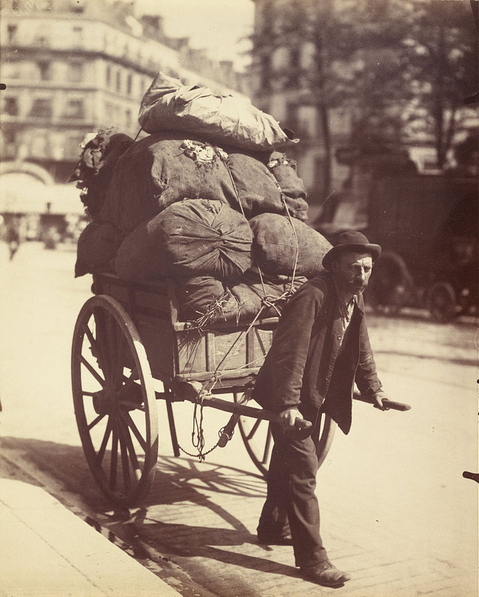
The collection of garbage in Old Regime Paris was an impressive undertaking by any measure, especially for its time. Once a week early in the century, and daily by 1770, two-wheeled carts rolled through the streets of the French capital. In 1766, the year Smith lived in Paris, about 120 carts and 240 men were at work cleaning the City of Lights.[3] The men engaged in this work were mostly farmers (laboureurs) or small landowners who worked their own land near Paris, but the garbage collectors were not poor peasants, since they owned their own horses and carts and were paid approximately 2000 livres per year for their services.[4]

Each morning, the attendants manning these carts collected the refuse that residents had amassed in front of their homes.[5] One half hour before the carts arrived (between 8:00 and 9:00 A.M. in winter and 7:00 and 8:00 A.M. in summer), 20 employees of the police passed throughout each quarter sounding a small bell. The bell warned residents that they were to begin assembling waste and dirt in neat piles for the garbage collectors. These piles were then loaded by the two men who attended each cart–one working with a shovel, the other with a broom–and the rubbish was then transported directly to refuse dumps outside the city.[6]

(As an aside, these dumps were originally located outside the city gates and often grew into small hills. See Barles 2014, p. 202. In Paris, these mounds have been completely integrated into the urban landscape; the labyrinth of the Jardin des Plantes, for example, are on the remnants of a historical dumpsite that is still visible today. Ibid.)

Alas, I can find no reference to the essential function of garbage collection in The Wealth of Nations. Either Smith failed to take notice of the trash collectors of Paris, or he did not find this essential public work sufficiently noteworthy to comment on in his second magnum opus.[7] But what Smith could not have missed–indeed, what no visitor to the “City of Lights” at the time could have failed to observe and appreciate–was the lighting of Paris by night. (I will write about the street lamps of the French capital in my next post.)

Screen Shot 2022-05-02 at 3.35.55 AM

Credit: Eugène Atget (circa 1899), via Wikimedia Commons (Google Art Project)

Continue reading

Posted in Uncategorized | 1 Comment

Smith’s Faubourg Saint-Germain (part 1 of 3)

I mentioned in my previous “Smith in the City” post (see here) that Adam Smith’s principal residence in Paris in 1766, the Hotel du Parc Royal, was located in the historic Faubourg Saint-Germain. Originally, this faubourg or “suburb” was an agricultural area located beyond the old city walls of early medieval Paris. By the time of Adam Smith’s residency in Paris (1766), however, this quiet quarter, still far less populated and polluted than the other parts of this growing metropolis, was becoming one of the most exclusive and fashionable parts of the City of Lights.

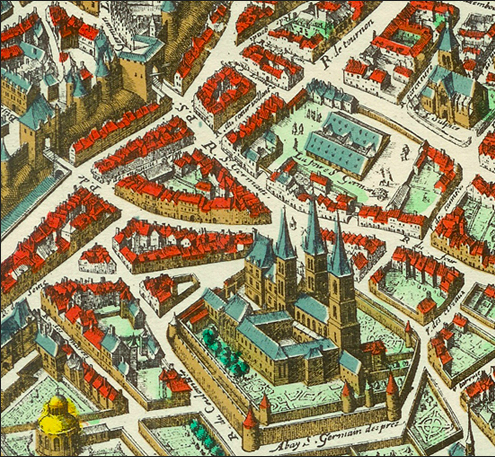
Two great monuments marked the outer boundaries of this up-and-coming district. On one end was the Invalides, a grandiose hospital and retirement community for aged soldiers built in the 1670s, nine decades prior to Smith’s visit.[1] On the other, next to the oldest part of old city wall of Paris, the Wall of Philip Augustus, stood the thousand-year-old abbey complex of Saint-Germain-des-Prés, the burial place of Saint Germanus and of King Childebert and other Merovingian kings and one of the oldest churches in Paris. Pictured delow is a fragment of the 1615 Merian map of Paris (available here), which shows the original abbey complex (bottom center) and old city wall (top left) as well as the Rue du Colombier (bottom center):

The name of the Abbey of Saint-Germain-des-Prés, which was founded by Childebert I during the Middle Ages (6th century), derives from Saint Germanus, the bishop of Paris during Childebert’s reign (511–558) and the fact that it was originally built on a meadow, prés in French.[2] The north side of the abbey complex faced the Rue du Colombier, which ran parallel to the River Seine and was where the Hôtel du Parc Royal was located. Under royal patronage, the Abbey of Saint-Germain-des-Prés became one of the richest in France and remained a center of intellectual life in the French Catholic church until it was disbanded during the Revolution. Today, most of the abbey complex is gone, but the original abbey church still stands as the Église de Saint-Germain-des-Prés.[3]

Between these two ends of Faubourg Saint-Germain were many hôtel particuliers, private gardens, the Café Procope, theatre houses, and other sights.[4] But as far as I am concerned, what must have struck Adam Smith the most about this district–and about the City of Lights overall–was the corps of garbage collectors and lamp lighters who performed their municipal tasks each day. Garbage was collected every morning, and street lamps were lit every evening. Given Smith’s keen sense of observation and attention to detail, how could he have not taken notice of the scale and efficiency of these quotidian public works?

I will describe the details of the daily garbage collection and lamp lighting operations of the police of Paris in my next two posts.

Continue reading
Posted in Uncategorized | 3 Comments

Monday Music: Viva la Vida

I will resume “Smith in the City” in my next post; in the meantime, here is a Coldplay song from 2008. The part of the song starting at 2’59” was my ringtone back when I had a Blackberry!

Posted in Uncategorized | Leave a comment

Epigraph to Smith in the City

Before I resume my multi-part “Smith in the City” series (“Smith” being Adam Smith and the “City” being Paris, not London), I want to share the following quote from the 1936 paper “New Light on Adam Smith” by William Scott, a quote which serves as a perfect epigraph to my project: “The more we discover of his life, the more the fineness of his character stands out.”

Adam Smith - Econowmics
Posted in Uncategorized | Leave a comment

World Book Day

I will resume my “Smith in the City” series on Monday or Tuesday. In the meantime, to commemorate the 27th anniversary of World Book Day (23 April 2022), below is a listing, in no particular order, of some book reviews and book chapters that I have written over the years:

  1. Review of Ryan Patrick Hanley’s book about Adam Smith, Our Great Purpose (forthcoming).
  2. Review of Jeremy Adelman’s biography of Albert O. Hirschman, Worldly Philosopher (available here).
  3. Review of Tyler Cowen’s Love Letter to Big Business (here).
  4. Review of Randy Kozel’s Settled Versus Right: A Theory of Precedent (here)
  5. Review of Cheryl Misak’s biography of Frank Ramsey, A Sheer Excess of Powers (here).
  6. Review of Nate Oman’s The Dignity of Commerce (here).
  7. Chapter for Economics of the Undead: “Buy or Bite?
  8. Chapter for Better Call Saul & Philosophy: “Breaking Bad Promises.”
  9. Chapter for Blade Runner: memorias, vigilencia y el sujeto desechable: “El ajedrez en Blade Runner: lecciones de la Partida Inmortal” (in Spanish).
World Book Day 2021: the novels that have inspired academics - Futurum
Posted in Uncategorized | Leave a comment

Smith in the City: Hôtel du Parc Royal, Rue du Colombier

Among the best hotels or lodging houses in “Quartier S. Germain des Pres” listed in the 1770 edition of The Gentleman’s Guide in his Tour through France is the “Hotel du Parc Royal, from 24 to 450 livres per month.”[1] At the time, the best town houses in Paris had their own private water wells, and the best apartments in the city had their own bathtubs.[2] Alas, we don’t know much about Hôtel du Parc Royal,[3] Adam Smith’s lodgings during his nine-month residency in Paris (February to October 1766), but we do know the following:

First off, we know that both David Hume and Horace Walpole lodged there.[4] Hume relocated to the Parc Royal in November of 1765 and stayed there until his departure from Paris on January 4, 1766, while Walpole stayed at the Hôtel du Parc Royal from October 1765 until his departure from Paris in April 1766.[5] That such great men of letters as David Hume and Horace Walpole would stay at the Parc-Royal is some indication of this hotel’s quality.[6]

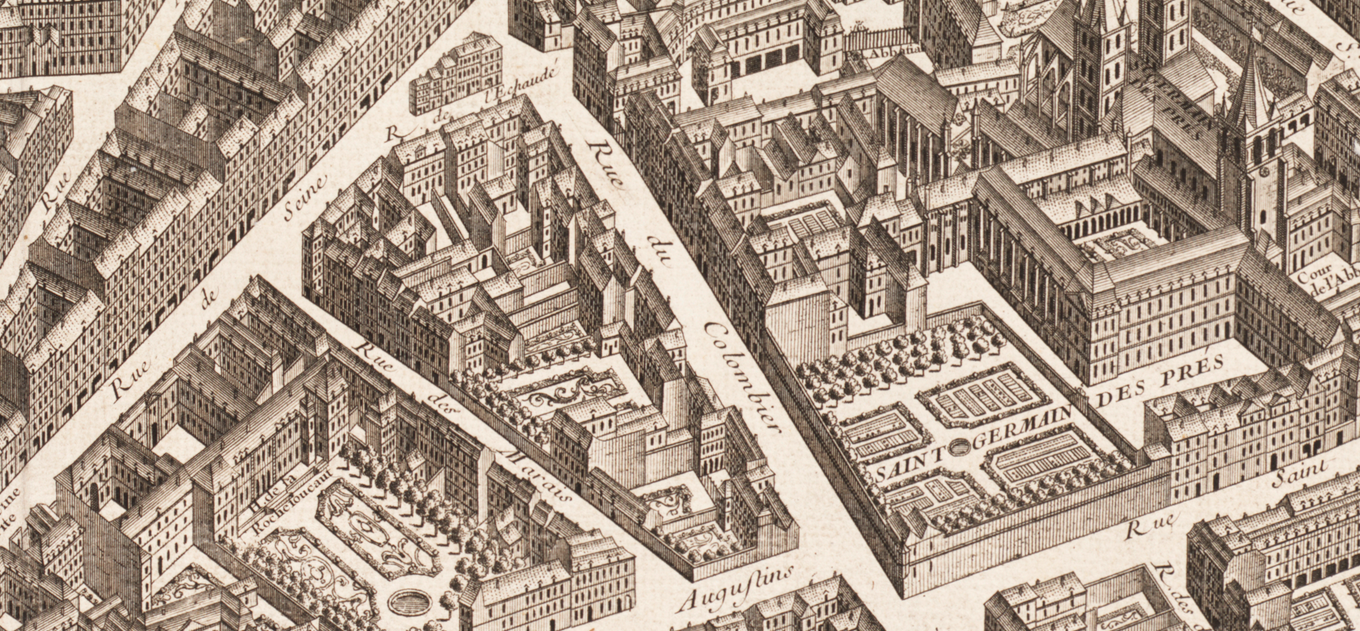
Secondly, we know that the Hôtel du Parc Royal was located on the Rue du Colombier, close to the original abbey complex of Saint-Germain-des-Prés. Today, the Rue de Colombier is the Rue Jacob, a quiet street in the 6th arrondissement of modern-day Paris.[7] At the time of Smith’s stay, however, the Rue du Colombier and the Rue Jacob formed one long street. Writing in May of 1766, for example, the Reverend William Cole describes the Rue du Colombier thus: “This Rue du Colombier, & the Rue Jacob make one long Street from the Rue du Seine quite down to the River; & the Rue des Petits Augustins, where I lodged came into this long Street, near the Joining together of the Rue du Colombier & the Rue Jacob.”[8]

Third and most importantly, we know that the Hôtel du Parc Royal and Rue de Colombier were located in the Faubourg Saint-Germain, one of the most fashionable and aristocratic quarters of Paris at the time. I will say more about this beautiful neighborhood and how it must have appeared to Adam Smith in 1766 when I resume this series of blog posts on Monday, April 25. For now, however, below is a closeup of the Rue du Colombier from a 1739 map of Paris.

Continue reading
Posted in Uncategorized | 1 Comment

Adam Smith in Paris, 1766 (Part 1)

Let’s begin my “Smith in the City” series by narrowing down the date of Adam Smith’s arrival in Paris. We know that Smith lived in Paris for most of 1766, but when exactly did he arrive there?

Adam Smith and his then-pupil Duke Henry, the future 3rd Duke of Buccleugh, began their Grand Tour of Europe in early 1764 and first arrived in the City of Lights on February 13 of that year. Their first sojourn in Paris, however, was a relatively short one: they remained in the French capital for only a few days before relocating to Toulouse, where they resided for the next 18 months, i.e. from March of 1764 to October of 1765.[1] Later on, Smith, Duke Henry, and the Duke’s younger brother Hew Scott Campbell, who had joined his brother in Toulouse in the summer of 1764, all travelled to the Swiss city of Geneva sometime in October of 1765 before returning to Paris a second time.[2] So, when exactly did they return to Paris for their second, much longer, sojourn?

According to Ian Simpson Ross (2010, p. 209), citing two of Smith’s previous biographers, John Rae and E. G. West: “It has been assumed Smith and his pupils [Duke Henry and Henry’s younger brother Hew] travelled to Paris from Geneva in December 1765, in time to see Hume and possibly Rousseau before they left the French capital for England on 4 January 1766.”[3] But as Ross himself correctly notes (ibid.), the surviving correspondence between Hume and Smith does not indicate that any such meeting between them, or between Smith and Rousseau for that matter, ever occurred. Instead, Ross reports that “[t]he first news from Paris of Smith being there comes from Horace Walpole, who recorded on 2 March 1766 that [they] had gone to an ‘Italian play’ … at the Comedie-Italienne.”[4] In fact, the first reference to Smith in Walpole’s private travel journal appears on February 15, 1766. His journal entry for that date begins thus: “Dr. Smith came.”[5]

By contrast, another contemporary source, the Reverend William Cole, has Smith’s pupil, Duke Henry, arriving in Paris as early as October 26, 1765.[6] Although Reverend Cole’s account does not mention Adam Smith or Duke Henry’s younger brother Hew Scott Campbell by name, it is unlikely that Duke Henry would have travelled to Paris from Geneva alone. Of these two primary sources, however, I find Horace Walpole to be far more credible than Reverend Cole for three reasons.

First, as mentioned above, Smith and Duke Henry were most likely in Geneva during the months of October and November of 1765.[7] Secondly, Walpole was annotating his activities in Paris on a daily basis contemporaneously during his seven-month stay in Paris (Walpole was in Paris from September 1765 to April 1766), while Cole began writing his Paris travel memoire almost six months after he left Paris.[8] And thirdly, and perhaps most importantly, Smith and Walpole were residing in the same place, the Hôtel du Parc Royal.

But where in Paris was the Parc Royal located, and why did Smith choose to stay there? I shall address those questions in my next post.

Paris in the 18th century - Wikipedia
View of Paris from the Pont Neuf (1763) (Getty Center, Object 581)
Continue reading
Posted in Uncategorized | Leave a comment

Introduction to Adam Smith in Paris, 1766

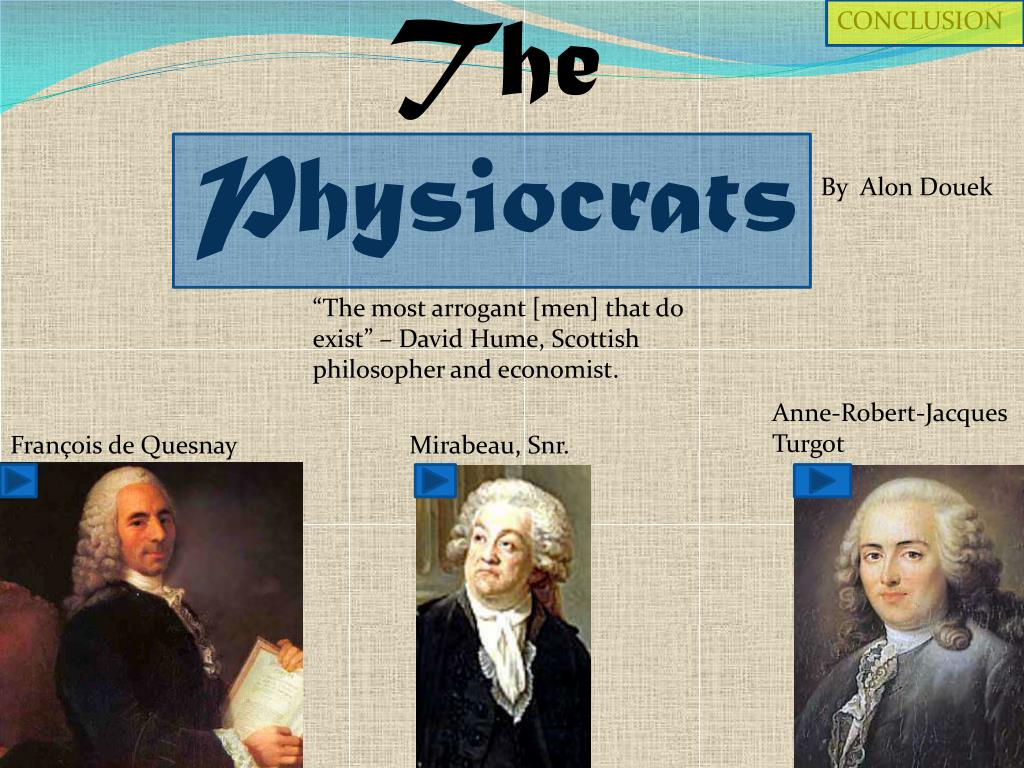
Adam Smith lived in Paris for most of 1766. Among other things, it was during this fateful year that Smith attended the celebrated salons of the leading ladies of Paris and dined with such lights as Diderot and d’Alembert, co-editors of the great Encyclopedie. But most importantly, it was in Paris where Smith met and exchanged ideas with the leading economistes of Europe. In the eloquent words of one student of Smith’s life (Ross 1984), “the encounters with the economic theorists of Paris [the so-called “Physiocrats”] can be considered one of the most exciting passages in Smith’s intellectual development, second in importance only to his early contacts with Hume.”[1] Given how important Smith’s stay in Paris was to his transformation from a moral philosopher into a modern political economist, I will assemble the available evidence and retrace Smith’s footsteps in the City of Lights.

But, first, when did Adam Smith arrive in Paris? One contemporary source (Rev. William Cole, who was in Paris from October to December 1765) has Smith arriving in the City of Lights as early as October 1765, while another source (Horace Walpole, who was in Paris from September 1765 until April 1766) has him arriving as late as February 1766. In my next post (4/21), I will try to narrow down the actual date of Smith’s arrival.

PPT - The Physiocrats PowerPoint Presentation, free download - ID:1980960
Image Credit: Alon Douek

[1] Ian [Simpson] Ross. 1984. The Physiocrats and Adam Smith. Journal for Eighteenth‐Century Studies, Vol. 7, No. 2 (Sep., 1984), pp. 177-189 (p. 185).

Posted in Uncategorized | Leave a comment

New Series: Adam Smith in the City of Lights

Starting tomorrow (April 20), I will begin posting a new multi-part series on “Adam Smith in Paris, 1766.” In the meantime, pictured below is one part of a 1739 map of Paris known as the “Turgot Map.” Among other things, the left side of this beautiful fragment shows the famed Île de la Cité — the island on the River Seine where such landmarks as the Notre Dame Cathedral and the Pont Neuf are located.

Also, this fragment is part of a much larger map of Paris, which was commissioned in 1734 by Michel-Etienne Turgot, the provost of the merchants of Paris, a position roughly equivalent to that of the present-day Mayor. Turgot selected Louis Bretez, a member of the Academy of Painting and Sculpture, to prepare a new printed map to record and promote the city of Paris. Bretez and his assistants then spent more than two years making detailed, measured studies of the buildings and other landmarks of Paris for this project. The final (1739) version of the Turgot/Bretez map was executed on a scale of approximately 1:400. More details about this map are available here, via Wikipedia, and here, via the Princeton University Library.

Posted in Uncategorized | Leave a comment