Kudos to Devon, i.e. @devonzuegel. Although I am still off Twitter and will most likely remain off for the foreseeable future (#SelfCancel), I found this fascinating thread via Marginal Revolution on the topic of “What are the criticisms of your work that you find most interesting?” (Hat tip: The Amazing Tyler Cowen.) Although I am not a big fan of the word “interesting,” I love the spirit of this question!
What are the criticisms of your work that you find most interesting?
Note: This is my fourth and last blog post (for now) in my series on “Lockean takings.”
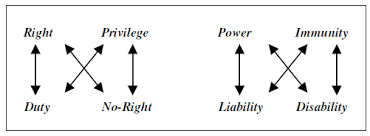
I want to conclude this series by noting the “Hohfeldian” structure (see image below) of the self-ownership principle.[1] In brief, if each person owns the legal right to his labor, if each person is a self-owner, so to speak, then–regardless of whether this right originates in natural law (Locke), social utility (Hume), or positive law–this right generates a correlative duty on the part of others.[2]
This Hohfeldian analysis also highlights the reciprocal nature of the pandemic problem.[3] On the one hand, not shutting down the economy makes it easier for the pandemic to spread, but on the other, the decision to order an economic shutdown also imposes significant costs on “non-essential” workers. Ifthe government is going to order “non-essential” workers to stay at home for the greater good, then the government is also required under the Constitution to pay “just compensation” in exchange for one’s cooperation. This property rights approach to the pandemic not only respects the federal structure of our constitutional system of government, it also represents a fair compromise between our need to make significant sacrifices for the common good by staying at home for a reasonable period of time and our bedrock self-ownership right as well as our moral right to receive some of form of meaningful or just compensation in exchange for the deprivation of liberty.
One more thing. My Lockean or labor-as-property approach also follows from the reasoning in Robert Nozick’s Anarchy, State, and Utopia.[4] Nozick begins with the premise that every person has rights, including the right to liberty and property. Specifically, in Nozick’s words, “Individuals have rights, and there are things no person or group may do to them (without violating their rights).”[5] These rights are pre-political and must be respected by all, but at the same time, these rights are limited by the existence of other rights-holders and the existence of correlative duties.[6] As a result, you must respect the rights of others; you do not have the right to cross any moral boundaries while you are exercising your rights. Specifically, you do not have the right to impose unjustified harms or unjustified risks on others.
This Nozickian or classical liberal approach may appear unworkable in the context of a pandemic because one person’s refusal to engage in social distancing by itself creates significant risks for innocent third parties, including the risk of death for persons with underlying medical conditions. In other words, every human activity–no matter how benign its motivation or useful its consequences–carries some positive and nontrivial risk of injury to self and to others.[7] Or as Nozick (1974, p. 75) himself points out, “it is difficult to imagine a principled way in which the natural rights tradition can draw the line to fix which probabilities impose unacceptably great risks upon others.” Here is where the Hohfeldian logic of the self-ownership principle comes into play. If an economic shutdown is indeed the most effective method of saving lives during a pandemic–by requiring workers to stay at home and businesses to shut down–, then everyone who is inconvenienced by the shutdown (rich or poor) must be compensated for this inconvenience as soon as possible by the governmental entities that ordered the shutdown. (Footnotes are below the fold.)
Note: This is my third blog post in my series on “Lockean takings.”
Now that we have surveyed some lockdown orders, the next question is, Why doesn’t the concept of self-ownership inform our understanding of the Takings Clause?
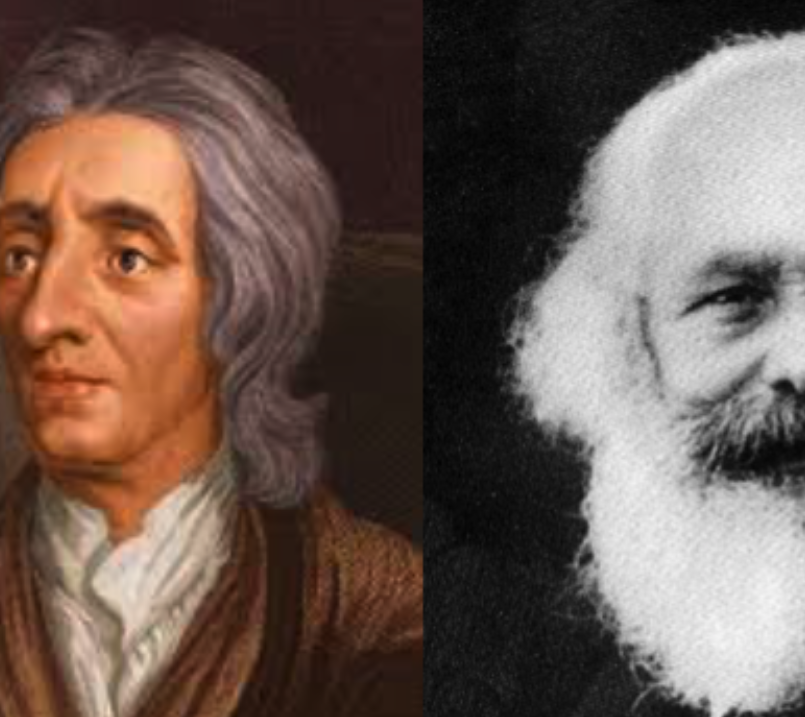
Generally speaking, there are two broad schools of property rights: natural law theories, which emphasize the moral aspect of property, and consequentialist theories, which link property rights to social welfare. John Locke, for example, famously defended the proposition that people have natural rights to property, while David Hume, Karl Marx, and many others have argued that property is merely a useful social convention, one that is in our self-interest to follow.[1] Nevertheless, whether the justification of property is rooted in social utility or in natural rights, most theories of property share the same Lockean premise: each person owns his own body and is generally entitled to the fruits of his own labor.[2] Of course, both perspectives–the Lockean/Nozickian one grounded in natural rights or Humean/Marxian theories based on social conventions–both can be true. We can have a natural right to X, and at the same time, X can also constitute a socially-useful artificial convention.
Either way, whichever perspective one prefers–i.e. whether property rights are considered a Lockean natural right essential for human autonomy or a Humean social convention essential for the maximization of economic welfare–most people agree that everyone owns their own labor, or in the memorable words of John Locke (1690, Sec. 27), “every man has a property in his own person; this nobody has any right to but himself.”[3] As Richard Epstein (1985), Alex Tuckness (2020), and others have noted, Locke’s general self-ownership principle–regardless of whether it is rooted in natural law or positive law–is among his most important contributions to political philosophy.[4]
Some commentators, however, have criticized this Lockean premise–i.e. self-ownership–as too individualistic and narrow-minded.[5] Following in the footsteps of Aristotle and Aquinas, some scholars like to emphasize the notion of “the common good” above and beyond personal self-interest.[6] This communitarian critique of Locke’s self-ownership principle, however, overlooks an important point: it is up to each person to decide for himself what the common good consists of. In fact, many Marxists and so-called “left libertarians” embrace the self-ownership principle as the starting point of their critiques of capitalism and inequality.[7]
In addition, I wish to make a further clarification here. Locke’s self-ownership principle should not be confused with his labor theory or “mixing” theory of property rights–the idea that we acquire property rights over something (something unowned) when we mix our labor with that thing.[8] Put another way, makers have property rights over what they make. This aspect of Locke’s theory, however, runs into some notorious difficulties. Robert Nozick, for example, a libertarian political philosopher sympathetic to Locke, posed the following famous hypothetical: “If I own a can of tomato juice and spill it into the sea so that its molecules (made radioactive, so I can check this) mingle evenly throughout the sea, do I thereby come to own the sea, or have I foolishly dissipated my tomato juice?” (Nozick, 1974, p. 175.)
Putting aside Nozick’s fanciful hypothetical, another difficulty with Locke’s labor theory of property occurs in science and mathematics. Proving a theorem or discovering a law of nature like F = ma takes a lot of work, but who owns the rights to the proof or the discovery? The person who proved the theorem or made the discovery? Or do theorems, like most scientific discoveries, belong to our “intellectual commons”?[9] At the same time, even if no one “owns” mathematical proofs or other types of intellectual discoveries in a legal sense, the informal “priority rule” in science nevertheless confirms the resiliency and generality of Locke’s labor theory of property. Generally speaking, “priority” (i.e. credit for making a discovery) is supposed to go the person or group who first made the discovery; theorems and discoveries are supposed to be named after the person who discovered them.[10] At the very least, only the discoverer of a theorem or law of nature is entitled to publish the results of his work.
In any case, although Nozick’s radioactive can of tomato juice and the process of intellectual discovery in science and mathematics both test the outer limits of Locke’s labor theory of property, these examples do not detract from Locke’s general self-ownership principle: we own our own bodies and the fruits of our labors; we get to decide how to live our own lives. Most, if not all, “left libertarians” accept the general Lockean principle of self-ownership.[11]
So, to sum up our definitional analysis of “property” thus far, most people, even the most ardent opponents of natural rights and critics of Locke, generally agree with the principle of self-ownership, that we have property rights in our persons. This key Lockean insight is so fundamental and so universally accepted that it should inform our understanding of the Takings Clause. Specifically, when the government restricts our self-ownership by preventing us from leaving our homes to make a living, we are owed just compensation. In my next post, I will discuss the reciprocal nature of the pandemic problem. (PS: My footnotes are below the fold.)
Note: This is my second blog post in a series on “Lockean takings.”
Last year many State governors across the United States promulgated a series of unprecedented and compulsory economic suppression orders–commonly referred to as “lockdown,” “stay-at-home,” or “shelter-in-place” orders–in response to the coronavirus pandemic.[1] In brief, these Stalinesque orders did two things: they required all non-essential businesses to close their doors, and they prohibited the employees of these business firms from leaving their homes to work. Although the definition of “essential” varied with each order, the common goal of these executive orders was to promote social distancing and slow the spread of infection.
Note: This is my first blog post in a series on “Lockean takings.”
In his 1985 book Takings, Richard A. Epstein’s landmark work on takings law (the cover of which is pictured below), Epstein (1985, p. 31) identifies four fundamental questions that courts and scholars must address when studying or interpreting the Takings Clause:
Is there a taking of private property?
Is there any justification for taking that private property?
Is the taking a public use?
Is there any compensation for the property so taken?
Yet, absent from Epstein’s legal laundry list is this key question, What forms of private property are protected by the Takings Clause? Specifically, why don’t takings of one’s labor count as a “taking” under the Constitution?
A few days ago I asked, “What else have they lied to us about?” I am now re-blogging that post because it turns out the “lamestream” media also lied to us about the cause of death of Brian Sicknick, the Capitol Hill police officer who died under mysterious circumstances on January 6, 2021. At first, we were told a lie: he was killed by members of a pro-Trump mob. Now, more than 100 days later, we are being told a far different story: Officer Sicknick suffered a stroke on that day and died from natural causes.
Sunday is supposed to be a day of rest and reflection, so let’s reflect on this: media bias and social media censorship. Remember when journalists propaganda agents at Jeff Bezos’ Washington Post reported that the Russian military was paying bounties to the Taliban for killing U.S. soldiers in Afghanistan? Wikipedia does. The lamestream media (print, TV, cable, and online) over-hyped this story, while Twitter (and now LinkedIn!) was censoring reports about Hunter Biden’s laptop. (Not to be outdone in the censorship game, Facebook is busy censoring this story as we speak.) Well, now it turns out this entire bounty story was bullshit, after all (see here, for example)! So, what else have they lied to us about?
Why isn’t data fraud a crime? In a working paper I wrote in 2019, I proposed charging researchers who fabricate data with wire fraud. Here is an excerpt from my 2019 paper (edited by me for clarity):
The literature on data fraud and data fabrication views these bad practices through a purely ethical lens …. This paper, by contrast, will explore the possibility of criminal sanctions against academic researchers who fabricate data. My previous work in this domain (Guerra-Pujol, 2017 [available here, by the way]) explored the possibility of imposing various forms of tort and contract liability for data fraud committed by academic researchers. Building on my previous work, I will explore the possibility of criminal liability when a researcher knowingly fabricates research data in a published paper. In a word, the fabrication of data–the attempt to publish fake data, to be more precise–should be treated as a crime * * * * for it is beyond question that the outright fabrication of data … not only calls into question the integrity of academic accounting; a strong case can also be made that fraudulent research constitutes the crime of wire fraud.
Fast forward to 2021 and this report by Scott Jaschik: “Ex-Dean at Temple Indicted on Charges of Manipulating Rankings.” (Hat tip: Brian Leiter.) In brief, federal prosecutors have charged Moshe Porat (pictured below), the former dean of Temple University’s business school (from 1996 to 2018), with one count of conspiracy to commit wire fraud and one count of wire fraud for submitting fake data to U.S. News & World Report about Temple business school’s online MBA and part-time MBA programs in order to inflate his school’s rankings in the annual U.S. News surveys. (Here is some additional background about this remarkable case, and here is the official announcement from the U.S. Attorney’s Office for the Eastern District of Pennsylvania. If convicted, this disgraced former dean faces up to 25 years in prison and a $500,000 fine.)
Given the problem of fabricated data in science (see, for example, RetractionWatch), who will be next?











 prior probability