Kudos to Gareth Wild (@GarethWild) and his six-year quest to park his car in every single parking spot at his local grocery store. Although this particular quest was a trivial one, Mr Wild’s methodology is solid, and his spreadsheets are beautiful!
For the last six years I’ve kept a spreadsheet listing every parking spot I’ve used at the local supermarket in a bid to park in them all. This week I completed my Magnum Opus! A thread.
Nobel-laureate (2002, economics) Daniel Kahneman (Princeton) published his popular book “Thinking Fast and Slow” in 2011 to much acclaim. His book became an instant best-seller and won many awards and prizes; see here, for example. Kahneman’s field is psychology, however, and if you know anything about the “replication crisis” in this field, you may already know where this blog post is headed. Specifically, how much of the social psychology research cited in Kahneman’s 2011 book is either bogus or suspect? This is precisely the question that Ulrich Schimmack (University of Toronto) decided to answer, and the results–available here on his influential R-Index blog–aren’t pretty! Professor Schimmack’s devastating analysis of the work cited in Kahneman’s 2011 book makes me wonder what empirical studies in other fields would fail to replicate if subjected to such scientific testing? The moral of this story? You may have heard the phrase “trust the science,” but the field of social psychology should serve as a warning to us all.
Let’s dedicate May Day (May 1st) to the worldwide victims of Communism and Socialism. (Full disclosure: I originally heard this idea from my colleague and friend Ilya Somin, but I second it wholeheartedly! More details here.)
I will be blogging lightly next week–at most, one post per day–as my wife and I will be traveling to Dallas, Texas next week to celebrate our wedding anniversary on Cinco de Mayo. After next week, I will be blogging about this excellent paper by my colleague and new friend Robert Sanger, and then after that, I will revisit the Lockean principle of self-ownership. It turns out there is a vibrant “anti-self-ownership” literature in which the principle of self-ownership is rejected outright for a wide variety of reasons. I will therefore sum up these anti-self-ownership reasons and respond to them in due course later on.
Note: This is the last of three blog posts on the case of U.S. v. Porat
It’s time to wrap up this series on wire fraud and college rankings. We have already surveyed several questions posed by U.S. v. Porat, the federal criminal case involving the disgraced former dean of the Temple University business school, who is charged with wire fraud for providing false information to U.S. News & World Reports to boost his school’s ranking in the annual survey of graduate programs published by U.S. News. (See here for more details about this novel case.) To the point, what all these questions boil down to is this: what thing of value, e.g. money or property, did Dean Porat obtain as part of his (alleged) fraudulent scheme.
For their part, Professor Kerr (see here) and former prosecutor Levy (here), who have guided our analysis thus far, both seem to suggest that the federal wire fraud case against Porat is weak because, even if he did commit fraud in the literal sense by sending doctored data to U.S. News, he did not literally receive anything of value in return. But I beg to differ for the following reasons. First off, it’s essential to point out the following key fact about this case: when Porat (allegedly) sent fake data to U.S. News to boost his school’s ranking in the U.S. News annual survey of graduate programs, his school’s ranking did not just go up one or two places. It shot up from #25 all the way up to #1! It therefore does not take a genius to figure out what the thing of value was that Porat obtained as part of his (alleged) fraudulent scheme. In short, the thing of value was this #1 ranking from U.S. News.
(As an aside, for reasons that are beyond the scope of this blog post, being #1 is a huge deal in North American culture and in the competitive worlds of sports, business, and academia generally. The song below captures this spirit perfectly!)
Seen in this light, the myriad concerns and technical difficulties identified by Kerr and Levy about this case evaporate. To begin with, it does not matter that the U.S. News survey is silly or flawed, that it’s methodology is opaque or easily-gamed, or that it makes no effort to audit or verify the data it is sent. Why not? Because at the end of the proverbial day what really matters with these admittedly dumb and easily-gamed rankings is just one thing–which school gets the #1 ranking. The #1 ranking confers on the top school a kind of unofficial seal of approval, and this seal of approval, however dubious or undeserved in fact, is the thing of value that triggers the wire fraud statute when the ranking is obtained under false pretenses.
Furthermore, Levy’s question about whether the identity of the deceived has to be the same as the identity of the defrauded is now beside the point. It was U.S. News who was deceived (when Porat allegedly sent the fake data to them) and it was thus U.S. News who was defrauded when it assigned the #1 ranking to Porat’s business school. Lastly, and perhaps most importantly, given that Temple business school’s online program would not have received the #1 ranking but for Porat’s (alleged) scheme, the students did not, in fact, “get what they paid for” (to borrow Levy’s apt phrase) when they attended Temple’s business school. They thought they were paying for an academic degree from a business school with the #1 online program in the country; what they got instead was a degree from a third-rate school run by a bunch of thieves. Case closed!
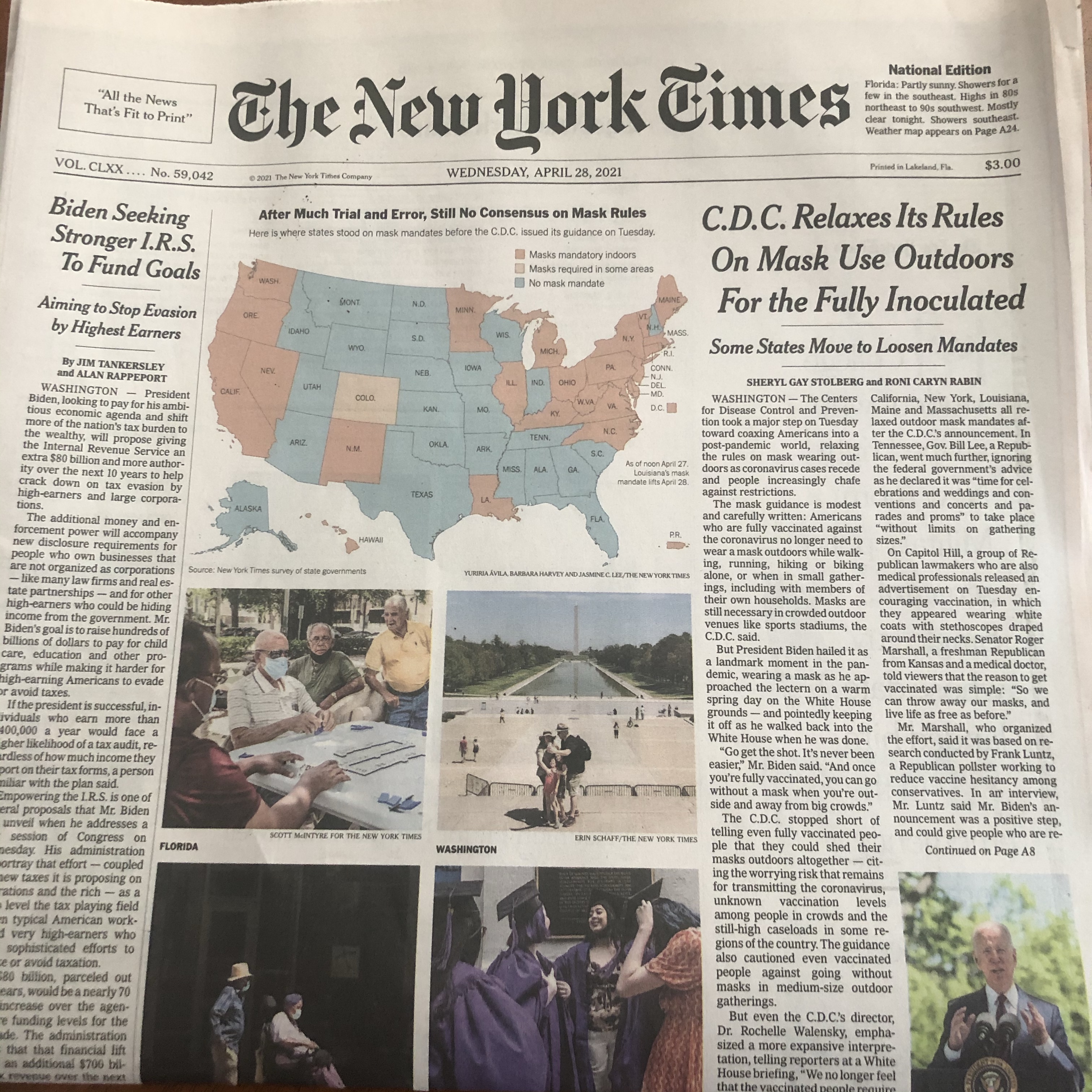
I am interrupting my series of blog posts on wire fraud to say: “I told you so.” My copy of the Wednesday New York Times (pictured below) has this headline above the fold: “CDC Relaxes Its Rules on Mask Use Outdoors for the Fully Inoculated.” That is one small step in the right direction, but as I explain in my work-in-progress on “Lockean Takings” (available here via SSRN), the imposition of mask mandates pales in comparison to the illegal “takings” of labor without the payment of just compensation that occurred across the nation when States ordered “non-essential” workers to stay home last year.
Note: This is the second of three blog posts on the case of U.S. v. Porat.
Michael Levy, a former federal prosecutor, has written up a brief but excellent analysis (see here) of some of the legal issues in the case of Moshe Porat, the disgraced former dean of the Temple University business school, who was charged with wire fraud by the U.S. Attorney’s Office in Philadelphia. In brief, the indictment, a copy of which is available here, alleges that Dean Porat provided false information about his school to U.S. News & World Reports in order to boost his school’s ranking in U.S. News’ annual survey of graduate programs. According to Levy’s expert analysis, the Porat case poses three tricky legal questions:
1. Does the person deceived have to be the person defrauded? In this case, for example, it was U.S. News & World Reports that was directly deceived (allegedly) by Porat. Aside from being lied to, however, what economic harm did U.S. News suffer as a result of Porat’s alleged fraudulent scheme? For his part, Levy notes that to the extent U.S. News was the “unwitting transmitter” of the false statements to the victims “the people deceived and the people defrauded [are] the same,” but I would pose the following second-order question: Is U.S. News, in fact, an “unwitting transmitter” of Porat’s fake date, or does the magazine have an independent duty to verify the information that it publishes? If so, shouldn’t the magazine be jointly liable, along with Porat, for this fraud?
2. Were the students who decided to attend Porat’s business school based on the school’s inflated ranking “defrauded” in any real sense? That is, even if the person deceived (U.S. News) does not have to be the person defrauded (the students), are you a victim of fraud if you are lied to but nevertheless get what you paid for? Or in Levy’s words: “Even if the students opted to go to [Temple] because of the fraudulently obtained rating, they got what they paid for–a [Temple] business school education and MBA.” Furthermore, according to the facts alleged in the indictment of this case, the price of tuition during the scheme either remained the same or went down! So, if Dean Porat did not charge more for his school’s degrees, and if students got what they paid for (a Temple business school education), then where is the harm? What money or valuable property did Porat or the business school obtain as a result of Porat’s (allegedly) fraudulent scheme?
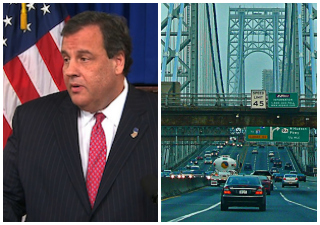
3. Last but not least, even if we were to assume for the sake of argument that the students in Porat’s case were, in fact, harmed or defrauded, was the harm in this case the object or main purpose of Porat’s (allegedly) fraudulent scheme or was this harm merely incidental to it? In other words, remember the infamous “Bridgegate” case? Back in 2013, public officials in New Jersey had conspired to create major traffic jams in the town of Fort Lee after the mayor of that town refused to endorse the re-election bid of then-Governor Chris Christie. Among other things, these public officials were charged with, and convicted of, wire fraud. On appeal, however, a unanimous U.S. Supreme Court reversed the conviction because “the scheme … did not aim to obtain money or property.” See Kelly v. United States, 590 U.S. ___ (2020). In other words, to prove wire fraud, the prosecution has to prove not only that the defendants engaged in a fraudulent scheme; it also has to prove that the main purpose of the scheme was to obtain money or property.
To sum up, contrary to my initial assessment of the Temple business school case (see here), it looks like Porat has a real good chance of getting the wire fraud charges against him dismissed by the judge in his case. Yet, assuming that Dean Porat did, in fact, submit doctored data about his school to U.S. News to inflate his school’s ranking, would a dismissal of the criminal charges against him be the “right” result? In my next post (the last one in this series), I will offer a common-sense interpretation of the federal wire fraud statute and of the facts in the Porat case.
Before I proceed with my three-part series on wire fraud and the U.S. News rankings, I want to elaborate on one of the points in my previous post. Specifically, are the fraud allegations against the Temple business school a one-off–an unusual or rare event like Halley’s Comet–or are these allegations just the tip of a more massive iceberg? More generally, how much of the annual higher-ed rankings published by U.S. News & World Report are based on fake data? By way of example, consider this NYT report titled “College Says It Exaggerated SAT Figures for Ratings.” In brief, Claremont McKenna College (CMC), a private institution in Southern California, admitted in 2012 to having submitted inflated SAT scores to U.S. News for years. If CMC, one of the most prestigious liberal arts colleges in the country, is guilty of sending doctored data to U.S. News, it makes me wonder what other places, besides Temple’s business school (allegedly), have succumbed to this temptation? In any case, even if most of the data used by U.S. News to compute its rankings are not fake (a big “if” given CMC’s 2012 confession), there are so many other ways of “gaming” those rankings. (Again, see here for a survey of the most serious problems with the U.S. News system.) This is a serious question because, as I explained in my previous post, if those rankings are not credible to begin with, maybe U.S. News itself is guilty of fraud writ large! Instead of bringing charges against a few college administrators, why don’t the Feds go after the Big Fish? I will explore that possibility in my next post …
Note: This is the first of three blog posts on the case of U.S. v. Porat.
I mentioned in a previous post that Moshe Porat, the former dean of Temple University’s business school, was recently charged by the Feds with one count of conspiracy to commit wire fraud and one count of wire fraud for submitting fake data to U.S. News & World Report about Temple business school’s online MBA and part-time MBA programs in order to inflate his school’s rankings in the annual U.S. News surveys. Today, I want to take a closer look at this fascinating Twitter thread by my colleague and friend Orin S. Kerr, a law professor at Cal Berkeley, about some of the legal issues posed by this wire fraud case.
In summary, Kerr correctly notes that the federal wire fraud statute, which is codified at 18 U.S.C. §1343, makes it a crime to commit fraud across State lines in order to obtain money or valuable property. Professor Kerr then poses the following two questions:
What exactly is criminal, if anything, about submitting fake data to US News?
And who was tricked into giving up their money?
It turns out that these two questions are one and the same. Why? Because to obtain a conviction under the federal wire fraud statute it’s not enough to prove that the defendant knowingly and intentionally made a fraudulent and material misstatement of fact (e.g. a business school dean who provides fake data to US News about his school’s programs). The prosecution must also prove that someone was actually harmed by the defendant’s fraudulent activity. But in the case of Moshe Porat, the former disgraced dean of Temple’s business school who allegedly sent fake data to US News in order to improve his school’s ranking, the key legal question is, Who was harmed by Dean Porat’s alleged fraud?
One could argue, or course, that it was the many applicants and wealthy donors to Temple’s business school who were harmed–at least to the extent that they applied or donated money to Temple under false pretenses–but at the same time one could just as well argue that the annual US News survey of graduate schools is not a reliable indicator of a school’s true worth or quality. To the point, if the annual US News survey of graduate schools is a bunch of bullshit to begin with, then no one is really harmed if this annual survey is based on doctored data! (Or in the more dignified words of Professor Kerr: “… Deans who submit fake U.S. Numbers aren’t trying to harm applicants and donors. They think their schools are fantastic, and that the U.S. News isn’t realizing how fantastic they truly are.”)
For lack of a technical or proper legal term, let’s call this the “calling bullshit” defense to wire fraud. Even if a business school dean in fact provides fake data to a third party like US News in order to fraudulently improve his school’s relative ranking, there is no crime of fraud if the US News annual survey of graduate programs is itself bullshit, which it probably is (see here, for example), though a full analysis of the utility of those annual surveys would require another series of blog posts. Instead of rehashing the same old pro and con arguments about these academic beauty contests, I will consider former prosecutor Michael Levy’s expert analysis of Porat’s case in my next post …
Three updates re: wire fraud charges against the disgraced former dean of Temple Business School for submitting fake data to U.S. News & World Reports (see my post below):
1. My colleague and friend Orin S. Kerr has posted this thread on Twitter asking the following question, “What exactly is criminal, if anything, about submitting fake data to US News?” (I guess there is such a thing as a dumb question.)
2. Professor Kerr’s friend Micheal Levy, a federal prosecutor, has also commented on this wire fraud case here.
3. I will be responding to both Kerr and Levy in the days ahead.
Why isn’t data fraud a crime? In a working paper I wrote in 2019, I proposed charging researchers who fabricate data with wire fraud. Here is an excerpt from my 2019 paper (edited by me for clarity):
The literature on data fraud and data fabrication views these bad practices through a purely ethical lens …. This paper, by contrast, will explore the possibility of criminal sanctions against academic researchers who fabricate data. My previous work in this domain (Guerra-Pujol, 2017 [available here, by the way]) explored the possibility of imposing various forms of tort and contract liability for data fraud committed by academic researchers. Building on my previous work, I will explore the possibility of criminal liability when a researcher knowingly fabricates research data in a published paper. In a word, the fabrication of data–the attempt to publish fake data, to be more…










 prior probability