Homemade circular rainbow

Instructions, via Dexter See: “Form a circle with Skittles on a plate (colours should be in repeated order, preferably according to colours of the rainbow e.g. purple, green, yellow, orange, red), then pour hot water over them.” (Hat tip: The Amazing Cliff Pickover.)

Posted in Uncategorized | Leave a comment

Single-peaked preferences: words versus mathematical notation versus visualization

The entry in Wikipedia for “single-peaked preferences” explains this concept in three different ways: in words, then using formal mathematical notation, and then with a simple image. First, the concept is defined in wordsContinue reading

Posted in Uncategorized | 2 Comments

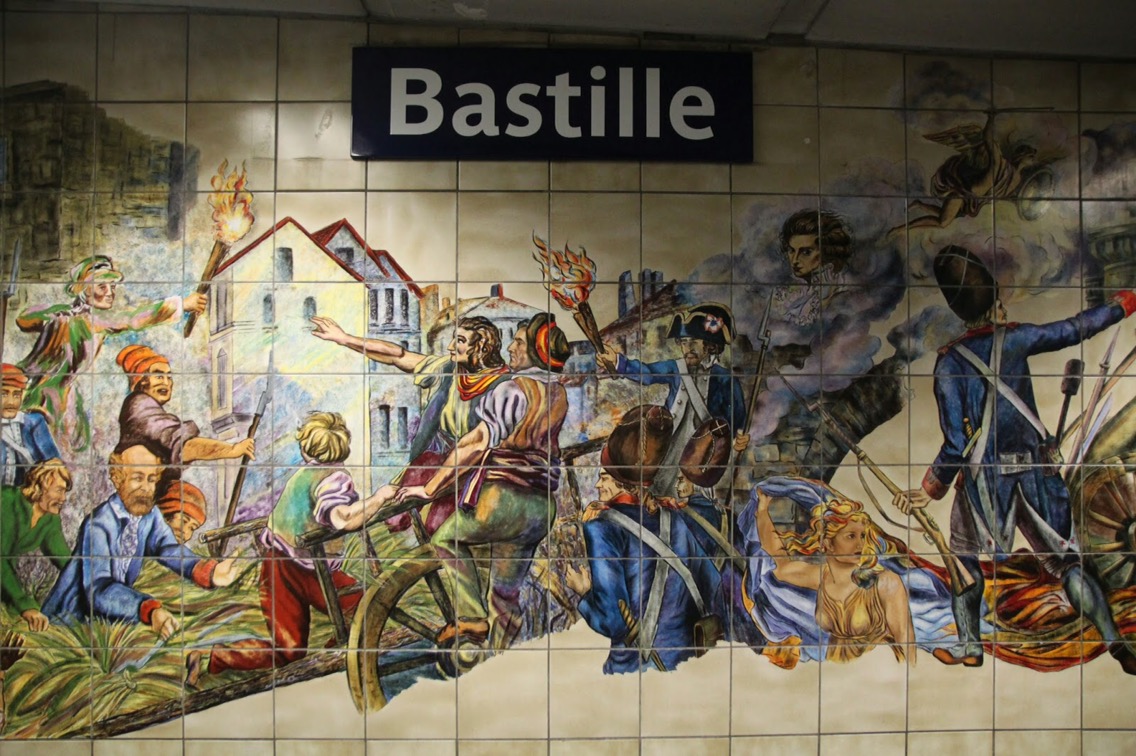
Tous à la Bastille!

Bon 14 juillet

Posted in Uncategorized | Leave a comment

Visualization of the logic of storytelling

Compelling stories all share a similar structure (see image below), even stories as radically different as the simple plot line in the movie Trolls or the complex one in the series Breaking Bad. For more, check out this essay by Cristina Wodtke titled “The Shape of Story.”

Credit: Cristina Wodtke (tip of the hat to Cliff Pickover)

Posted in Uncategorized | Leave a comment

Why did JAY-Z and Beyoncé trademark the names of their children?

Shout out to our student Nathalies Amitie! During this morning’s Summer B lecture, she posed a great question about JAY-Z and Beyoncé’s decision to trademark the names of their newborn twins (Rumi and Sir, for the record). After all, why get a trademark when the common law already creates legal rights to one’s name, likeness, and image? We did some research and found this report by Kenza Moller. According to Ms Miller: “there are legitimate reasons for celebrities to want to trademark their children’s names. In fact, Beyoncé and JAY-Z’s company — BGK Trademark Holdings — didn’t even try trademarking Blue Ivy’s name until a couple of other individuals and companies attempted to do so first. One individual reportedly tried to trademark the name ‘BLUE IVY CARTER NYC’ for a children’s clothing company, while a Long Island company registered ‘BLUE IVY CARTER GLORY IV’ as a name for fragrances.” In other words, Beyonce and JAY-Z may have decided to trademark the names of their children for defensive reasons: to keep other people and firms from trying to profit off of their names.

Image result for jayz beyonce twins

Posted in Uncategorized | Leave a comment

Burdens of proof

The burden of proof is a key feature of legal trials. In brief, in order to secure a conviction in a criminal case or an award of money damages in a civil case, the moving party must produce sufficient evidence or proof that his allegations are true. (In the Anglo-American legal tradition, the burden is “proof beyond a reasonable doubt” in criminal cases, while the “preponderance of the evidence” standard is used in most civil cases.) This concept is relevant to many areas of life beyond law as well. Here is Google Scholar; below is a partial lit review:

J. P. McBaine, Burden of proof: degrees of belief, California Law Review, Vol. 32, No. 3 (1944), pp. 242-268, available here. This law review article contains proposed jury instructions for various burdens of proof (i.e. preponderance of the evidence, clear & convincing proof, and proof beyond a reasonable doubt.

Rita James Simon & Linda Mahan, Quantifying burdens of proof: a view from the bench, the jury, and the classroom, Law & Society Review, Vol. 5, No. 3 (1971), pp. 319-330, available here. This paper presents the results of several experiments conducted on sociology students at the University of Illinois and on judges and jurors in Champaign County Court. Specifically, the researchers attempt to measure how students, judges, and jurors translate legal burdens of proof into numerical probability estimates.

Louis Kaplow, Burden of proof, Yale Law Journal, Vol. 121, No. 4 (2012), pp. 738-859, available here. This book-length “paper” (consisting of 122 pages and 218 footnotes) explores the burden of proof from an economic perspective.

Related image

Posted in Uncategorized | 1 Comment

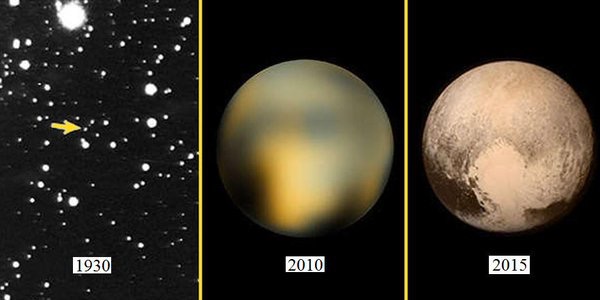
Views of Pluto (1930 to present)

Hat tip: the amazing Cliff Pickover

Posted in Uncategorized | 1 Comment

Twitter: random knowledge generator

As a follow up to a recent series of blog posts by our colleague and friend Eric Posner (see: “Twenty theses about Twitter” and “Twitter is a slot machine composed of humans“), we would argue that Twitter is mostly just a repository of memes and wisecracks. But at the same time, Twitter can be an excellent “random knowledge generator.” In particular, if you are selective and strategic about who (whom?) you follow, then Twitter can be a great place to discover new ideas. By way of example, here are three links we found scrolling down our Twitter feed today (8 July):

1. Modelling fish stocks by Murray Bourne, via @mathematicsprof.

2. Undefined behavior in 2017 by Pascal Cuoq and John Regeher, via @CompSciFact.

3. The myth of the apolitical Montaigne by Robert Minto, via @PhilosophyMttrs.

Image result for twitter meme generator
Posted in Uncategorized | Leave a comment

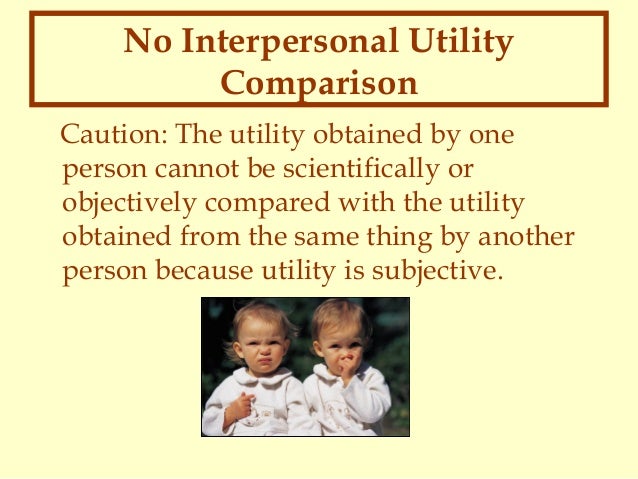
Can we make interpersonal comparisons of utility?

Or to be more precise: can we measure absolute levels of interpersonal utility or just relative differences of utility between individuals? (More fundamentally, what the heck is “utility”?) Either way, these are fundamental questions in theoretical economics, and they have always puzzled us. Depending on how the ultimate question is framed, some economists say yes; most say no. (If economists are right that the answer is no, it would mean that most, if not all, social science studies relying on surveys and other subjective tests are totally bogus. By the way, it was this post regarding the Implicit Association Test that motivated us to pose this question about interpersonal comparisons.) For your reference, here are some assorted links on this question: Eric Angner; Ken Binmore; Peter Hammond; John Harsanyi; Nicholas Kaldor.

Image result for interpersonal comparisons of utility

True or false?

Posted in Uncategorized | Leave a comment

Visualization of the logic of multiplication

Image result for multiplication table the griddle

Credit: David Millar

Posted in Uncategorized | Leave a comment