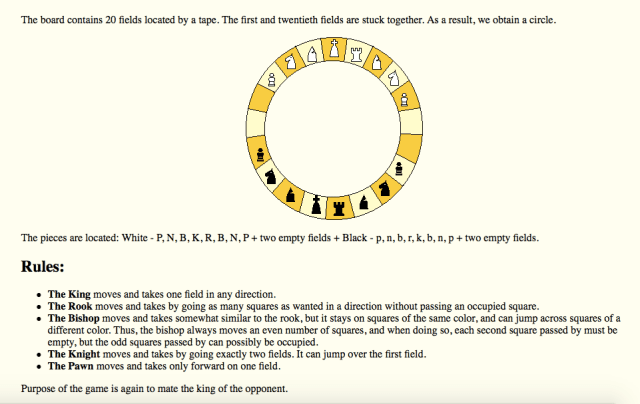
One-dimensional circle chess

screen-shot-2016-09-11-at-11-01-16-pm

Credit: Sergey Sirotkin, via chessvariants.com

Posted in Games, Rules | Leave a comment

Amazon’s first hire

Via kottke, we learned that the first person Jeff Bezos ever hired at Amazon was Shel Kaphan. In this illuminating interview in The Macro, Kaphan describes his first meeting with Bezos and the early days of Amazon.com. Here is an excerpt:

“I wanted to take Books In Print or something like it and make a hypertext version. I’d been thinking about that before I even met Jeff. I wasn’t thinking about it in the context of selling books, but I was thinking, “Man, I hate going to the library and ruffling through those card catalogues and trying to find that thing that I’m looking for.” Nobody alive probably remembers that anymore. You actually had to go through drawers full of index cards to find books you were interested in. Then you’d walk around the library and browse the shelves to see if maybe the thing you’re interested in would be nearby.”

Image result for card catalogue

Remember me?

Posted in Bayesian Reasoning, Economics, History, Questions Rarely Asked | 1 Comment

Visualization of mathematics

Image

Via SoundReading (soundreading.wordpress.com)

Posted in Mathematics | 2 Comments

Necessity as a conjecture (post 5 of 5)

In our previous post (9/6), we referred to the work of legal scholar Giorgio Agamben, and we presented our own pragmatic or “common sense” view of the doctrine of necessity: necessity as a safety valve or gap-filling device for unforeseeable or unexpected situations. Now, in this fifth and final post (for now) in our series on necessity, let’s apply our approach to the Trolley Problem and to Lon Fuller’s “Case of the Speluncean Explorers”–the two hypothetical examples that led us to the common law doctrine of necessity in the first place.

First, notice that our safety-valve or gap-filling view of necessity flows from a contractual, Coasian, or quasi-Rawlsian approach to the Trolley Problem or the Cave Case. We say “Coasian” and “quasi-Rawlsian” because we would dispense with Rawls’s fiction of an “Original Position” and pose a simple contractual conjecture instead. In particular, what would happen if we could bargain over the actual terms and conditions of the necessity rule instead of searching for some magical rule in the sky? By way of example, imagine if all the people in the trolley or cave scenarios–the five explorers who are trapped in Lon Fuller’s cave or all seven actors in the standard version of the trolley problem, i.e. the man next to the switch and the six workmen on the two tracks–could negotiate (either ex ante or even ex post!) the terms and conditions of the necessity rule. What type of necessity rule would they agree to ahead of time?

Secondly, notice, too, what we are not trying to do. We are not trying to figure out the meaning of the word “willful” in Fuller’s murder statute in the cave case; nor are we searching for a single right definition of necessity or for some deep philosophical truth. Rather, all we are trying to do is to make an educated guess. Specifically, we are trying to guess what most people would actually do if they were to find themselves in the trolley hypothetical or in the cave thought-experiment. If most people would pull the lever (in the trolley problem) or throw the dice (in the cave case), then we should allow the doctrine of necessity to work as an excuse or justification in either case. Now, my guess might be totally different than your guess, or our guesses might change over time, but on my safety-valve view of necessity, that’s fine because guessing is the best we can do when different people have different intuitions about right and wrong, about lawful and unlawful behaviors.

Image result for guess

Your guess is as good as mine …

Posted in Ethics, Law, Philosophy | 1 Comment

Necessity: a third view

Note: this is the fourth of five posts on the doctrine of necessity.

In our previous posts (9/1, 9/4, and 9/5), we referred to the work of legal scholar Giorgio Agamben (in particular, his beautiful book State of Exception), and building on his ideas we presented two competing theories of the doctrine of necessity: one narrow; the other broad. Under the narrow view of necessity, this legal doctrine operates as a limited dispensation or ex post exception to law, one that excuses or justifies an illegal act when that act is the lesser of two evils, while under the broad view, the doctrine of necessity is turned on its head. According to the broad view: necessity is the law (i.e. the ultimate ground and original source of law), so all necessary acts are inherently lawful ex ante.

Both of these competing theoretical pictures of necessity, however, are problematic. Generally speaking, the narrow view is too narrow, while the broad view is too broad. Let’s discuss the problems with the narrow view first. If necessity functions as a dispensation (i.e. an excuse or justification), then the “law of necessity” is not (at least not in the literal sense) a legal doctrine–hence the paradoxical maxim “necessity knows no law.” Instead, it is something external to law, operating as an ad hoc and extra-legal exception to law. The broad view, by contrast, is problematic because it is inconsistent with how the doctrine of necessity actually operates in practice. If necessity were the true source of law, for example, then the defense of necessity should operate as a legal trump card in civil and criminal cases. Yet it is the defendant who is always required to plead and prove that he acted in necessity.

Accordingly, here we present a third picture of necessity: necessity as a safety valve or gap filler. All legal systems (and all systems of rules generally) will have unavoidable gaps or blind spots. Consider, for example, H.L.A. Hart’s example (from the 1950s) of a local ordinance prohibiting motor vehicles in the park. A situation may occur that was unforeseeable when the law was first enacted. Does a miniature drone, for example, fall under the definition of a motor vehicle? Or the law in question might be open to multiple or conflicting interpretations, such as the meaning of the word “willful” in the simple murder statute in Lon Fuller’s fictional “Case of the Speluncean Explorers.” (See our blog post of 8/29.) Given that blind spots or gaps are inevitable in law, the doctrine of necessity (like the various rules of equity in common law systems) can be seen as a safety valve or gap-filling device, but one that authorizes judges, police, and even private citizens to literally take the law into their own hands in emergency situations. On this gap-filling or safety-valve view of necessity, we are all law-makers … We will discuss the implications for this third view of necessity in our next blog post (9/7).

Image result for no vehicles in the park
Posted in Ethics, Law, Philosophy | 2 Comments

Necessity as a source of law

Note: this is the third of five posts on the law and morality of necessity.

My wife and I have been watching season 2 of Narcos on Netflix this Labor Day weekend. Narcos revolves mostly around Pablo Escobar, a notorious Colombian drug lord, narco-terrorist, and fugitive from the law. In one episode, after Escobar’s men have ambushed and killed dozens of Colombian police officers in Medellin (Escobar’s hometown), the President of Colombia appoints Colonel Horacio Carrillo (played by Maurice Compte, pictured below) to capture or kill Escobar. Colonel Carrillo, however, resorts to several extra-legal methods in order to accomplish his dangerous and difficult mission. But are his methods really “extra-legal” given the difficulty of his mission or given the dire danger Escobar poses to Carrillo and his men? Once again, then, the dramatic real-life events depicted in the TV series Narcos—like the hypothetical Trolley Problem in moral philosophy and Lon Fuller’s fictional “Case of the Speluncean Explorers” in legal philosophy, both of which we have discussed in a previous post—give us an opportunity to revisit the legal and moral doctrine of necessity.

Previously (9/4), we presented the standard narrow view of necessity. In this post, by contrast, we shall consider an intriguing alternative theory of necessity: necessity as an ex ante and independent source of law. In support of this alternative view, one contemporary jurist, Giorgio Agamben, refers to the ancient legal maxim “necessity knows no law” and to the work of an early 20th Century Italian legal scholar, Santi Romano. In particular, in an obscure law treatise published in 1909, Romano describes necessity as “the first and originary source of all law.” (Agamben, p. 27.) In this way, Romano turns the doctrine of necessity on its head. Rather than creating a limited exception–one that excuses or justifies a particular transgression of law–, necessity instead converts an otherwise unlawful act into a lawful and legitimate one. On this broad ex ante view of necessity, an act done under necessity is an inherently lawful act because “necessity constitutes … the ultimate ground and very source of the law” (Agamben, p. 26) and thus makes lawful what would otherwise be unlawful.

But this alternative theory of necessity raises a new set of difficult theoretical and practical questions. To begin with, in the eloquent words of Agamben (p. 29), necessity creates “a threshold where fact and law seem to become undecidable.” On the one hand, the commission of a particular act is a fact, but on the other, whether the act was done under necessity or not requires a legal (and moral?) judgement. And so, among other things, Agamben asks (p. 29): “If a measure taken out of necessity is already a juridical norm [i.e. a lawful act] and not simply fact, why must it be ratified [ex post] and approved by a law …?” This haunting question (and the apparent contradiction with the broad view of necessity) will lead us to present a third picture of necessity, a theory we shall discuss in our next blog post (9/6).

Image result for narcos series
Posted in Ethics, Law, Philosophy | 4 Comments

Necessity as an ex post exception

Note: this is the second in a series of five posts on the common law doctrine of necessity.

In our previous post (9/1), we presented three general theories of the legal doctrine of necessity. Here, we consider the first of those theories in greater detail: necessity as an ex post exception. First, let’s review the standard legal or common law definition of this doctrine. Briefly, necessity is an affirmative defense (i.e. it must be pled and proved by the defendant) and can work either as an excuse or a justification. (Cf. Suber, 1998, p. 91.) When a defendant invokes necessity as an excuse, he means to say that he lacked the requisite mens rea (i.e. criminal intent) when he acted. A classic example of excuse is the insanity defense (diminished mental capacity) in criminal cases. By contrast, when necessity is invoked as a justification, the defendant is conceding that he intentionally breached a legal duty but that his breach was the lesser of two evils. Classic examples of common law justification are self-defense and defense of others.

In both of these classic defense theories (excuse and justification), the key point is that the doctrine of necessity has the effect of releasing one from legal responsibility. (Cf. Suber, 1998, p. 84.) In other words, although the law as a whole remains in place, necessity (when successfully invoked) authorizes a narrow exception to the law based on the facts of a particular case. Theoretically, this view of necessity—i.e. necessity as a legal exception—is ex post and narrow. Or in the words of one legal scholar (Agamben, 2005, p. 24): “more than rendering the illicit licit, necessity acts here to justify [or excuse] a single, specific case of transgression by means of an exception.”

By way of example, consider the case of the fake bishop, that is, “the case where a person who could not accede to the episcopate [but who] has in fact already been ordained as bishop” (Agamben, p. 26). (This canonical example (pun intended) originally appeared in the work of the jurist Gratian, pictured below.) In this case, the “transgressive deed” or rule-violation has already occurred. So, what is to be done? The Church could either elect to strip the pretender of his position (once the error is discovered) or to ratify the anomaly by leaving things as they are. If the latter option is chosen, the Church is not suspending its rules (i.e. the qualifications necessary for a person to be appointed a bishop in future cases); instead, it is merely making an ex post exception to its rules in this one case. Thus, on this narrow view of the doctrine of necessity, “Necessity … merely releases a particular case from the literal application of the norm.” (Agamben, p. 25.)

In our next blog post (9/5), we shall consider an alternative and more broad theory of necessity: necessity as a source of law.

Image result for gratian jurist

Sources: Giorgio Agamben, State of Exception, University of Chicago Press (2005); Peter Suber, The Case of the Speluncean Explorers: Nine New Opinions, Routledge (1998).

Posted in Ethics, Law, Philosophy, Uncategorized | 1 Comment

Three theories of necessity (Post 1 of 5)

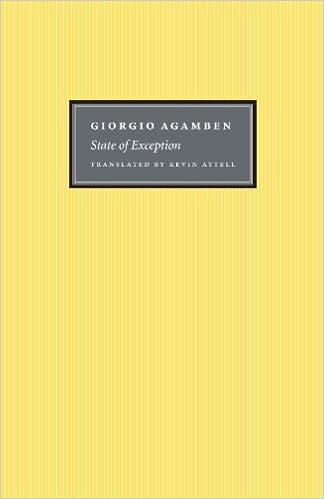
In our previous post, we compared and contrasted the standard version of the Trolley Problem with Lon Fuller’s “Case of Speluncean Explorers.” Another possible commonality between both hypotheticals is the legal theory of necessity. Since both cases involve thought experiments that present life-and-death scenarios in which one life must be sacrificed in order to save four or five lives, why can’t the defense of necessity apply to the facts of either scenario? This critical question, in turn, raises a new set of technical and definitional questions. What is necessity? Is it an excuse or justification? And how broadly or narrowly should we define this legal concept (i.e. where do we draw the proverbial line)? In this post, we shall take a different approach to these questions. Specifically, building on the work of jurist Giorgio Agamben (whose beautiful book “State of Exception” is pictured below), we shall present three different pictures or theories of the concept of necessity. In brief, we can view necessity narrowly as an ex post exception to violations of law, or in the alternative, we can view necessity broadly as an ex ante independent source of law. Thirdly, we can take an intermediary position and view necessity as an all-around utility player or legal gap filler, i.e. a concept that applies only when our sources of positive law (the law on the books) are silent, conflicting, or otherwise vague and ambiguous. Stay tuned … We will elaborate on all three theories of necessity in our next few blog posts.

Image result for state of exception

Posted in Ethics, Law, Uncategorized | 1 Comment

The Law of the Trolley Problem

We recently rediscovered and reread Lon Fuller’s classic “Case of the Speluncean Explorers” (via Peter Suber), and in the process of writing up our own response to Fuller, we noticed a possible parallel between this hypothetical case and the famous “Trolley Problem” in the field of moral philosophy. (There are several variants of the problem (see below); we will refer to the standard version in this post.) By way of background, we summarized the facts of Fuller’s fictional case in a previous post; alternatively, here is a simplified account of the cave case (via Wikipedia):

The case involves five explorers who are caved in following a landslide. They learn via intermittent radio contact that, without food, they are likely to starve to death before they can be rescued. They decide that someone should be killed and eaten so that the others may survive. They decide who should be killed by throwing a pair of dice. After the four [remaining] survivors are rescued, they are charged and found guilty of the murder of the fifth explorer.

By comparison, the trolley problem is a moral dilemma that involves a similar numerical calculus, but instead of five explorers trapped in a cave, there are six hapless workmen (five on one track and one on another) and an innocent bystander standing next to a switch or lever where the track divides into two. We restated the standard version of this moral dilemma in a previous paper; here too is the standard set up of the trolley problem (again, via Wikipedia):

There is a runaway trolley barreling down the railway tracks. Ahead, on the tracks, there are five people tied up and unable to move. The trolley is headed straight for them. You are standing some distance off in the train yard, next to a lever. If you pull this lever, the trolley will switch to a different set of tracks. However, you notice there is one person on the side track. You have two options: (1) Do nothing, and the trolley kills the five people on the main track. (2) Pull the lever, diverting the trolley onto the side track where it will kill one person. Which is the correct choice?

The question we have is this: are the factual differences in both the cave and trolley scenarios morally or legally relevant? In both cases there is an imminent threat or mortal danger to five human lives, and both cases involve sacrifices, but the relevant decision makers are different in each case. In one case, the persons whose own lives are in danger are able to deliberate and ponder their collective fate. Moreover, they initially agree to sacrifice one member of their party through a random mechanism. In the other case, by contrast, someone external to the danger (the person standing next to the lever) has no time to deliberate. He must make a snap decision and that decision (including the decision to do nothing) will result in the loss of either one or five lives.

In short, is the trolley problem relevant to our legal or moral analysis of the case of the explorers? By way of illustration, let’s transpose the trolley problem to Fuller’s fictional land of Newgarth. (Recall the language of the relevant murder statute in Newgarth: “Whoever shall willfully take the life of another shall be punished by death.”) Putting the ethics of the trolley problem aside (assuming it is even possible to separate morality from law), would the person at the switch in the trolley problem be guilty of murder under this statute if he were to divert the trolley onto the side track? Further, does our answer to this question apply or control the result in the case of the explorers?

Trolley problems …

Posted in Ethics, Law, Philosophy | 6 Comments

The fractal nature of law?

Image Credit: F. E. Guerra-Pujol

Posted in Uncategorized | 12 Comments