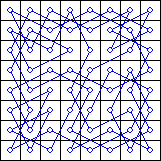
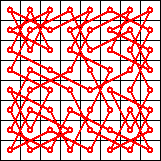
Dmitry Brant solves the knight’s tour problem

According to Wikipedia (emphasis in original; footnote omitted): “A knight’s tour is a sequence of moves of a knight on a chessboard such that the knight visits every square only once. If the knight ends on a square that is one knight’s move from the beginning square (so that it could tour the board again immediately, following the same path), the tour is closed, otherwise it is open.

“The knight’s tour problem is the mathematical problem of finding a knight’s tour. Creating a program to find a knight’s tour is a common problem given to computer science students. Variations of the knight’s tour problem involve chessboards of different sizes than the usual 8 × 8, as well as irregular (non-rectangular) boards.”

Knight’s Tour on an 8×8 board:

Not a Knight’s Tour, but still a solution:

More info here (via DimityBrant.com). Hat tip: Cliff Pickover.

Posted in Mathematics | 3 Comments

Is it too late for Mitt Romney or John Kerry to run as an independent?

Who you got? ‘Crooked Hillary’ or ‘Mein Trumpf’?

Posted in Uncategorized | Leave a comment

The Law of Ideas

“I’m thinking we keep it simple and call it the facebook.”

–Harvard sophomore Mark Zuckerberg, as quoted in Ben Mezrich, The Accidental Billionaires.

When Mark Zuckerberg registered the domain name for “thefacebook” and began building his new website in late 2003 and early 2004 (the original Facebook homepage is pictured below), he was potentially creating several valuable forms of intellectual property. But what type or types of intellectual property was Zuckerberg creating? Accordingly, in our next lecture we will study intellectual property rights or the “law of ideas,” including copyrights and trademarks (Lesson 6) as well as trade secrets (Lesson 7). Specifically, we will explore the relation between these major forms of intellectual property and the launching of the original Facebook website on 4 Feb. 2004.

Bonus IP question: By the way, what do you think about intellectual property rights in tattoos? (My former student Talina Santiago posed this problem to me a few years ago in Ponce, P.R., and her question still resonates with me all these years later.) Specifically, can you copyright a tattoo design, and if so, who would own the legal rights to the tattoo design: the tattoo artist or the person who paid for the tattoo? We will consider the 2011 “Mike Tyson tattoo case” (Whitmill vs. Warner Brothers, Case No. 4:11-cv-752), and try to answer these questions in class. Specifically, we are going to re-enact an informal mediation session in our next class, based loosely on the facts in the actual Mike Tyson tattoo case. In summary, tattoo artist S. Victor Whitmill created a face tattoo for boxer Mike Tyson in 2003. As the creator of this world-famous tattoo, he sued Warner Bros. for using his design in one of its films (The Hangover: Part II) without the artist’s express authorization. (In addition, for this exercise, let’s assume that Mike Tyson is also suing the movie studio on the theory that he, not the artist, owns the legal rights to his face tattoo. After all, it’s his face!) Warner Brothers’ position, of course, is that tattoos cannot be copyrighted.

In real life, this interesting case was settled out of court through mediation, so in our next class, we are going to re-enact this mediation session. Accordingly, we will need several volunteers for this activity:

  • Mike Tyson: Your role is to explain why you own the legal rights to your face tattoo.
  • S. Victor Whitmill (tattoo artist): Your role is to explain why you own the legal rights to Mike Tyson’s face tattoo.
  • Kevin Tsujihara (CEO of Warner Brothers): Your role is to explain why tattoos cannot be copyrighted as a matter of law.
  • The mediator: The class as a whole will play the role of the mediator and will vote on what course of action to recommend to the judge in this case.
Posted in Ethics, Law | Leave a comment

#NextBond

Posted in Bayesian Reasoning, Culture | Leave a comment

Bill Gates’s Summer Syllabus

Posted in Culture | Leave a comment

Is there such a thing as an immoral promise?

Or is an immoral or wicked promise not a real “promise” qua promise at all? In either case, we need to have some reliable method of determining right from wrong, yet most (if not all) theories of promissory obligation fail to distinguish between morally ‘good’ and morally ‘bad’ promises in any systematic manner. Even consequentialist theories are deficient in this regard, since utilitarians are no better at predicting the probabilistic consequences of promise-keeping or promise-breaking than the rest of us are. (Update: we have posted a revised draft of our most recent paper Immoral Promises on SSRN. Our paper was previously titled “illegal promises,” but we have decided (for now) to focus on promises that are malum in se or inherently wrong or wicked.)

Posted in Ethics, Law, Paradoxes, Philosophy | Leave a comment

5-minute flick

Most movies nowadays are just way too long. (Does Captain America, for example, really need to be 2 hours and 27 minutes long?) Here, by contrast, is a wonderful five-minute film (via digg). Tell us what you think …

Posted in Art, Culture | Leave a comment

Imports map

https://i0.wp.com/i.imgur.com/myEkyM1.png

This map (via reddit; h/t Cliff Pickover) shows the origin of each country’s leading import source, or from where each country imports the most.

Posted in Economics, Maps | Leave a comment

Next Lecture: Contracts & Fraud

Part 1 — Contracts (Lessons 3 & 4)

“The Social Network” (the film version of our assigned book “Accidental Billionaires”) depicts an ill-fated promise. After the Winklevoss twins introduce themselves to fellow classmate Mark Zuckerberg, they pitch him their idea for a social network website: the Harvard Connection. In the movie version of these events, Mark tells them “I’m in” without hesitation, and then, in the very next scene(!), we see Mark and his best friend Eduardo Saverin negotiate an informal partnership agreement with the purpose of launching a new rival website (which Mark would eventually christen “thefacebook”). Assuming the veracity of the movie version of these critical events, here is the key question for today’s class: are either of these oral agreements legally binding?

Part 2 — Fraud (Lesson 5)

“Fifty-two emails between Mark, the Winklevosses, and Divya, a half-dozen phone calls—and always, the kid had seemed as thrilled and excited about the project as he had been during that first dinner meeting.”–Ben Mezrich, The Accidental Billionaires, Ch. 12.

In the second half of our next lecture, we are going to re-enact a pre-trial “motion hearing” in the real-life law case of ConnectU versus Facebook (Case No. 04-11923), so we will need several student volunteers for this activity: two co-counsel to represent the Plaintiff (ConnectU, the firm owned by the Winklevoss twins), and two co-counsel who will represent the Defendant (Facebook, Mark Zuckerberg’s firm). In brief, the attorneys for Facebook will present at least two reasons why the Court should dismiss the Plaintiff’s “fraudulent misrepresentation” claim from the Complaint. For their part, the attorneys for ConnectU will provide at least two reasons why the Court should not dismiss the fraud claim. Generally speaking, fraud occurs when one party intentionally deceives another party. So, here is the main question we will discuss in class: even if the informal agreement between Zuckerberg and the Winklevoss twins was not a legally-binding contract, did Zuckerberg commit fraud by allegedly pretending to work on the Harvard Connection website when, in fact, he was really working on his own website?

“The Social Network”

Postscript: In preparation for our next class, we have asked our students to write up a sample contract or “agreement in principle” between Mark Zuckerberg and the Winklevoss twins before coming to class. Our goal in creating this assignment is to put our students in the same position that Mark Zuckerberg, Eduardo Saverin, and the Winklevoss twins found themselves in the fall of 2003.

Posted in Ethics, Law | Leave a comment

Indeterminate chess rules

In the course of writing up our paper on “immoral promises,” we searched for and read the essay “Wicked Promises” by J.E.J. Altham, and in the process of obtaining Altham’s essay, we stumbled upon a short paper by Ian Hacking titled “Rules, scepticism, proof, Wittgenstein.” (Both essays appear in the book Exercises in Analysis, edited by Prof. Hacking. By the way, neither essay is available online. We actually had to go to a library and hunt for a physical copy of this obscure book!) Professor Hacking discusses the problem of indeterminate rules in his essay, a problem that is central to our field (law). To illustrate this problem, Hacking presents the following example of an indeterminate rule from the world of chess–a game may be drawn if the same position on the board occurs thrice–and then asks, what happens if the same position occurs thrice, but with black’s rooks interchanged? In the words of Hacking, two interpretations are possible: “One party says that the game is not drawn, because two positions in the course of the game are identical only if numerically identical pieces are on the same squares. *** The other party says that the game is drawn, because chess is a matter of structure on the board, not the history of the game. One rook is as good as another.” So, how should we decide which interpretation is the correct one?

Glinski’s hexagonal chess.

Posted in Games, Paradoxes, Philosophy, Uncategorized | 2 Comments