Jurisdiction & Ethics (Lessons 8-9)

“This wasn’t right, damn it. This wasn’t fair.”

–Quoted from Ben Mezrich, The Accidental Billionaires.

In our next lecture (2/22), we are going to re-enact another pivotal scene from the movie “The Social Network”–a scene based on chapter 16 of the book Accidental Billionaires. This scene takes place in the spring of 2004 in the office of Larry Summers, the president of Harvard University. Tyler and Cameron Winklevoss have arranged a meeting with President Summers (in real life, they waited in line like everyone else to meet Dr Summers during his monthly office hours) in order to accuse a fellow student (Mark Zuckerberg) of violating Harvard’s Honor Code. So, we will need three volunteers for this in-class activity. In the meantime, please think about the following three questions:

1. In your opinion, did Mark violate the Honor Code?

2. Does Harvard have “jurisdiction” in this matter?

3. If not, what court would have jurisdiction, a State court or a federal one?

In addition to the technical legal issue of jurisdiction, in the second part of our next lecture we are also going to discuss the fundamental problem of personal ethics. Simply put, how do you decide between right and wrong?

don’t be evil = do the right thing?


Posted in Ethics, Law | Leave a comment

tic tac art (or reverse entropy)

TicTac

Image Credit: Adam Hillman

Posted in Art | Leave a comment

17 x 17 x 17 cube

Posted in Games | Leave a comment

Reblog: “Punctuation in novels”

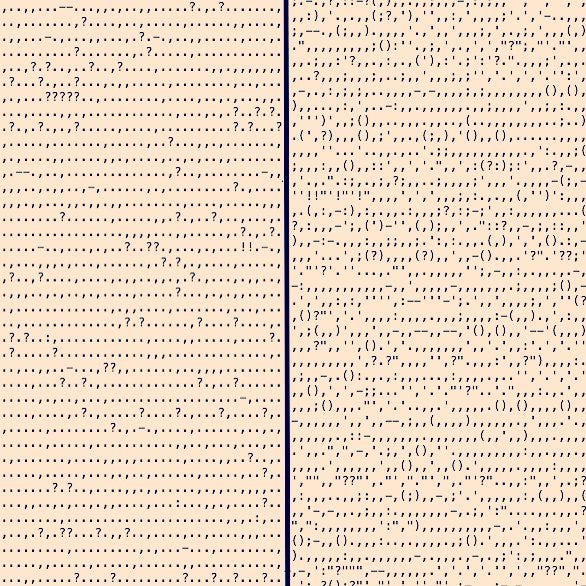
Corrected (2/18): In case you’re wondering, via Adam J. Calhoun this is what two different English-language novels look like if you were to take out all the words and sentences and just leave the punctuation marks behind:

Punctuation in Blood Meridian by Cormac McCarthy (left) and in Absalom, Absalom! by William Faulkner (right). Hat tip: Peak Memory.

Posted in Academia, Art | 1 Comment

Antonin Scalia

We had the honor of meeting the gregarious Antonin Scalia on several occasions during his visit a few years ago to the Pontifical Catholic University in Ponce, Puerto Rico, where we used to teach. At a faculty luncheon in his honor, one of my colleagues (Ruben Nigaglioni, a respected attorney and long-time torts professor) asked Justice Scalia what was the most difficult decision he had ever made as a sitting judge. I will never forget this moment. The room fell quiet as Scalia thought about this question. After a few moments of quiet reflection, Scalia finally answered Boyle v. United Technologies Corporation (a products liability case). He said that his heart told him to rule in favor of the plaintiff, a Marine helicopter pilot who died in a tragic accident caused by a product defect, but his legal reasoning led him to cast the deciding vote in favor of the defendants, the military contractors that had designed and built the defective helicopter. I will never forget this moment (and Scalia’s answer), for it illustrated the enormous chasm that exists between judges and law professors. Law professors get to argue about “hard cases” from the luxury of our Ivory Towers. Judges, however, are the ones who actually have to decide these cases.

Image Credit: Art Lien

Posted in Law | Leave a comment

Valentine’s Day should last all year!

Family = Love

Posted in Culture | Leave a comment

Cause or effect?

Image Credit: F. E. Guerra-Pujol

Posted in Culture, Logical Fallacies | Leave a comment

Final results of the 2015 New Zealand flag referendum

The New Zealand flag referendum was decided using an instant run-off voting procedure. Under this system of preference voting, the voters rank the choices in order of preferred alternatives. Notice how voting occurs over several stages or rounds and how the choice with the fewest number of votes is eliminated during each round. Here is a reddit thread on this particular vote.

Posted in Culture, Voting | 1 Comment

Tree time …

We converted our traditional Christmas tree into an “NFL playoffs tree” after Three Kings’ Day (we completed this makeover while the family was sleeping). Now that the Super Bowl is done, my wife wants me to take down our tree. I, however, want to convert it into a St Valentine’s Tree. Who wins?

Save me!

Posted in Culture, Voting | 1 Comment

A Bayesian Model of “Making a Murderer”

In our previous posts (here and here), we revisited two of our research papers–one on range voting; the other on the Turing Test–and created alternate legal universes in which jury trials were decided using a range voting procedure or some form of Alan Turing’s “imitation game.” In this post, we shall discuss our 2011 peer-reviewed paper “A Bayesian Model of the Litigation Game” published in the European Journal of Legal Studies. Instead of creating an alternate legal universe (like we did in our previous posts), our Bayesian litigation paper models the existing legal system as is, warts and all. Specifically, we developed a Bayesian model of criminal and civil litigation, a model that is relevant to the central question posed in “making a Murderer”: how confident are you in Steven Avery’s guilt? Our Bayesian model includes a scenario in which the outcome of a trial is purely random (like a coin toss) and in which the moving party is “risk-loving” (i.e. in which the prosecutor is only 60% confident the defendant is guilty). Unfortunately for Mr Avery, the surprising result about our Bayesian model is that even in this random, risk-loving scenario, the posterior probability that the defendant is, in fact, guilty is pretty high.

Painting by S. Uchii

Posted in Current Affairs, Justice, Law | Leave a comment