“Syllabus of the month”

That is a new feature from the Open Syllabus Project, an online database of university syllabi. (What a great idea, by the way!) Last month’s featured syllabus, which is just one page long (!!!), is for Professor Kieran Healy’s graduate-level course “Social Theory Through Complaining.” (Dr Healy teaches sociology at Duke.) Here is the course description:

This course is an intensive introduction to some main themes in social theory. It is required of first-year Ph.D. students in the sociology department. Each week we will focus on something grad students complain about when they are forced to take theory. You are required to attend under protest, write a paper that’s a total waste of your time, and complain constantly. Passive-aggressive silence will not be sufficient for credit.

I think we would ace this course!

Posted in Academia | 4 Comments

Different surfaces have different n-color map theorems

Via Cliff Pickover’s entertaining and educational Twitter timeline, we discovered this beautiful essay by Evelyn Lamb, a promising postdoc at the University of Utah. Dr Lamb describes the fascinating and paradoxical topology of a strange surface–the Möbius strip–a surface with only one side and only one boundary. Among many other things we did not know is this: “You may have heard of the four-color theorem: any map can be colored using four distinct colors so that no bordering countries share a color. This theorem is not quite true as stated. We need to specify that the map is on a sphere or plane. Different surfaces have different ___-color map theorems, and for the Möbius strip, it’s the six-color map theorem.” Bravo!

Credit: Evelyn Lamb

Posted in Mathematics | Leave a comment

Randomness and the Iowa Caucus

For reasons that are obscure to us, the State of Iowa holds the first presidential primary in the nation every four years. (Shouldn’t the first presidential primary vote be allocated at random to a different State every four years?) This year, the Iowa Caucus took place on 1 February 2016. Aside from the outcome of the caucuses, it is also being reported (see here, for example) that a total of six “county delegates” were allocated to Hillary Clinton by six separate coin tosses and that Secretary Clinton won all six coin tosses! Although such an outcome appears highly improbable, since there is only a 1-in-64 (or a 1.56%) chance of all six coin flips going Clinton’s way, scientist Ethan Siegel explains in this informative essay that the true probability of one candidate winning all six coin tosses is in reality 3.12%:

Sure, there might have only been a 1.56% chance that Clinton would win all six, but those odds aren’t all that long, especially when you consider that there’s also a 1.56% chance that Sanders could’ve won all six, for a total chance of 3.12% that someone would have won all six. Three percent may not be a lot, but it’s not that small either: if you had a three percent chance of getting run over the next time you crossed the street, you just might think twice before doing so.

More importantly, while we’re on the subject of randomness, the voters in Iowa have a pretty bad track record at predicting the eventual nominee (sorry, Senator Cruz). According to Wikipedia (emphasis added), “Since 1972, the Iowa caucuses have had a 43% success rate at predicting which Democratic candidate … and a 50% success rate at predicting which Republican candidate … will go on to win the nomination of their political party [for president] …” In other words, with respect to the Republican candidates, the results of the Iowa caucuses are historically no better than random, like a coin toss! And with respect to the Democratic candidates, in a two-man race you’d have a better chance of predicting the eventual nominee by flipping a coin.

Image credit: Ethan Siegel, using MS Excel.

Posted in Politics, Probability | Leave a comment

Bargaining and Betrayal in Breaking Bad

Last fall, we posted the abstract to our work-in-progress titled “Breaking Bad and the Natural Law Tradition.” Originally, we were going to write about the conflict between meth kingpin Walter White (alias Heisenberg) and DEA agent Hank Schrader from a natural law perspective, but since then, we re-discovered a bargaining game known as “So Long Sucker” and have thus become captivated by two central themes that permeate every episode of Breaking Bad: the themes of bargaining and betrayal. We have since written up a 7000-word paper exploring these themes in greater detail. (You can read the first draft of our paper on SSRN.) In the meantime, here is our new abstract:

This short paper explores a number of commonalities between the bargaining game “So Long Sucker” and the critically acclaimed TV series Breaking Bad. In brief, “So Long Sucker” has been variously described as “a dog-eat-dog world” (Anatol Rapoport), “vicious” (William Poundstone), “anti-chess” (D. Graham Burnett), and “fiendish” (Peter Tannenbaum). That these dire terms equally describe the meth underworld as depicted in Breaking Bad is no coincidence, for the game “So Long Sucker” and the meth trade in Breaking Bad both share a number of commonalities. In both worlds agreements are unenforceable; double crosses, recurrent; victory, elusive. Moreover, these commonalities raise deeper questions about the nature of morality in a “society of ruffians” (see, e.g., David Hume), questions we explore in the conclusion of this paper.

Posted in Culture, Ethics, Game Theory, Games, Law | 1 Comment

An offer he could not refuse (Lessons 3 & 4)

Because our business law class meets only once per week, we are combining Lessons 3 & 4 into a single lecture. As it happens, both business law lessons have something important in common: contracts. In the film “The Social Network” (the movie version of our assigned book “Accidental Billionaires”), after the Winklevoss twins (pictured below) introduce themselves to fellow classmate Mark Zuckerberg and pitch him their idea for a social network website, Mark tells them “I’m in” without hesitation, and then, in the very next scene(!), we see Mark and his best friend Eduardo Saverin negotiate an informal partnership agreement with the purpose of launching a new rival website (which Mark would eventually christen “thefacebook”). Assuming the veracity of the movie version of these critical events, here is the key question for today’s class: are either of these oral agreements legally binding?

Postscript: In preparation for today’s class (Feb. 1st), we have asked our students to write up a sample contract or “agreement in principle” between Zuckerberg and the Winklevoss twins before coming to class. Our goal in creating this assignment (and in making it due before today’s contracts class), is to put our students in the same position that Mark Zuckerberg, Eduardo Saverin, and the Winklevoss twins found themselves in the fall of 2003.

You don’t say?

Posted in Uncategorized | 1 Comment

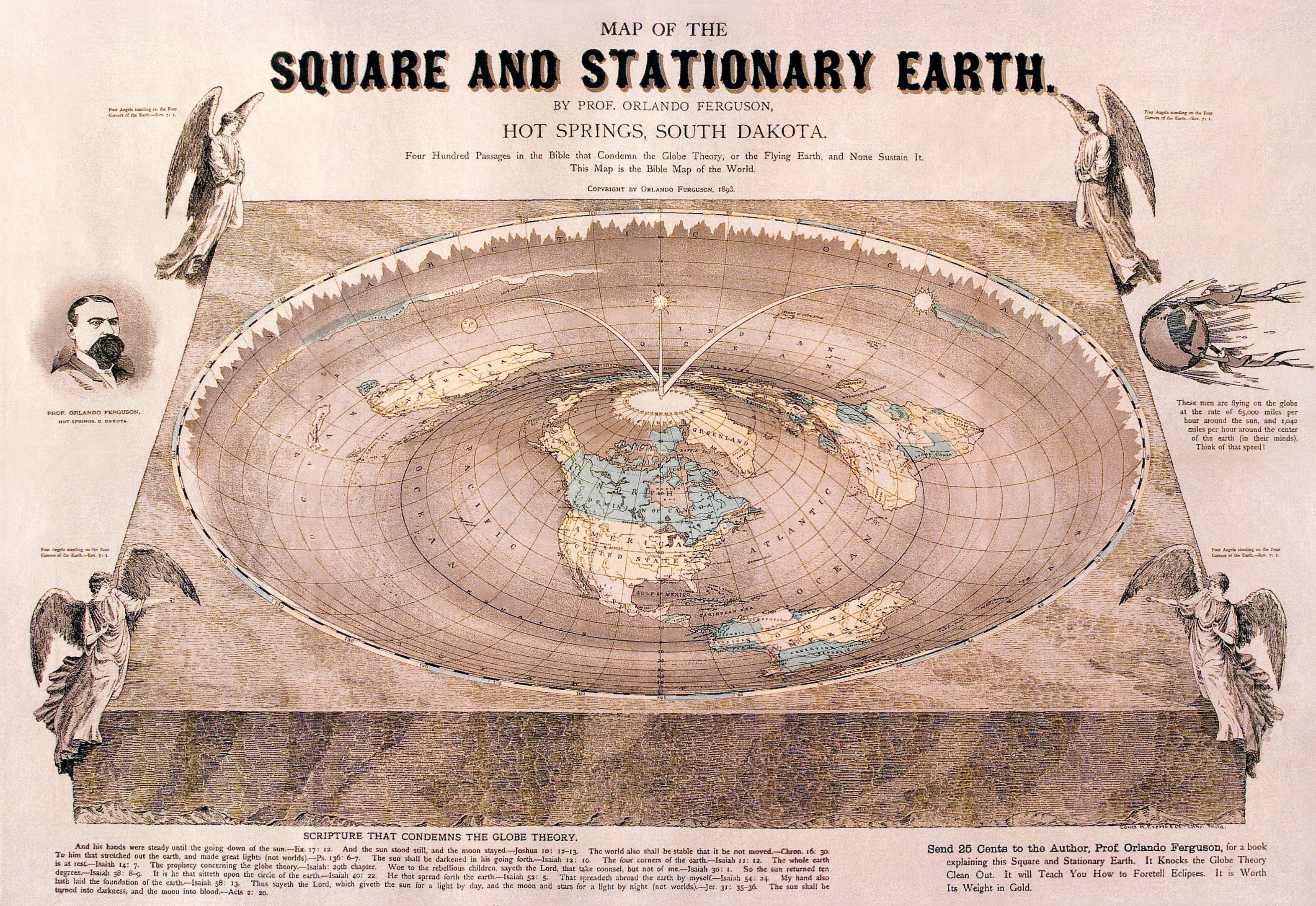
Flat-Earth map (circa 1892)

This is what the one particular flat-Earth paradigm looks like … Any questions?

Posted in Maps | Leave a comment

Where did the “I’m feeling lucky” option go?

Can you solve the case of the missing “I’m feeling lucky” feature? For starters, check out this screenshot taken from our iPhone 5 earlier in the day (Jan. 30, 2016):

Did you notice that the “I’m feeling lucky” feature on Google search is gone? Where did it go? More to the point, did you ever–even once–use this option? (We never used it either!)

Posted in Uncategorized | Leave a comment

Theoretical and empirical analysis of airline boarding

We understand why so-called “security” checkpoints at airports are so slow and horribly inefficient? But why are airline boarding procedures (which are implemented by the for-profit private sector) so slow and horribly inefficient? This short video (it’s only two and one-half minutes long) explains why.

Posted in Uncategorized | Leave a comment

Target practice?

Posted in Uncategorized | Leave a comment

Cartoon family resemblance

 Via kottke, check out this crazy table of cartoon characters drawn by artist Jaakko Seppälä. The diagonal from top left to bottom right (shaded gray) portrays a variety of familiar cartoon characters; the rows contain re-interpretations of these characters based on the cartoon styles of the cartoons in the shaded area in each column. Genius!

Posted in Uncategorized | 2 Comments