The Law of Agency (Lesson 13)

Because of the ubiquity of principal-agent relationships in the business world, we will spend an entire lecture on the law of agency in our next class (3/21).

Although we have been focusing mostly on the founding of Facebook this semester, let’s take a “time out” from Facebook, and let’s instead consider the fictional world of secret agent 007 James Bond. In legal terms, Mr Bond works for the British secret intelligence service, known as “MI6” for short. Mr Bond is thus the AGENT, while MI6 is the PRINCIPAL. Whenever we see a principal-agent relationship, an important legal question that often arises is this: When is the principal legally liable for the acts committed by its agents? Under the legal doctrine of respondeat superior, the answer depends in large part on whether the principal’s agents are employees or whether they are independent contractors.

Consider, by way of example, the opening car chase sequence in the film “Skyfall,” in which James Bond and fellow secret agent Eve Moneypenny chase some bad guys and appear to cause various property torts against merchants of the Grand Bazaar, a huge market located in Istanbul, Turkey (a map of which is pictured below), where this car chase sequence takes place. Now, let’s imagine what would happen if the owner of the Grand Bazaar were to sue MI6 in tort for the negligent acts of MI6’s agents James Bond and Eve Moneypenny. Would MI6 be legally liable under the law of agency — specifically, under the doctrine of respondeat superior — for the property damage caused by secret agents Bond and Moneypenny in the course of their mission?

To answer this question, we will re-enact a hypothetical legal proceeding in our next class: Grand Bazaar vs. MI6. We will need several student volunteers for this in-class assignment:

  1.  Barrister-at-law* for the Grand Bazaar: Your mission, should you decide to accept it, is to argue why MI6, the principal, is legally liable for the torts (property damage) caused by its secret agents James Bond and Eve Moneypenny during the car chase scene in the Grand Bazaar.
  2. Barrister-at-law* for MI6: Your mission is to argue why MI6, the principal, is not legally liable for the tortious act of its secret agents James Bond and Eve Moneypenny.
  3. Barrister-at-law* for the secret agents: Your mission is to argue why your clients James Bond and Eve Moneypenny did not commit any torts, i.e. are not themselves directly responsible for the property damage that occurred during the car chase.
  4. The Jury: The class as a whole will play the role of the jury.
[*] Note: A barrister is how a trial lawyer is referred to in England.
Posted in Law | Leave a comment

Lego art (Dome of the Rock edition)

From Wikipedia (footnotes omitted): “The Dome of the Rock — Arabic: قبة الصخرة‎ (transliteration: Qubbat Al-Sakhrah), Hebrew: כיפת הסלע‎ (transliteration: Kipat Hasela) — is a shrine located on the Temple Mount in the Old City of Jerusalem … [It] is now one of the oldest works of Islamic architecture [and] has been called ‘Jerusalem’s most recognizable landmark’ * * * The site’s significance stems from religious traditions regarding the rock, known as the Foundation Stone, at its heart, which bears great significance for Jews and Muslims.”

Posted in Art, Culture, History | Leave a comment

Classroom primary

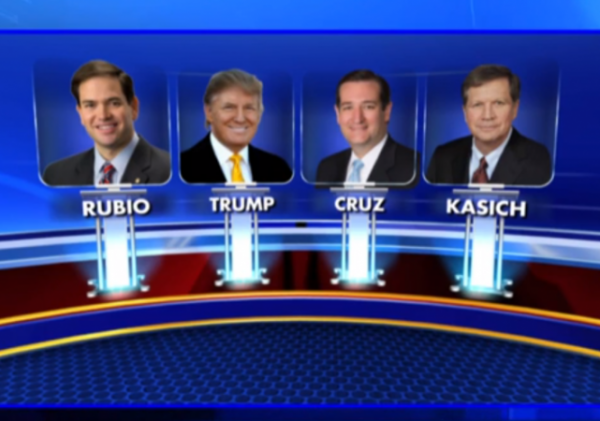
We teach a large business law and ethics lecture (n = 750) at a research university in Central Florida, and on Monday (3.14), we conducted an informal poll (via REEF polling) to see which candidates on the Republican side our students would vote for. The choices were as follows:

(A) Marco Rubio

(B) Donald Trump

(C) Ted Cruz

(D) John Kasich

(E) None of the above

Guess which choice won the most votes?

Yup … (E)

Posted in Current Affairs, Politics | Leave a comment

“Robots in American Law”

That is the title of this paper by Ryan Calo. Here is an excerpt from the abstract of the paper: “This article closely examines a half century of case law involving robots … Most of the cases involving robots have never found their way into legal scholarship. And yet, taken collectively, these cases reveal much about the assumptions and limitations of our legal system. Robots blur the line between people and instrument, for instance, and faulty notions about robots lead jurists to questionable or contradictory results. *** The article concludes that jurists on the whole possess poor, increasingly outdated views about robots and hence will not be well positioned to address the novel challenges they continue to pose.” We can’t wait to read the full article, and we will report back soon. For now, however, we pose a simple question: what happens when artificial intelligence is applied to fields like law and to legal reasoning generally?

What happens when robots can think?

Posted in Uncategorized | Leave a comment

Pi art

Happy Pi Day! Image Credit: David Reimann

Posted in Art, Mathematics | 1 Comment

Coffee cup art

Coffee Cups
Via Gear Patrol, check out this beautiful collection of NYC disposable coffee cups; hat tip: kotkke.
Posted in Art, Culture | Leave a comment

“thefacebook LLC” and first-movers (Lessons 11 & 12)

“Tyler … knew all about the business concept of ‘first-mover advantage’ … For certain industries, it wasn’t about the quality of product or even corporate strategy. It was about who got there first.”

–Ben Mezrich, Accidental Billionaires (Ch. 20)

In our next two lectures (10/20 & 10/25), we will explore two important business law questions: one specific; the other general. First, we will focus on Facebook’s formal legal structure as a company. Specifically, why did Facebook become a “Limited Liability Company” or LLC in April of 2004? (See Lesson 11 of our Case Study for a copy of Facebook’s original “Articles of Organization.”)

Secondly, we will study the general strategic concept of “first-mover advantage” and apply this important idea to business litigation. Generally speaking, is there a first-mover advantage in business litigation? (If you have time, check out this article by Fernando Suarez and Gianvitto Lanzolla in the Harvard Business Review explaining the idea of first-mover advantage in business. See also Lesson 12 of our Case Study for a copy of the original complaint in ConnectU v. Facebook.)

Lastly, since we are using the founding and growth of Facebook as an in-depth case study to explore the legal and ethical environments of business, we will also re-enact a crucial scene from the movie “The Social Network” on Tuesday, Oct. 25th. This particular scene occurs overseas in the beautiful village of Henley-on-Thames in England (see image below) and involves many characters, including a member of Monaco’s Royal Family (Prince Albert), so we will need at least 6 volunteers for our next class.


Posted in Law | Leave a comment

Promises, promises (Epilogue)

We wrote up a four-part series on the problem of promises (specifically, why is it morally wrong to break a promise?), using a recent episode from the world of politics to explore the moral foundations of promises. In particular, we saw how Marco Rubio, Ted Cruz, and John Kasich offered radically different reasons–ranging from Rubio’s consequentialism (“we must defeat Hillary Clinton“) to Cruz’s virtue ethics (“I gave my word“) to Kasich’s Kantian reciprocity (“you want to respect the people that you’re in the arena with“)–explaining their individual pledges to support the eventual nominee of their party, even if the nominee were Donald Trump. But, so what? What’s the point of exploring the moral foundations of promises? To answer this question, we’ve decided to write this epilogue, and we’ve decided to pose a new question: which candidate is least likely to break his pledge to support Trump if he (Trump) were to win the nomination?

Let’s start with Senator Rubio. Since his promise is based on consequential reasoning, there is no guarantee that he won’t simply change his mind down the road about Trump being the “lesser evil” than either Clinton or Sanders. So much for Rubio. What about Senator Cruz, who gave his solemn word to support the eventual nominee? Well, what happens when one minor promise conflicts with another more major promise? After all, Cruz has also given his word to support the true conservative cause, so we could easily see Cruz renouncing his promise to support Trump if that promise conflicts with his previous promise to defend the conservative cause. Now, let’s conclude with Governor Kasich. We may be wrong about this, but in our view, because his promise to support Trump is grounded in Kantian reciprocity and respect, Kasich is the least likely man to break his pledge, for he would not only be harming the promissee or recipient of his promise if he were to go back on his word; he would also be harming himself.

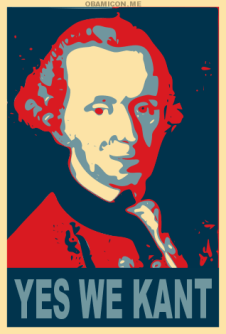
A true Kantian?

Posted in Philosophy | Leave a comment

Promises, promises (part 4 of 4)

Note: this is the last post of this four-part series.

Our previous posts in this series have explored the moral foundations of promissory obligations. Furthermore, instead of investigating this important philosophical puzzle in the abstract, we have turned our attention to the rough-and-tumble world of politics, since all three of Donald Trump’s remaining Republican rivals (Marco Rubio, Ted Cruz, and John Kasich) recently reiterated their solemn pledge to support Trump if he (Trump) were to win their party’s nomination. Thus far in this series, we compared and contrasted the competing reasons offered by Senators Marco Rubio (consequentialism) and Ted Cruz (natural law theory) for keeping their promise to Trump. Today, we will focus on Governor John Kasich, who offered this powerful Kantian argument in defense of keeping his pledge:

 “And, yeah, look, when you’re in the arena, and we’re in the arena, … we’re traveling, we’re working, we spend time away from our family, when you’re in the arena, you enter a special circle. And you want to respect the people that you’re in the arena with. So if he ends up as the nominee — sometimes, he makes it a little bit hard — but, you know, I will support whoever is the Republican nominee for president.”

In other words, Governor Kasich’s promise-keeping rationale is based on Kantian or rational ethics. According to the great German philosopher Immanuel Kant, it is immoral to use another person merely as a means to an end; people must be treated as ends in themselves. Governor Kasich’s elegant and humorous answer to the Trump question affirms this Kantian sentiment.

But what does it mean to treat people as ends? In brief, Kant argued that moral duties–duties like telling the truth and keeping one’s promises–are based on universal rules or “the categorical imperative.” Specifically, moral duties must at a minimum meet two fundamental conditions: consistency (i.e. the rule must treat like cases alike) and reversibility (one must abide by the same rules one uses to judge the morality of other persons’ conduct).

Both of these fundamental conditions not only apply to the general moral duty of keeping one’s promises; they also appear to apply to the specific political pledge made by the Republican presidential candidates to support their party’s eventual nominee. In short, if Trump’s rivals want Trump to support the eventual nominee, then they too have to be willing to support Trump if he wins the nomination this summer.

Posted in Philosophy | 1 Comment

Promises, promises (part 3 of 4)

Note: this is the third post in a four-part series.

In our previous blog posts, we saw how Donald Trump’s remaining Republican rivals (Rubio, Cruz, and Kasich) have all pledged to support the eventual nominee of their party, even if the dreaded Trump were to win the nomination. We also focused on Rubio’s pragmatic rationale for making his promise–e.g. Trump is better than his most likely rival Hillary Clinton–and we offered two criticisms of Rubio’s reasoning. Today, let’s focus on Senator Cruz’s rationale for promising to support his party’s eventual nominee.

To begin with, here is the exact question Fox News reporter Brett Baier posed to Ted Cruz: “Senator Cruz, yes or no, will you support Donald Trump if he’s the nomimee?,” and here is Cruz’s concise and eloquent response: “Yes, because I gave my word that I would, and what I have endeavored to do every day in the Senate is do what I said I would do.”

Unlike Senator Rubio’s pragmatic reasoning, Senator Cruz’s competing reason for keeping his promises is grounded in the natural law or “virtue ethics” tradition. According to this traditional theory, when we voluntarily make a promise, we are duty-bound to keep our word. This “voluntary duty argument” makes intuitive sense, but there is a logical weakness with this argument when we examine it closely. In a word, the problem with the duty argument is that it is circular. That is, Cruz is essentially saying that he will keep his promise to Trump because he (Cruz) promised to do so!

Furthermore, in the words of one philosopher (Allen Habib), “The idea that we simply manufacture promissory obligations by speaking them, like an incantation, is decidedly mysterious.” In fact, this critique goes back to our favorite philosopher and intellectual hero David Hume, who wrote (emphasis in original):

“… since every new promise imposes a new obligation of morality on the person who promises, and since this new obligation arises from [the promissor’s] will, it is one of the most mysterious and incomprehensible operations that can possibly be imagined, and may even be compared to transubstantiation of holy orders, where a certain form of words, along with a certain intention, changes entirely the nature of an external object, and even of a human creature.”

In our view, no one has provided a persuasive reply to Hume’s devastating critique of the traditional natural law theory of promises, except maybe the great Immanuel Kant, so in our next post, we will conclude this series with John Kasich’s Kantian reasoning in support of keeping his promise …

Posted in Philosophy | 2 Comments