Promises, promises (part 2 of 4)

Note: this is the second post of a four-part series.

In our previous blog post, we mentioned how Marco Rubio, Ted Cruz, and John Kasich recently reiterated their solemn pledge to support the eventual nominee of their party, even if the nominee were Donald Trump. In addition, we saw how Trump’s three remaining rivals offered radically different moral reasons in support of their promise. In this post, we will focus on Senator Rubio’s consequentialist or utilitarian reasoning in particular. To begin with, here is Rubio’s reasoning in his own words:

“I’ll support Donald if he’s the Republican nominee, and let me tell you why. Because the Democrats have two people left in the race. One of them is a socialist. America doesn’t want to be a socialist country. If you want to be a socialist country, then move to a socialist country. The other one is under FBI investigation, and not only is she under FBI investigation, she lied to the families of the victims of Benghazi, and anyone who lies to the families of victims who lost their lives in the service of our country can never be the commander-in-chief of the United States.”

In other words, Rubio’s promise to support Trump is a pragmatic one: however despicable Trump might actually be (a “con man” and a “liar” according to Rubio himself), once we consider and weigh the even worse Democratic alternatives to Trump, then we should support Trump because he is still preferable to Senator Sanders or Secretary Clinton. Okay, now that we have restated Rubio’s reasoning, we must ask, is it sound? Unfortunately for Rubio, we don’t think so.

In brief, there are two fundamental flaws with Rubio’s pragmatic and consequentialist reasoning. (1) One problem with pragmatism is that it is totally unprincipled, like most utilitarian reasoning generally. For instance, if one could somehow persuade Senator Rubio that either Sanders or Clinton were, in reality, preferable to Trump, Rubio would then be morally justified in breaking his solemn promise to support his party’s nominee. (2) The other problem with pragmatism or consequentialism is the problem of measurement. In this particular case, for example, how do we really know whether Sanders or Clinton would be worse than Trump? The relative merits of these candidates is not only a matter of subjective opinion; we will never really know who the “best” man (or woman!) for office is because only one of them can win come November!

Image credit: Sahar Shehata
 

Posted in Philosophy | 3 Comments

Promises, promises

Note: This is the first post of a four-part series on the theme of promissory obligations.

During the summer of 2015, all the main Republican presidential candidates took a solemn pledge to support the eventual nominee of their party. Although such a political pledge does not appear to be legally binding, most people would agree that it is morally wrongful to not keep one’s promises. But why? Now, let’s fast forward to the most recent Republican debate–here is an anotated transcript via the Washington Post–which took place in Detroit on March 3, 2016. At the end of this debate, Fox News anchorman Brett Baier asked Donald Trump’s three remaining challengers (Marco Rubio, Ted Cruz, and John Kasich) this question:

“Gentlemen, this is the last question of the night. It has been a long time since our first debate, seven months ago in Cleveland. A lot has transpired since then, obviously, including an RNC pledge that all of you signed agreeing to support the party’s nominee and not to launch an independent run. Tonight, in 30 seconds, can you definitively say you will support the Republican nominee, even if that nominee is Donald J. Trump?”

All three candidates promised to honor their promise—to support Mr Trump if he were to win the nomination next summer—but interestingly, they offered radically different moral reasons in support of their pledge, including consequentialism (Rubio), virtue ethics (Cruz), and Kantian reciprocity (Kasich).

  • Senator Rubio, for starters, said he would support Donald Trump in the end because Trump, even with all his faults, was still a better choice than the two remaining Democratic choices, Senator Bernie Sanders and Secretary of State Hillary Clinton. In other words, Rubio offered a consequentialist or utilitarian reason for keeping his promise: Trump is less bad than the other alternatives.
  • In contrast to Rubio’s consequentialist claim, Senator Cruz offered an aretaic or virtue-ethics rationale for keeping his promise to support the nominee. Specifically, Cruz said he would support Trump if he won because “I gave my word that I would.” In other words, a virtuous man is one who keeps his word.
  • For his part, Governor Kasich offered a deontological or duty-based reason for keeping his promise. He said, “when you’re in the [political] arena, you enter a special circle, and you want to respect the people that you’re in the arena with.” This statement is consistent with Kantian ethics, which requires one to treat one’s rivals with equal dignity–as ends and not as means.
Posted in Philosophy | 3 Comments

“Spotlight”

Here is our review:

Although this film is ostensibly about a team of journalists at the Boston Globe who exposed corruption at the highest levels of Boston’s Catholic Church, it’s also about the law and about lawyers. Interestingly, lawyers are both the villains and the heroes of this remarkable story: (i) the villains who defended scores of corrupt priests and helped cover up their evil misdeeds by negotiating secret out-of-court settlements with victims; (ii) the heroes who represented the victims and fought on their behalf in open court, refusing to negotiate secret back-room deals with the Church.

Moreover, one of the most momentous turns in this story does not occur in a press room; it occurs in a courtroom, when lawyers for the Globe present a motion requesting the release of sealed documents that would expose to the world the Church’s immoral cover-up. The judge who rules for the press and unseals the documents is Constance Sweeney. Without her ruling or the persistence of some of the lawyers for the victims, there would probably be no front-page story. As such, we wish to echo film critic Richard Brody’s sentiments. He wrote last fall, “As I watched the movie, I was utterly frustrated—I wanted the camera to be a fly on the wall in Judge Sweeney’s chambers as she discussed the case with her law clerk, or perhaps with a colleague, so that her reasoning would become part of the film. No such luck; the ruling is delivered, and the journalists get back to work.”

Give the lawyers some credit (and blame) too …


Posted in Culture, Law | Leave a comment

Gradient vector flow snakes!

In addition to this short film clip illustrating a “flow snake,” you can read more about this beautiful mathematical/fractal pattern in this formal paper by Alejandro Cartas-Ayala.

Posted in Mathematics | Leave a comment

Taxonomy of colors

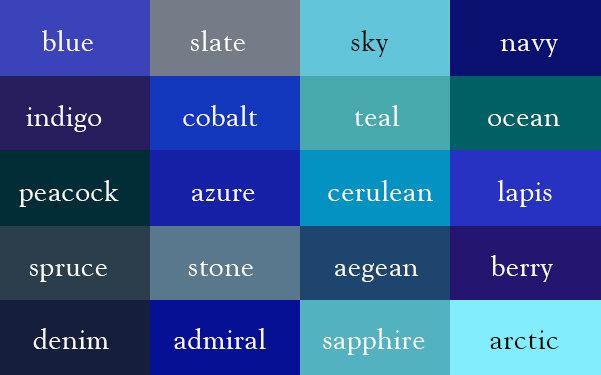
Blue

Via kottke, we discovered this Color Thesaurus created by designer and author Ingrid Sundberg. Ms Sundberg’s original and beautiful “color thesaurus” provides a taxonomy or breakdown of all the shades of color within each major primary color group, including white, yellow, orange, red, purple, blue (pictured above), green, brown, and black, among others.

Posted in Art, Culture | Leave a comment

How many squares (of all sizes) are on a chess board?

Posted in Mathematics | Leave a comment

Espresso art

Artist credit: Giulia Bernardelli

Posted in Art, Culture | Leave a comment

Should Marco Rubio or Ted Cruz drop out? (Republican Primary Prisoner’s Dilemma)

Our friend and colleague Steve Landsburg makes the following two observations on his blog: (i) “for either Ted Cruz or Marco Rubio to become the Republican nominee, he must first consolidate the anti-Trump vote, which is to say that either can succeed only if the other drops out,” and (ii) “Cruz and Rubio have approximately equal chances of driving each other out” between now and the last primary. Given these premises, Professor Landsburg then proposes that Cruz and Rubio toss a fair coin to determine which man should drop out of the race. According to Landsburg (emphasis in original): “This [a coin toss] gives each of them only a 50% chance of survival. But if they’ve already each got only a 50% chance of survival, that’s no loss. And it substantially increases the value of survival, because it gets things over with now instead of a month from now.”

For our part, we like Landsburg’s proposal, but here is why we think neither Cruz nor Rubio will ever agree to let a coin decide their political fates. In brief, they are locked in a political version of the famous prisoner’s dilemma: both would be better off cooperating (i.e. agreeing to the coin toss), but the logic of defection (i.e. “I stay in; the other guy drops out”) results in mutual defection (both stay in and both lose).

Update (3/2): Ken B writes that our prisoner’s dilemma analogy does not apply here because Senators Cruz and Rubio “are not in a one time game [;] they have careers and future elections.” Ken B makes a good point. In our democracy, elections are really more like an iterated or repeat game since there are presidential elections every four years. But we think Ken B is wrong in this particular case because of the inherent uncertainty in future election cycles. Furthermore, unlike Kasich and Carson, both Cruz and Rubio are serious contenders, and both want to win their party’s nomination in this election cycle. As a result, this year’s election is for all practical purposes a one time game. Lastly, we would add that the payoff for mutual defection will occur very soon (i.e. both Cruz and Rubio will lose to Trump), as it now appears that Trump will wrap up the nomination in a matter of weeks unless either Cruz or Rubio drops out.

TCMR

Which one should drop out?


Posted in Cooperation, Politics, Probability | Leave a comment

Game theory: the way forward? (part 3 of 3)

In our previous two posts, we identified a blind spot in the work of John Rawls and Bob Nozick: the problem of betrayal–what game theorists call “defection.” In brief, Rawls’s original agreement might embody timeless principles of justice, and Nozick’s private protection groups might be the first step towards his political utopia, but in both cases, there is nothing stopping people from repudiating their mutual promises or double-crossing each other. What is the way forward, then?

Game theory offers some possible solutions to this trust dilemma. Even in the case of the deservedly famous Prisoner’s Dilemma, where fear of the dreaded “Sucker’s Payoff” leads the prisoners to betray each other (see below), Robert Axelrod and the late Bill Hamilton identified the conditions in which cooperation might yet still be possible: iteration (i.e. playing the game more than once) and uncertainty as to when the last round of the game will occur. But there is also a major blind spot with Axelrod and Hamilton’s work and with game theory generally. In addition to our two prisoners, game theorists silently assume a third player: a judge or strongman who is able to distribute the payoffs of the prisoner’s game and enforce its rules. But who is this secret third actor or deus ex machina? Where does he come from? Why should the prisoners pay him any heed?

In short, overcoming the problem of betrayal/defection–getting cooperation off the ground–appears to be a truly intractable problem, and yet we still see many examples of cooperation and mutual trust around us. Is there a better way of explaining the puzzle of cooperation? Is there a new way forward, one that does not rely on unenforceable original agreements (Rawls), or on ahistorical mutual protection agreements (Nozick), or on secret third-party payoff enforcers (Axelrod & Hamilton and all game theorists generally?) We are certainly open to suggestions …

Where is Player C, i.e. who distributes these payoffs and enforces the rules?

Posted in Cooperation, Game Theory, Law, Philosophy | Leave a comment

Rawls vs. Nozick (part 2 of 3)

In our previous post, we identified a weakness in Rawls’s theory of justice: the possibility of betrayal once the veil of ignorance is lifted. Now, let’s turn to Robert Nozick’s classic tome Anarchy, State, and Utopia (1974), a book Nozick wrote in response to Rawls’s work. In Chapter 1 of Anarchy, State, and Utopia, Nozick postulates the emergence of voluntary private protection agencies in an ahistorical state of nature. In other words, instead of a hypothetical original agreement à la Rawls, Nozick imagines mafia-like protection rackets filling the legal and political void (p. 12): “Groups of individuals may form mutual-protection associations: all will answer the call of any member for defense or for the enforcement of his rights.” (As an aside, Nozick even retrodicts (p. 13) that “some entrepreneurs will go into the business of selling protective services.”) But there is a blind spot in Nozick’s theory of the pre-political state, the same blind spot that Rawls overlooks in his work: the possibility of betrayal.

In summary, since the private protection services and protection agencies in Nozick’s state of nature are the result of voluntary agreements, who enforces them? After all, Nozick’s imaginary protection agencies are operating in a lawless world, so these private protection agreements are not legally or morally binding in any meaningful sense. And without any external or credible enforcement mechanisms in a pre-political or stateless world, why should we assume that people in Nozick’s state of nature won’t betray each other when it suits them. That is, since Nozick’s private protection agencies are operating in a lawless and stateless world, what is stopping any member of any given private protection agency from repudiating his membership or from betraying a fellow member or from joining another rival protective association?

In a word: nothing.

At one point, Nozick briefly contemplates the possibility of a “breakup” (p. 13) of a private protective association due to internal discord or dissension, but he does not consider the systematic possibility of betrayal or breach among the members of his protection agencies. Nor does he explain why such private agencies would be immune to the problem of betrayal. Yet, we would expect betrayal to occur frequently in a state of nature. To sum up, then, Nozick–like Rawls–ignores the possibility of betrayal. Specifically, just as Rawls assumes that the hypothetical parties to his hypothetical “original agreement” won’t betray each other once the veil is lifted, Nozick too assumes that the private members of his private protection agencies won’t betray each other as well. But in a world where there is no penalty for breach–whether it be Rawls’s hypothetical post-original position or Nozick’s ahistorical state of nature–, these are false and fool-hardy assumptions. The original agreement or agreements for private protection are not self-enforcing.

Posted in Cooperation, Game Theory, Law, Philosophy | Leave a comment