Hypothetical theft-deterrence devices

Hat tip: obviousplant (via reddit).

Posted in Uncategorized | 2 Comments

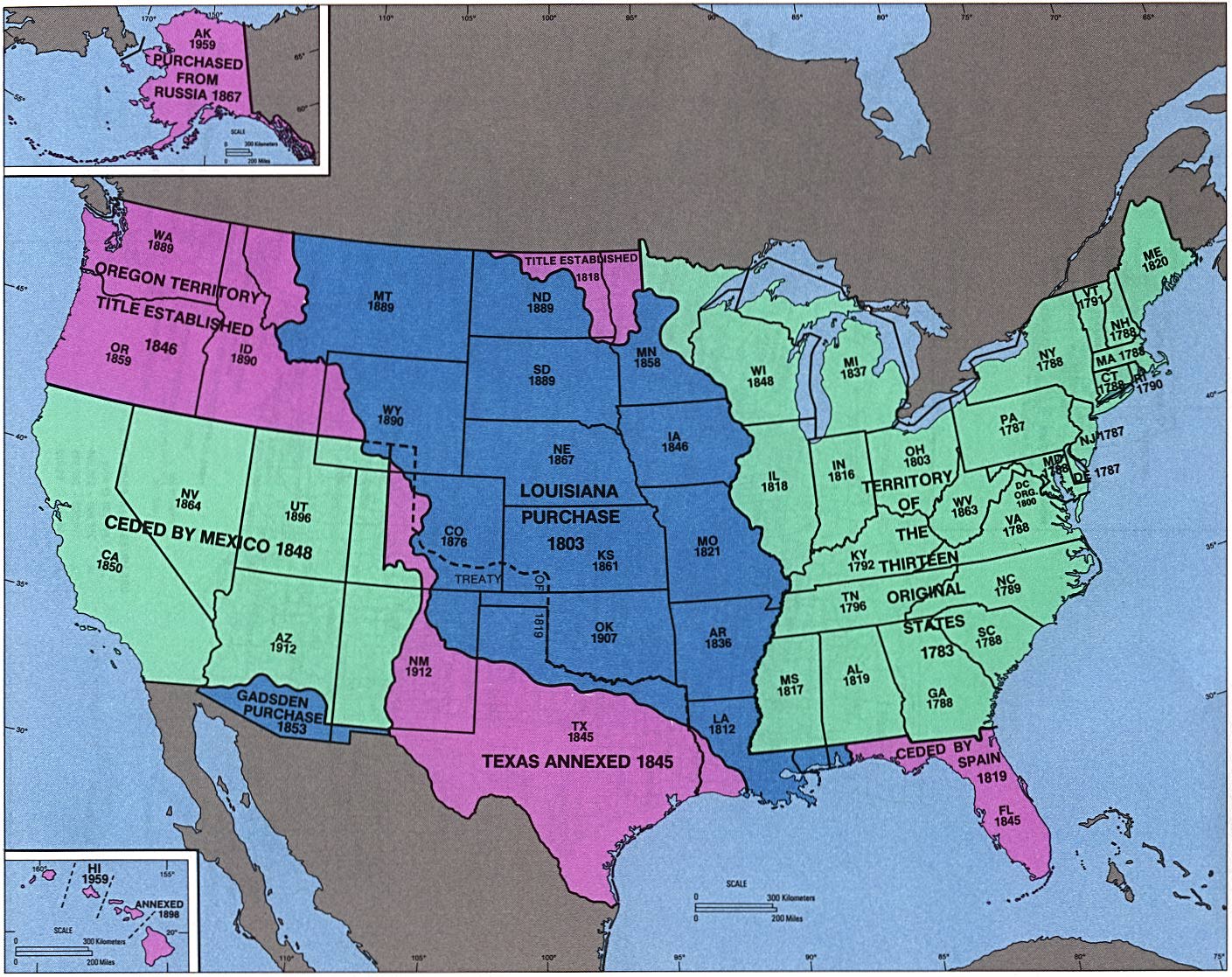
U.S. statehood map

When will the next State (Puerto Rico or Nova Scotia anyone?) be added to this list, or did the era of U.S. territorial expansion end in 1959 with Hawaiian and Alaskan statehood? (By the way, 1959 was also the year of the Cuban Revolution.)

Posted in History | Tagged | Leave a comment

Why did the N.Y. Times drop Joe Sharkey’s travel column?

According to this report by the excellent Jim Romenesko, it’s because some evil hack at the New York Times decided to slash the paper’s already paltry budget for freelance writers. Although Sharkey’s column had been published every Tuesday in the business section of the Times for the last 16 years, no one–not even Joe Sharkey himself–saw this coming. (Why didn’t the Times use this opportunity get rid of David Brooks or Charles Blow’s utterly predictable and unoriginal columns instead?) Am I the only one mad at the Times for dropping Sharkey’s Tuesday travel column and for eliminating the weekly profiles of frequent fliers to boot? Now the “Itineraries” section is completely lame and irrelevant. Thanks New York Times. You managed to alienate one of your last faithful print readers … Continue reading

Posted in Uncategorized | Leave a comment

In defense of pirates …

Posted in Uncategorized | Leave a comment

So when is Cheryl’s birthday?

Posted in Mathematics | Tagged , | Leave a comment

Coase theorem primer (police shooting video edition)

Broadly speaking, the so-called Coase theorem states that when bargaining is feasible (i.e. when transaction costs are low), bargaining among parties with conflicts of interest will produce an efficient economic outcome regardless of the initial allocation of property rights. English economist Ronald Coase originally developed this idea to explain the economics of externalities, such as railway sparks. Does his theorem also apply to media outlets that air newsworthy videos filmed by private citizens? From the New York Times (17 April 2015, p. A21):

The video of a North Charleston police officer shooting an unarmed man in the back will now cost news outlets that want to run it $10,000, according to a publicist representing the man who shot it. Cease-and-desist letters went out this week to news outlets around the world from Markson Sparks, a publicity and celebrity management company based in Sydney, Australia. The video, taken April 4, showed a North Charleston police officer, Michael T. Slager, shooting a man who ran from him after a traffic stop. A bystander, Feidin Santana, took the video and then turned it over to the family of the man who was killed, Walter L. Scott.

Posted in Uncategorized | Tagged , | Leave a comment

What will your epitaph say?

Via reddit.

Posted in Culture, History, Questions Rarely Asked | Tagged | Leave a comment

A 2016 fable (“Hillary Rodham and the seven dwarfs” edition)

Who you got? (Not pictured: the seventh dwarf–Ted “Grumpy” Cruz.)
Posted in Uncategorized | Leave a comment

Should passports become obsolete?

After all, you don’t need a passport to travel across State lines within the U.S., so why do foreigners need a passport or even a visa to enter the United States? Why won’t any government-issued I.D. suffice? Heck, why do we even need a government-issued I.D. to travel? Just asking …

Image courtesy of Shauna Miller and The Atlantic.

Posted in Questions Rarely Asked | Tagged , | Leave a comment

Cowen’s First Law is self-refuting

The hyper-productive Tyler Cowen recently formulated his “first law” of logical argumentation as follows: “There is something wrong with everything (by which I mean there are few decisive or knockdown … arguments, and furthermore until you have found the major flaws in an argument, you do not understand it).” Although we agree with the spirit of this statement, it suffers a serious flaw. The problem is that Cowen’s First Law is self-refuting, for if “there is something wrong with everything,” then there must also be something wrong with the argument there is something wrong with everything. For his part, Kevin Drum has fixed this fatal flaw by restating Cowen’s First Law as follows: “For any any problem complex enough to be interesting, there is evidence pointing in multiple directions. You will never find a case where literally every research result supports either liberal or conservative orthodoxy.” By the way, Drum’s restatement of Cowen’s First Law helps explain why the study of law (especially the compulsive study of appellate cases in law school) is not a science …

Posted in Logical Fallacies | Tagged , | Leave a comment