Happy Bastille Day!

Image Credit:

Roberta, via Creative (Un)block.

Posted in Uncategorized | Leave a comment

Pop Quiz (Twitter Edition)

https://twitter.com/farnamstreet/status/514362704312934401?refsrc=email

For us, it’s either Thomas Schelling’s The Strategy of Conflict (look it up!), or … anything ever written by David Hume. (Via Marginal Revolution.)

Posted in Uncategorized | Leave a comment

The Coase Theorem and the Prisoner’s Dilemma

The John Marshall Law Review or JMLR has just published our paper (with Orlando I. Martinez-Garcia) “Does the Prisoner’s Dilemma Refute the Coase Theorem?” (Our editors were a little behind schedule, as the official citation to our paper is JMLR, vol. 47, no. 4 (summer 2014), pp. 1289-1318. Yes, by the way, we greatly prefer the MLA or APA citation style–anything but the cumbersome and lame Bluebook used in most law review articles, but this will be the subject of a future blog post.) In our paper, we review two of the most important models in economics and law: the “Coase Theorem” and the “Prisoner’s Dilemma.” In addition, we explore the possible relation between these two influential models through a creative thought-experiment of our own: what would happen if the prisoners in the dilemma were allowed to bargain with each other rather then left incomunicado in separate cells? Would they agree to cooperate (as Coase’s theorem predicts)? Or would they still defect? Other scholars have contemplated this question, but we’re the first to apply the concepts of uncertainty, exponential discounting, and price elasticity to solve this problem. Enjoy …

Image Credit: Giulia Forsythe.
Posted in Uncategorized | Leave a comment

Time Zone Map

Posted in Uncategorized | Leave a comment

Instructions Included

Hat tip: tormunk (via reddit). 

Posted in Uncategorized | Leave a comment

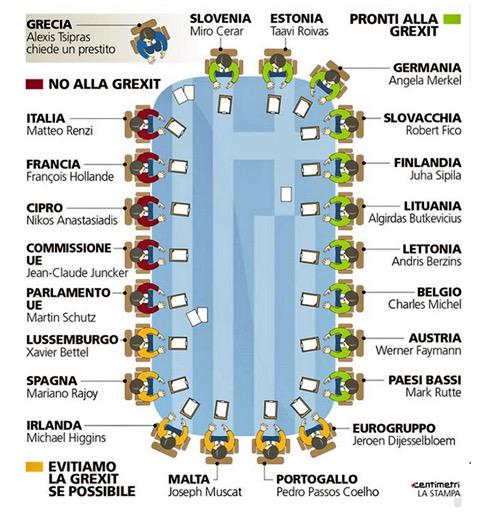
Yea or Nay? (Grexit Edition)

Embedded image permalink      Hat tip: Holger Zschaepitz (via Twitter).

Posted in Uncategorized | Leave a comment

The Bluffing Game (Grexit Edition)

Which side is bluffing in the current Game of Chicken* between Greece and the EU? (*Or is it a “War of Attrition”?) Maybe we should be asking a different question: Who has more to lose if Greece were to leave the EU? From yesterday’s Telegraph (UK), for example, we see there are “deadlines”:

The European Union faces “the most critical” moment in its 64-year history, after leaders warned they had five days to prevent Greece from careering out of the euro and into a full blown humanitarian crisis.

And then there are deadlines:

Without any fresh injection of emergency funds, Greece is set to default on a €4.2bn payment to the European Central Bank in 12 days time, putting it on the inexorable path of issuing an alternative currency and a chaotic eurozone exit.

Enough already … Why hasn’t the European Union just kicked Greece out of the EU already? Doesn’t Greece need the EU more than the EU needs Greece? Or is it the other way around? After all, isn’t it possible that a Greek exit (or “Grexit”) from the EU would irreparably weaken the EU and set in motion the complete disintegration of the Euro as a single currency–much like Slovenia’s early exit from Yugoslavia led to the entire collapse of that Balkan federation? So, who has more to lose if Greece leaves the EU?

Posted in Uncategorized | Leave a comment

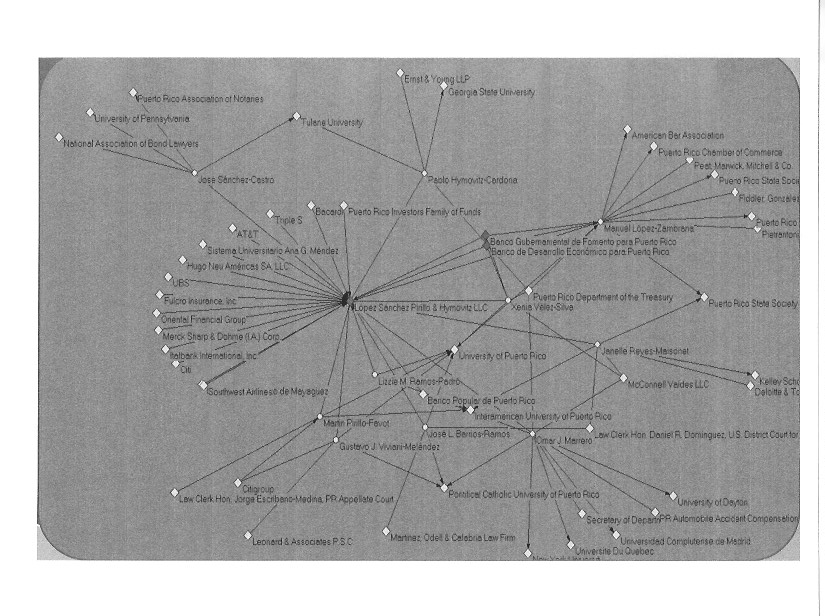
Legal Networks in Puerto Rico

OrlandoMHow are lawyers, law firms, and law professors all connected in a given legal jurisdiction? Using the advanced mapping and mathematical methods of network theory, our close friend and colleague Orlando I. Martinez-Garcia, a respected attorney and adjunct in the Social Science Department of the University of Puerto Rico (Arecibo Campus), is exploring the “ecological environment” of the legal profession in the Commonwealth of Puerto Rico. We can’t wait to read the full paper … Network Map Credit (above): Orlando I. Martinez-Garcia.

Posted in Uncategorized | Leave a comment

Canon 5

The facts: (a) A right-wing politician makes an indecent proposal in the National Review regarding the Supreme Court. (b) An intellectual judge, responding to this silly proposal, then calls out the politician on his personal blog–a wonderful blog, by the way, called “Hercules and the Umpire“–opining that the politician is “demonstrably unfit to become President.” (c) A right-wing law professor, in turn, chimes in, “surreplying” to the judge on a right-wing legal blog (The Volokh Conspiracy), accusing our friend the judge of violating Canon 5 of the Judicial Code of Conduct, which prohibits judges from “publicly endorsing or opposing a candidate for public office.” So, what’s the remedy here? Admonition? (Boring.) In any case, to the extent the act of voting (like the act of blogging or talking) is a public act, one could argue that Canon 5, taken literally, thus prohibits judges from voting!

Posted in Uncategorized | 1 Comment

Network Effects?

 How did we all get stuck using the Gregorian calendar? Aside from the QWERTY problem, can you think of any other examples of a network effect keeping us in a suboptimal equilibrium? How about LinkedIn, licensure requirements, or three years of law school? (If you don’t know what a network effect is, look it up!) Hat tip: MrSquig.

Posted in Uncategorized | Leave a comment