Captain Kirk’s Constitution

What theory of constitutional interpretation does Captain Kirk subscribe to? Hat tip: Will Baude. Addendum: At the end of the film clip, Dr Spock  logically asks: “… but does our involvement here also constitute a violation of the Prime Directive?” (Note: The Prime Directive prohibits Starfleet personnel from interfering with the internal development of alien civilizations.) Captain Kirk, however, simply brushes off Spock’s question, arguing in essence that the ends of the mission justify the means. Is Kirk right? Whether or not he violated the Prime Directive, this particular episode of Star Trek raises a deep and difficult question about higher law.
Posted in Questions Rarely Asked, Science Fiction | Tagged , , | 1 Comment

Things that cost more than space exploration

Pop Quiz: What do presidential libraries, advertisements for prescription drugs, and pennies (yes, pennies!) have in common? They are all things that cost more than space exploration! (Hat tip: Tyler Cowen.)

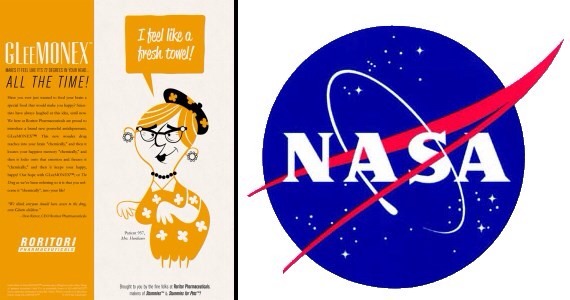
What costs more than space exploration? Advertisements for prescription drugs. According to the Congressional Budget Office, pharmaceutical companies spent “at least $20.5 billion” promoting their drugs in 2008. The breakdown of that number is interesting: only about $4.7 billion of that money was spent on the direct-to-consumer advertising that probably came to mind when you first read the statistic, such as the television advertising where they cheerfully list of potential side effects. A much larger sum of approximately $12 billion was spent on ‘detailing’ to doctors, nurse practitioners, and physicians assistants; in this case, detailing basically means phone calls and one-on-one meetings with the health care professionals who write prescriptions to provide background information on each drug. A further $3.4 billion was spent on sponsoring professional meetings for health care professionals, with a remaining $400 million spent buying advertising in professional journals. To my surprise, this total spending on promotion was nearly half of the total amount spent on pharmaceutical R&D in the same year ($38 billion). Of course, the total profits in the same year were $189 billion. Amongst the various drugs, erectile dysfunction medication not surprisingly (at least to anyone who has ever watched TV at any point in the past decade) had the highest expenditure on direct-to-consumer advertising, but was below average amont the ten drug classes studied by the CBO in terms of detailing expenditures; Statins (used to lower cholesterol levels) were the subject of the largest detailing spend (and presumably the largest overall spend). According to the White House Office of Management and Budget, In fiscal year 2008, NASA’s total outlays (The amount actually spent by NASA, which sometimes differs from the amount appropriated by Congress) were $17.8 billion. (Photo: A GLeeMONEX art print available for purchase from the artist and the NASA logo.)

Posted in Bayesian Reasoning, Economics, Questions Rarely Asked | Leave a comment

Battle of the computer-chess engines

Albert Silver recently conducted a fascinating computer experiment — a chess tournament between the Komodo 8 chess engine (running on an Android smart phone) playing against the Shredder chess engine (running on a much faster desktop computer — 50 times faster, to be exact). In Mr Silver’s words:

Since Komodo 8 exists on both the desktop as well as the Android smartphone, I decided to play a small match between it on a smartphone [an LG Optimus G Pro from 2013], facing Shredder on a modern, top of the line quad-core i7 processor.

Guess what happened?

Hat tip to Tyler Cowen for the pointer and for posing the question, “Is software outpacing hardware?

Posted in Games, Science, Web/Tech | Tagged , , , | 1 Comment

#2 Derek Jeter

Posted in Sports | Tagged | Leave a comment

“Visualizing Probabilistic Proof”

That is the title of our latest paper on the blue bus problem, a favorite law-school hypothetical of torts and evidence professors.  (We wrote up a first draft of our paper in Tarpon Springs, Florida during the summer of 2013 and made some stylistic as well as substantive revisions more recently in preparation for our paper’s forthcoming publication in volume 7 of the Washington University Jurisprudence Review.) Briefly, the main contribution of our paper is that we visualize the blue bus problem using Bayesian methods of probabilistic reasoning. By the way, although many legal scholars — most recently Edward Cheng — have applied Bayesian methods to the blue bus problem, none have taken a visual approach to the problem. Ironically, however, trial attorneys routinely rely on visual forms of evidence (e.g., pictures, objects, scale models, etc.) when presenting their cases to juries. In our blue bus paper, then, we follow the lead of trial lawyers and present a Bayesian approach to the blue bus problem in visual form using numerical frequencies instead of fractions or percentages. In addition to solving the blue bus problem, our larger aim is to reevaluate the problem of probabilistic proof and make the case for Bayesian methods in civil and criminal adjudication generally.

Posted in Bayesian Reasoning, Law, Truth | Tagged , | 1 Comment

What ESPN doesn’t want you to hear

Addendum: By the way, while we’re on the subject of ESPN’s three-week suspension of Bill Simmons, check out this original analysis of the economics of employee suspensions here. (Tyler Cowen offers two possible economic explanations of employee suspensions.) This part of Professor Cowen’s post in particular caught our attention: “If I were the commissioner, I would be insulted by the suspension of Simmons.  It suggests these are words which cannot be said, perhaps because they will elicit audience assent.  The suspension also signals that ESPN regards the commissioner as quite thin-skinned and presumably — especially if he is indeed thin-skinned! — he could be offended by that too.”

Posted in Bayesian Reasoning, Deception, Language | Tagged , , | Leave a comment

Who pays?

Is Wal-Mart legally liable for the wrongful death of John Crawford III? The victim was carrying an air rifle sold at the store.

Posted in Current Affairs, Law | Tagged , | Leave a comment

When are you most productive?

In terms of writing and thinking, we are most productive in the mornings. We are in good company in this regard: Continue reading

Posted in Art, Questions Rarely Asked, Time | Tagged , , | Leave a comment

In defense of simple models

We just found a 1963 reprint of W.W. Sawyer’s little book Mathematician’s Delight at Mostly Books, a family-owned bookstore on 529 Bainbridge Street in Philadelphia. In chapter 2 of his book, which was first published in 1943, Prof. Sawyer notes “the connexion between reason and imagination,” stating that “reason is … an experiment carried out in the imagination.” (What an amazing and beautiful phrase; the italics are Sawyer’s.) He also describes — and defends — simple models this way (again, emphasis in original):

It is impossible to imagine any event in perfect detail. In attacking any problem, we simplify the situation to a certain extent. We do not bother about those facts which seem unimportant. The result of our reasoning will be correct if the picture in our imagination is, not exactly correct, but sufficiently correct for the purpose in hand.

In other words, abstraction, parsimony, and reduction are not only necessary and unavoidable in solving problems logically. Abstraction, reduction, etc. can be helpful too.

Posted in Mathematics, Philosophy | Tagged , , , | Leave a comment

Tattoos, signals, and property rights

Tattoos have a long history (even Queen Victoria reportedly had a tattoo; see the TED video below), but why do people get tattoos? We see tattoos (or “body art” more generally) as a form of signaling, so what does a tattoo signal, especially to prospective partners and employers? Also, from a legal perspective, can a tattoo be copyrighted? That is, can there be property rights in tattoos?

Posted in Art, Law | Tagged , , | 98 Comments
