The limits of law: an update on San Francisco’s tour bus ban

A flat-out legal prohibition (e.g. “thou shalt not …”) represents a coercive, non-market approach to a given social problem. So, why aren’t legal bans always effective? Consider, for example, the tour bus ban approved last November by San Francisco’s Municipal Transportation Agency, which voted late last year to ban all sightseeing buses from a 25-square-block around Alamo Square Parkincluding the picturesque Steiner Street (pictured below), which appears on the opening credits of the TV series “Full House”–after many residents of this scenic and historic neighborhood complained of the buses and lobbied for a bus ban. According to this report by Evan Sernoffsky of the San Francisco Chronicle, many tour bus drivers are simply ignoring the ban: “With only a small chance of getting caught and cited, some bus drivers are flouting the ban and continuing to chauffeur groups close to the famed Victorian homes on Steiner Street …” The SF Chronicle’s report also notes that “San Francisco police officials are aware that some buses are breaking the new rules but say writing $100 tickets to drivers doesn’t rank high on the department’s priority list.” In other words, compliance with a law is not a given but rather a function of many factors, such as the severity of the penalty and the risk of getting caught.

File:Alamo Square with Painted Ladies, SF, CA, jjron 26.03.2012.jpg

By the way, instead of a draconian ban, why isn’t there room for a mutually-beneficial Coasean bargain between the tour bus operators and the neighbors? (Photo Credit: Wikipedia)

Posted in Uncategorized | Tagged , , | Leave a comment

“The Pervasive Effect of Priors”

That is the title of this informative four-part series of blog posts in which Claire Hill discusses and illustrates various aspects of people’s prior beliefs (aka “priors”). Here is an excerpt from part one of the series:

They (people’s priors) help explain why there are so many debates that never get anywhere.  Both sides might have terrific arguments, yet nobody is persuaded. And people keep on making the same sorts of arguments, even knowing this. Sometimes they wonder why more people aren’t persuaded. It’s a bit like the old joke about the person who goes to a foreign country and doesn’t know the language, so he tries to communicate in his own language and, when he’s not understood, he just tries again, repeating what he said . . . but louder.

How often, if ever, do you update your priors?

Posted in Uncategorized | Tagged | Leave a comment

Is the USA less free than Putin’s Russia or Communist China?

Read the full report by Ernest Drucker here (pp. 61-69).

Posted in Uncategorized | Tagged , | 1 Comment

What are Fractals and why should I care?

Hey! We are reblogging George Dallas’s fascinating post on the logic of fractals (see below). Notice the role that randomness plays in the geometry of fractals, but please enjoy responsibly …

checkdetector's avatarGeorge Dallas

Fractal geometry is a field of maths born in the 1970’s and mainly developed by Benoit Mandelbrot. If you’ve already heard of fractals, you’ve probably seen the picture below. It’s called the Mandelbrot Set and is an example of a fractal shape.

mandelbrot

The geometry that you learnt in school was about how to make shapes; fractal geometry is no different. While the shapes that you learnt in classical geometry were ‘smooth’, such as a circle or a triangle, the shapes that come out of fractal geometry are ‘rough’ and infinitely complex. However fractal geometry is still about making shapes, measuring shapes and defining shapes, just like school.

There are two reasons why you should care about fractal geometry:

1. The process by which shapes are made in fractal geometry is amazingly simple yet completely different to classical geometry. While classical geometry uses formulas to define a shape, fractal geometry uses iteration. It…

View original post 2,097 more words

Posted in Uncategorized | Leave a comment

The future of law enforcement?

Posted in Uncategorized | Tagged , | Leave a comment

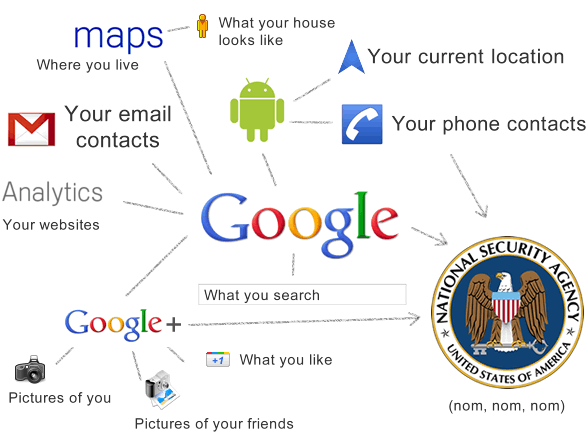
Is Google (potentially) more evil than the NSA?

Whoever wrote this blog entry seems to think so. But don’t Internet users knowingly and voluntarily consent to Google’s privacy policy when we sign up for Gmail? Or do Google’s terms of service constitute a tortious “invasion of privacy” under the common law? (hat tip: digg)

Who is the lesser evil?

Posted in Uncategorized | Tagged , , | 2 Comments

Torts II checklist

This semester we taught Torts II and studied various theories of legal liability, such as vicarious liability, strict liability, products liability, rescue (the general no-duty rule and exceptions to the rule), the Federal Tort Claims Act (federal government liability), defamation, and invasion of privacy. We also studied several commercial torts, including fraud, misrepresentation, and the duty to disclose. It’s now that time of year again … exam time. To prepare for your exam, consider the following questions–what is the common thread (if any) unifying these various torts? In the alternative, why don’t we have a single, across-the-board theory of liability (like negligence) for all injury-causing behavior?

Posted in Uncategorized | Tagged | Leave a comment

If Steve Jobs were alive today, would he be in jail?

That is the provocative question raised in this report by James B. Stewart in today’s New York Times. The Times’ report notes that Steve Jobs, the co-founder of Apple, was the “driving force” in a conspiracy to prevent competitors from poaching Apple employees, a felony under Section 1 of the federal Sherman Antitrust Act. So, why were charges never brought against Mr Jobs? Also, why did Jobs risk prosecution under the Sherman Act in the first place? (You may find some possible answers to these questions here, where we develop a formal “risk-regulation” model.)

Above the law, or just lucky?

Posted in Uncategorized | Tagged , , , , | Leave a comment

Korea–Korea

That is the title of this photographic exploration of a divided country.

Dieter Leistner

From the book’s dust jacket: In 2006, the German architecture photographer Dieter Leistner had both the opportunity and official permission to photograph public spaces in Pyongyang. His images show bus stops with long lines of people waiting, spruced up government buildings, bronze statues of Communist heroes, soldier cemeteries, flower markets, and wide avenues with only a few cars and people. In 2012, Leistner visited Seoul, where he sought and found similar locations with a very different feel. In Seoul, for example, the bus stops looked like oversized televisions, the bronze statues were of kings of the long-gone Korean empire, the flower markets neighbored on fish markets with a vast selection of wares, and the streets were choked with cars and people …

Posted in Uncategorized | Tagged , | Leave a comment

Google Car Update

We can’t wait to have share one of these …

Posted in Uncategorized | Tagged , | 2 Comments