Statutory interpretation: is a fish a “tangible object”?

It’s a federal crime to “knowingly alter, destroy, mutilate, conceal, cover up, falsify, or make a false entry in any record, document, or tangible object” with the intent of impeding or obstructing a federal investigation (italics added). But does this provision of the Sarbanes-Oxley Act of 2002 (codified at 18 USC 1519, if you must know), apply to a commercial fisherman who throws three illegally-caught fish overboard to avoid detection? That is the main issue in the case of Yates v. United States, which the US Supreme Court has agreed to adjudicate. (If you’re really bored today, you can read more about this delicate controversy here and here.) Does anyone want to bet with us on what the outcome of this case will be?

Posted in Uncategorized | Tagged , , | Leave a comment

Why are airline boarding procedures so inefficient?

Here is one hypothesis:

Because consumers want and value assigned seats. Overhead bin space is scarce as well, and airlines allocate that to their best customers through early boarding. In other words, there are competing business objectives. It turns out that the data on boarding processes is mixed. You can do simulations of faster boarding but it turns out that

* What’s fastest changes, you don’t actually get consistent results across airlines and over time

* There are switching costs, in terms of training agents and disrupting passenger routines

Do you agree with this analysis, or are airline managers just plain stupid? More here. (hat tip (yet again) to Tyler Cowen, Master of the Internet)

Posted in Uncategorized | Tagged , | 1 Comment

Sanctions schmanctions …

Article 6 of Chapter II of the United Nations Charter states that “a Member of the United Nations which has persistently violated the Principles contained in the present Charter may be expelled from the Organization by the General Assembly upon the recommendation of the Security Council.” Although the Russian Federation is a permanent member of the United Nations Security Council, the UN high council has 14 other members. Why wouldn’t a majority vote be sufficient for a “recommendation” of expulsion, or does Russia have the legal authority to veto its own expulsion? In the alternative, why don’t the members of the North Atlantic Treaty Organization consider imposing a NATO-wide travel ban on all Russian citizens, effective immediately?

Posted in Uncategorized | Tagged , | Leave a comment

Bayesian billiards

This simple thought-experiment appears in the first draft of our latest paper:

Imagine a large square table [like the one pictured above] so level that any billiard ball thrown upon the table has an equal chance of landing on any part of the table. Also, imagine yourself blindfolded so that you cannot see the surface of the table. Now, imagine yourself asking a friend to throw or toss a cue ball onto the table. Your task in this thought experiment is to guess where the cue ball had landed … How would you make this guess without looking at the table (and without asking your friend to tell you where the cue ball is located)? 

One possible solution, the Bayesian solution, is to ask your friend to throw a second billiard ball onto the table and then asking him to tell you whether the second ball landed to the right or left of the cue ball. If the second ball landed to the left of the cue ball, for example, then the cue ball is more likely to sit toward the right half of the table. In order to improve your guess, you should ask your friend to repeat this procedure many times, throwing n number of balls onto the table and reporting the relative location (i.e. left or right) of each subsequent ball in relation to the cue ball. Eventually, given a sufficiently large n, you should be able to narrow down the actual location of the cue ball …

Notice, though, that for Bayes’ solution-method to work the way Bayes himself intended, your friend must by willing to accurately and truthfully report the relative location of each subsequent ball thrown onto the table. That is, there is an implicit assumption in Bayes’ original thought-experiment–that the observer or information sender is always telling the truth … and it is this assumption that we wish to challenge here.

Our paper is titled “Bayesian manipulation of legal outcomes.” Can you see a direct analogy between Bayes’ thought-experiment and litigation generally? (Image of the square pool table courtesy of math.nyu.)

Posted in Uncategorized | Tagged , , | Leave a comment

Complexity versus simplicity

Explain this:

1. The official rules of America’s pastime consist of 119 singled-spaced pages.

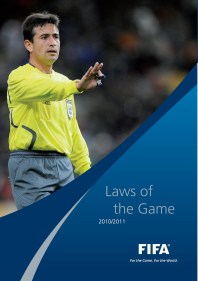
2. The official laws of the beautiful game, by contrast, take up less than 50 pages.

Why are the rules of baseball so much more complicated than the rules of soccer? Is there any testable cultural explanation for this disparity?


Posted in Uncategorized | Tagged , , , | Leave a comment

Foreign substances

When Yankees’ pitcher Michael Pineda was ejected last night at Fenway Park for openly using a “foreign substance” to get a better grip on the baseball, the Red Sox batter he was facing (Grady Sizemore) was openly wearing a pair of black batting gloves … presumably to get a better a grip on the bat. So why was only one player ejected by the umpire (and suspended 10 games by Major League Baseball)? Does this double-standard make any sense?

Posted in Uncategorized | Tagged , | Leave a comment

Spontaneous Order

This example of spontaneous order in Ethiopia is amazing. Can you think of any other such examples? Hat tip to Digg.

Posted in Uncategorized | Tagged | 2 Comments

More evidence that applied economics is not a science …

Economists still can’t agree on whether High Frequency Trading (HFT) is good or bad.

Dude, where’s my trade?

Posted in Uncategorized | Tagged , | 1 Comment

Is Google Glass Evil?

On balance, is Google Glass a good thing or bad thing? (Isn’t it both?) Either way, do we really need this product? More importantly, should markets decide these key questions or law/politics?

Posted in Uncategorized | Tagged | 2 Comments

Fair or foul?

What unwritten rule or social norm did Brewers’ slugger Carlos Gomez violate in this at-bat?

Addendum: Major League Baseball decided not to impose any suspension on Pirates’ pitcher Gerrit Cole (not even a token one-game suspension), even though he was the player who started the confrontation that lead to the brawl. Shouldn’t MLB have suspended Mr Cole for at least one game?

Posted in Uncategorized | Tagged , , | 3 Comments