

In other words, death penalty justice is not blind. Hat tip to Ian Millhiser for compiling the data and preparing the above diagrams.
In other words, death penalty justice is not blind. Hat tip to Ian Millhiser for compiling the data and preparing the above diagrams.
John Ioannidis does, that’s who. His 2005 paper “Why most published research findings are false” created quite a stir in academia, and now Dr Ioannidis is at it again with a new large-scale research project, the Meta-Research Innovation Center, at Stanford University. According to this report dated 15 March 2014 in The Economist,
METRICS, as the new laboratory is to be known for short, will connect enthusiasts of the nascent field in such corners of academia as medicine, statistics and epidemiology, with the aim of solidifying the young discipline. Dr Ioannidis and the lab’s co-founder, Steven Goodman, will organise conferences at which acolytes can meet in the world of atoms, rather than just online. They will create a “journal watch” to monitor scientific publishers’ work and to shame laggards into better behaviour. And they will spread the message to policymakers, governments and other interested parties, in an effort to stop them making decisions on the basis of flaky studies.
Sounds good. But what if most published research about published research is also false?
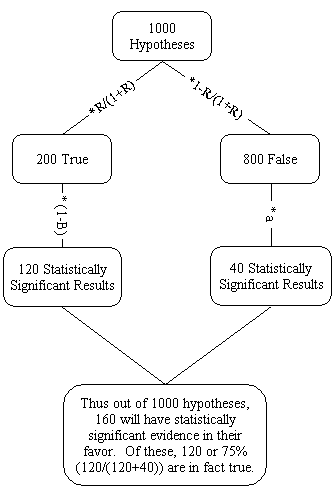
Also, what about a “journal watch” for work in economics and psychology, two fields rife with notoriously unreliable research findings? In any case, double hat tips to Professors Tyler Cowen and Alex Tabarrok for the initial pointer and for the diagram.
On March 12, 1989, the same year the Berlin Wall fell, Tim Berners-Lee, a researcher at CERN, wrote up and distributed a revolutionary proposal to improve information flows among computers: “a ‘web’ of notes with links between them.” (See diagram below from Berners-Lee’s proposal.) A few years later, CERN declared that the WWW technology developed by Tim Berners-Lee would be free, open, and available to all, without payment of royalties or other legal restrictions. In the words of Berners-Lee:
This decision (to keep the Internet free and open) enabled tens of thousands to start working together to build the web. Now, about 40 percent of us are connected and creating online. The web has generated trillions of dollars of economic value, transformed education and healthcare and activated many new movements for democracy around the world. And we’re just getting started. How has this happened? By design, the underlying Internet and the WWW are non-hierarchical, decentralized and radically open. The web can be made to work with any type of information, on any device, with any software, in any language. You can link to any piece of information. You don’t need to ask for permission. What you create is limited only by your imagination.
Notice the role (or should we say, non-role) that intellectual property rights played in the development of the Internet.

Have you heard the ancient proverb: The hedgehog knows one big thing; the fox, many little things …?
Nate Silver sure has. Mr Silver is relaunching his FiveThirtyEight blog this Monday, 17 March 2014, with this old proverb in mind. For those of you who can’t wait until Monday (like us), here is Mr Silver (in this recent interview) on the importance of empirical data and his scathing critique of hedgehog-like pundits in the moribund world of print and TV journalism:
Plenty of pundits have really high IQs, but they don’t have any discipline in how they look at the world, and so it leads to a lot of bullshit, basically … We take a foxlike approach to what data means. It’s not just numbers, but numbers are a big part of this. We think that’s a weakness of conventional journalism, that you have beautiful English language skills and fewer math skills, and we hope to rectify that balance a little bit. * * * We think the first step in using data is that you have to collect data, you have to organize it, and you have to explain the relationships …
Moreover, Mr Silver is willing to name names:
… the op-ed columnists at the New York Times, Washington Post, and Wall Street Journal are probably the most hedgehoglike people. They don’t permit a lot of complexity in their thinking. They pull threads together from very weak evidence and draw grand conclusions based on them. They’re ironically very predictable from week to week. If you know the subject that Thomas Friedman or whatever is writing about, you don’t have to read the column. You can kind of auto-script it, basically.
We love Nate Silver’s point-blank critique of such self-important op-ed pundits. The analyses of these pundits are indeed highly predictable, unoriginal, non-rigorous, and stale. But we would add the following two comments to Silver’s critique:
1. First, we think the main problem with pundits is not so much their hedgehog-like devotion to a single idea. After all, some of the greatest thinkers in science were hedgehogs (like Charles Darwin or Karl Popper). No, the main problem with pundits is their inability or refusal to update their ideological and normative priors.
2. Furthermore, notice that Mr Silver’s critique of pundits (and bullshit generally) applies not just to TV or op-ed pundits but also to traditional legal scholarship, except for the “beautiful English language skills” part. That is, most legal scholars not only have super-strong ideological or normative priors, priors which they are loathe to reevaluate or update; worse yet, most legal analysis is written in bad English, cluttered with footnotes and an obscure and archaic citation style, as Yale professor Fred Rodell noted many years ago in his classic essay Goodbye to Law Reviews.
The enigmatic irrational number π … to 100 decimal places. While you contemplate this strange and infinite number, do you detect a pattern, or is all you see pure randomness?


Happy National π Day! Go celebrate with your favorite π product. (Hat tip to beautiful Sydjia. Diagrams from Wikipedia.)
If the executive branch of the US government — starting with President Nixon — has declared a federal “war on drugs” as US national policy, aren’t all lower-level federal officials who carry out this stupid war the equivalent of “war criminals”, including federal police agents (who investigate and arrest people for drug crimes), federal prosecutors (who instigate federal charges for the commission of drug crimes), and federal judges (who impose harsh sentences for drug crimes — see, for example, the table in yesterday’s post below), especially when you consider that a large fraction of drug offenders just “happen” to be black or Hispanic?
Of course, these lower-level federal officials could argue that they are just “following orders”, but if this defense did not work for lower-level Nazi war criminals, why should it work for them?

Edward Snowden spoke via satellite to an audience at the SXSW conference in Austin, Texas earlier today. Here is the complete transcript of Snowden’s remarks, and here are Snowden’s thoughts on the lack of judicial and political accountability of U.S. public surveillance programs:
The key fact is accountability. We can’t have officials like James Clapper who can lie to everyone in the country. Who can lie to the Congress and face not even – not even a criticism, not even a strong worded letter. The same thing with courts. In the United States we have open courts that are supposed to decide and settle constitutional issues to interpret and apply the law. We also have the FISA court, which is a secret rubber stamp court. But they are only supposed to approve warrant applications. These (FISA court proceedings) happen in secret because you don’t want people to know, hey, the government wants to surveil you. At the same time, a secret court shouldn’t be interpreting the constitution when only NSA’s lawyers are making the case on how it should be viewed. Those are the two primary factors that I think need to change.
Fair enough. But what about mass surveillance in the private sector, like employee emails or casinos? Also, to whom is Mr Snowden himself accountable to?
We love the music in this song by Beyonce’. But what type of music is it? It’s not really rap; nor is it pure hip-hop. It’s definitely not rock or reggae; neither is it a slow jam or a traditional R&B ballad. So what is it? Is it a mixture of different musical genres or something entirely new?
That is the title of this thought-provoking talk given by Richard Hamming at Bell Labs on 7 March 1986. Among my favorite sentences from Dr. Hamming’s great talk is this one:
“If you don’t work on an important problem, it’s unlikely you’ll do important work.”
So, my dear friends, what important problems or research questions are you working on?










Welcome to the online home of the IASS
Hopefully It’s Interesting.
In Conversation with Legal and Moral Philosophers
dr hab. prof. UJ, Jagiellonian University
Books, papers, and other jurisprudential things
Ramblings of a retiree in France
BY GRACE THROUGH FAITH
Natalia's space
hoping we know we're living the dream
Lover of math. Bad at drawing.
We hike, bike, and discover Central Florida and beyond
Making it big in business after age 40
Reasoning about reasoning, mathematically.
I don't mean to sound critical, but I am; so that's how it comes across
remember the good old days...
"Let me live, love and say it well in good sentences." - Sylvia Plath
a personal view of the theory of computation
Logic at Columbia University
Just like the Thesis Whisperer - but with more money
the sky is no longer the limit
Technology, Culture, and Ethics
Just like the horse whisperer - but with more pages
Poetry, Other Words, and Cats


