Mindball

According to this article in Wikipedia, there are only seven Mindball game sets in all of North America. (A Mindball game set is a medium-sized contraption consisting of a table, a small magnetized ping-pong type ball, and some electronic sensors capable of measuring one’s brainwaves. Check out the above video for a demonstration of this cool game.) My wife and I recently played a match of Mindball at one of these seven tables on the third floor of the Museum of Science and Industry in Tampa, Florida.

As you can see from the video, Mindball is fun and interactive, but it is also by far one of the strangest games I have ever played, for here is how it works: there are two players, one on each end of a table. Each player wears an electronic headband that is able to monitor the electrical activity in one’s brain. The player who produces the least amount of brainwaves (i.e. the player that is the “most relaxed”) wins the game!

What is so fascinating about this particular game is that it totally inverts the traditional emotional logic of most competitive or “zero sum” games, i.e. games where there is one winner for every loser. Most such zero-sum games tend to be do or die, adversarial and combative, generating intense negative emotions, which is not surprising considering the zero-sum nature of such games. (This is especially true, by the way, in civil and criminal litigation, or what I have referred to in my previous work as litigation games.)

In Mindball, by contrast, it is the most calm or relaxed player who wins, not the most aggressive or eager one, as is usually the case. This feature totally freaked me out as I was playing Mindball “against” my wife, creating a dizzy feeling of cognitive dissonance as I played.

Where does a game like Chess fit in this emotional spectrum?

Posted in Uncategorized | Tagged , | 1 Comment

What does a micro-dissertation look like?

Check out the website LOL My Thesis to find out. In brief, it’s what you get when you cross a formal academic dissertation with a cyberpunk format like Twitter. Here’s one example: “I thought there was a solution to invasive lionfish, but there isn’t.” [*]

Can you describe your favorite social science or humanities thesis in a single sentence or two?

Triple Hat Tip: Tyler Cowen, Angus, and Handel

[*] Footnote: As a quick aside, in the words of fellow blogger Handel, commenting on the micro-thesis posted above: “Replace ‘invasive lionfish’ with ‘X’, and if you elaborate you can describe nearly all post-enlightenment political history.” So true …

Posted in Uncategorized | Tagged , , , | Leave a comment

What have you learned today?

The holidays are a good time to reflect on one’s life, including one’s intellectual life. Here is a brief excerpt from my own self-reflections in my (as of yet unpublished) intellectual autobiography:

My intellectual life truly began during the summer of 1998, the year I left my law practice and began teaching. Like a modern-day Augustine, I emerged from the darkness of Plato’s cave and left behind my dull and dreary life of billable hours and corporate clients. But instead of converting to Christianity, Marxism, or some other dour dogma, I became a literary law professor and a devotee of mathematical models and science. But mind you, I didn’t start out this way. No one does. Before I entered the legal academy, the “Republic of Mathematics” and the sacred teachings of science were as foreign to me as the savannahs of East Africa or the steppes of Mongolia. This, then, is my story, the story of my madcap intellectual metamorphosis …

Read the rest of my “madcap intellectual metamorphosis” here.

P.S. — happy birthday Sydjia!


Posted in Uncategorized | Tagged , | Leave a comment

Feliz Navidad

FamilyDec2013

Feliz Navidad

Feliz Navidad de Adela, Aritzia, Baby Adys, Sydjia, K. Enrique (hijo), y F. Enrique (padre) …

Posted in Uncategorized | Tagged , | 1 Comment

The economics of Christmas

How “inefficient” is Christmas and the tradition of gift-giving generally? According to this paper, The deadweight loss of Christmas, published in the prestigious American Economics Review 20 years ago this month (and from which the figure above is taken), holiday gift-giving destroys between 10 percent to one-third of the value of gifts. If you don’t feel like reading this classic paper for yourself, here is an overview from The Economist:

At the simplest level, giving gifts involves the giver thinking of something that the recipient would like—he tries to guess her preferences, as economists say—and then buying the gift and delivering it. Yet this guessing of preferences is no mean feat; indeed, it is often done badly. Every year, ties go unworn and books unread. And even if a gift is enjoyed, it may not be what the recipient would have bought had they spent the money themselves. Intrigued by this mismatch between wants and gifts, in 1993 Joel Waldfogel, then an economist at Yale University, sought to estimate the disparity in dollar terms. In a paper that has proved seminal in the literature on the issue, he asked students two questions at the end of a holiday season: first, estimate the total amount paid (by the givers) for all the holiday gifts you received; second, apart from the sentimental value of the items, if you did not have them, how much would you be willing to pay to get them? His results were gloomy: on average, a gift was valued by the recipient well below the price paid by the giver. The most conservative estimate put the average receiver’s valuation at 90% of the buying price. The missing 10% is what economists call a deadweight loss: a waste of resources that could be averted without making anyone worse off. In other words, if the giver gave the cash value of the purchase instead of the gift itself, the recipient could then buy what she really wants, and be better off for no extra cost.

While the general intuition of this paper might be correct (indeed, this is why we are big fans of gift cards and cash gifts generally), its methodology is of limited and doubtful value at best. Suffice it to say that data sets based on self-reported surveys are especially suspect. What are some other problems with Professor Waldfogel’s methodology? [Hint #1] [Hint #2]

Posted in Uncategorized | Tagged , , , , , | 1 Comment

Bayes again …

Brian McGill, an ecologist at the University of Maine and fellow blogger at Dynamic Ecology, recently wrote (last June) a helpful overview and nuanced critique of Bayesian probability titled “Why saying you are a Bayesian is a low information statement“. We not only carefully read his well-reasoned post; like the good Bayesians we are, we also updated our epistemological priors accordingly …

Here, we wish to focus on a very, very good question that McGill poses midway through his June 2013 post. In brief, he asks why would anyone ever “favor serial updating of the probability distribution using repeated applications of Bayes theorem for each new data collection rather than performing a comprehensive meta-analysis on all data collected”? In other words, what’s so great about Bayesian updating?

That’s a great question. Does anyone have any answers?

For our part, this is our tentative take on McGill’s thought-provoking question. Broadly speaking, Bayesian probability is a way of updating one’s priors whenever one receives a new piece of evidence or new information. But, as McGill asks, why not wait until all one’s data is collected before one evaluates such data, just as juries must wait until the end of a case before they are allowed to evaluate the evidence presented by the parties? This question, however, neglects the flexibility and versatility of the Bayesian approach. Yes, there are some situations in which frequentist or traditional statistical methods can take the place of Bayesian methods (as McGill himself notes in his post), but the reverse is not true (something McGill fails to mention). Moreover, Bayesian reasoning is especially applicable not only to single-probability events (like political elections or competitive sports), but to any event with an uncertain outcome that occurs in real time, or when evidence and information are presented in a sequential manner. Jurors, for example, don’t really wait until the end of a case to evaluate the evidence. In reality, jurors are assessing the evidence and engaged in Bayesian reasoning from the start of trial.

Posted in Uncategorized | Tagged , | Leave a comment

Madiba … Bayesian hero

The dramatic story of how Nelson Mandela reconsidered his long-held Marxist views and updated his political and economic priors is retold in this fascinating report “How Mandela Shifted Views on Freedom of Markets” published on 10 December 2013 in the New York Times. According to the Times:

When Mr. Mandela was released from prison in 1990, he told his followers in the African National Congress that he believed in the nationalization of South Africa’s main businesses. “The nationalization of the mines, banks and monopoly industries is the policy of the A.N.C., and a change or modification of our views in this regard is inconceivable,” he said at the time. Two years later, however, Mr. Mandela changed his mind, embracing capitalism, and charted a new economic course for his country.

This dramatic reversal, which is also recounted in greater detail in Anthony Sampson’s biography of the great Mandela, also poses a larger question about politics generally. Specifically, why are so few world leaders Bayesians like Mandela, i.e. willing to revise or even abandon their fundamental views of the world when confronted with new evidence? Is a political leader’s willingness to engage in Bayesian updating what separates great men like Mandela from despots (like Fidel in Cuba or Hitler in Nazi Germany) as well as from ordinary politicians (like, say, George W. Bush or Barack Obama)?

Posted in Uncategorized | Tagged , , | 1 Comment

The Bayesian approach to sports

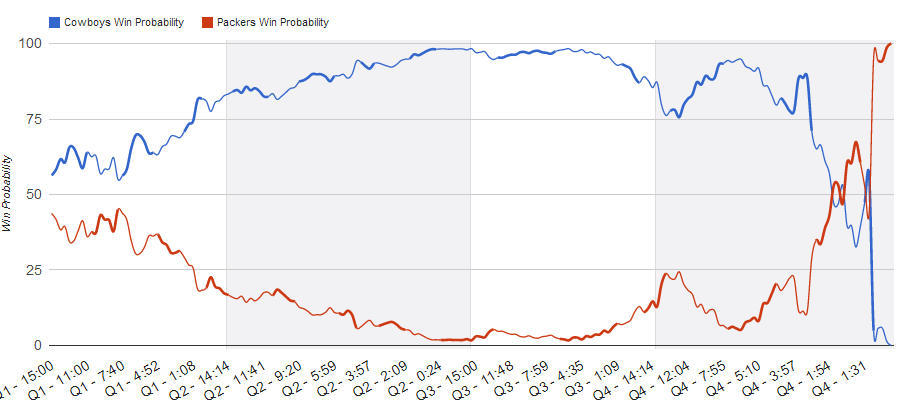
Consider the following image from ESPN Stats & Info (via Twitter):

This past Sunday afternoon, the overrated Dallas Cowboys led the venerable and tenacious Green Bay Packers by a score of 26-3 at halftime, yet the Cowboys somehow blew their large lead and lost the game. So what is the probability that the Packers would make such a comeback?

Easy. The visual image above presents a Bayesian time progression of both teams’ respective “win probabilities.” Notice the Bayesian nature of this graph–the win probability of the Dallas Cowboys increases as their lead over their opponent increases and then rapidly plummets to zero towards the end of the game. That is, the image above is Bayesian because, starting with 50/50 priors, it then proceeds to update the win probabilities of the teams as the game is played in real time and as the score changes. Now, try figuring out the win probabilities of the teams using standard statistical or Fisherian methods and see how far that takes you. You can’t, really, because each game in sports is a unique event, played  only once.
Posted in Uncategorized | Tagged , | Leave a comment

Earth Wind Map

prior probability enjoys collecting maps of various kinds, especially during our foreign travels. Our quirky and eclectic collection includes maps of the Amazon, the Moscow Metro, and the Berlin Wall, among many others. But we recently discovered (through digg.com) the most beautiful and ephemeral map we have ever seen, an “Earth wind map.” The picture included in this post does not do justice to the actual map, which is available at http://earth.nullschool.net (and at the link a few lines above), since the snapshot of the map (see picture above) is static while the real-time map on the “earth.nullschool.net” website is fluid and dynamic, constantly in motion, like the Earth herself …

Posted in Uncategorized | Tagged , , | 2 Comments

Why don’t more people play “credit card roulette”?

Credit Card Roulette or CCR is “a way of gambling for bills, usually played for the purpose of settling restaurant checks, by randomly drawing one participant’s credit card.” The website pokerterms.com (from which my definition of CCR is borrowed) offers the following illustration of the “elimination method” of playing this game:

For instance, after a meal involving 6 poker players, each person will place his card in a pile, the cards will be scrambled, and a number between 1-6 will be randomly generated by another participant. The card corresponding to this number will be taken out of the running and so on, until there is just one card left and that cardholder is the loser, responsible for paying for the entire meal. The less fun and less exciting method involves presenting all the cards in play to the server at the restaurant and letting him or her choose a card at random.

So why don’t more people play this game? One possibility is that CCR operates as a negative lottery. That is, if six friends are sharing drinks at a bar and they each end up ordering, say, $20 dollar’s worth of drinks, then each individual player has a 5/6th probability of “winning” the equivalent of $20’s worth of drinks (i.e. the amount of his or her individual tab) but has a 1/6th probability of losing $100 (i.e. the combined bar tab of the other five players). Although it is more probable that each individual will “win” a small amount (i.e. avoid having to pay his or her share of the tab), the small probability of having to pay a large amount (the entire tab) might dissuade all but the most risk-loving persons from wanting to play this game.

Bonus question: what is the legal status of CCR? Does this game violate any US gambling laws?

Hat tip: Ian Ayres (freakonomics.com)

Posted in Uncategorized | Tagged , , , | 1 Comment