The United States Supreme Court, like the Congress, operates under the principle of majority rule, but since the Supreme Court consists only of nine judges (or “justices”, as they are presumptuously called), a simple majority of five justices is sufficient to decide a case or declare a law unconstitutional. But does the principle of majority rule make any sense in the context of a judicial tribunal? Shouldn’t the voting procedures of the Supreme Court be revised to reflect the margin of victory when the Court is deciding a case? After all, why should a case decided by a narrow margin of 5 to 4 carry just as much weight as a case decided by a wide margin, such as 9 to 0 or 8 to 1? At the very least, shouldn’t the power of judicial review (the Court’s power to declare a law or executive action unconstitutional) require a super-majority of justices, just as legislative overrides of executive vetoes do?
Forget 9/11?
This week marks the 12th anniversary of the terrible events that took place on the morning of 11 Sept. 2001 in the United States … and the 40th anniversary of the terrible events of 11 Sept. 1973 in Chile (see the image below, depicting the moment when Chile’s Presidential Palace was bombed). The Republic of Chile has since become a prosperous constitutional democracy. What has the US government accomplished in the 12 years since 9/11?
prior probability is also reblogging this thought-provoking post by Robin Hanson at Overcoming Bias:
<< In the decade since 9/11 over half a billion people have died worldwide. A great many choices could have delayed such deaths, including personal choices to smoke less or exercise more, and collective choices like allowing more immigration * * * Yet, to show solidarity with these three thousand victims, we have pissed away three trillion dollars ($1 billion per victim), and trashed long-standing legal principles. And now we’ll waste a day remembering them, instead of thinking seriously about how to save billions of others. I would rather we just forgot 9/11 * * * >>
Is Hanson right? Shouldn’t we just forget 9/11, just like we have forgotten Pearl Harbor (1941) or the Boston Massacre (1770)? Are we being self-righteous (and defeatist), in addition to committing the fallacy of ignoring sunk costs, when we memorialize the events of 9/11?
Is there life on GJ 1214b?
Probably. According to this report, a team of Japanese astronomers has tested whether a planet 40 light years from Earth–a “super-Earth” known as GJ 1214b and located in the constellation Ophiuchus, northwest of the center of our Milky Way galaxy–has an atmosphere rich in water (like our Earth) or a hydrogen-dominated atmosphere (like Jupiter or Saturn) and confirmed its water-rich nature.
But how would you perform such a test?
Easy. You perform a Rayleigh scattering test. Below is a visual explanation of how this test works:

In summary, if the sky of a given planet has a hydrogen-rich atmosphere (as shown up top), Rayleigh scattering disperses blue light from the atmosphere of the host planet. The middle panel, by contrast, shows how Rayleigh scattering is much weaker in water-rich atmospheres, while the bottom panel shows what would happen if the sky had clouds.
Image courtesy of dailymail.com.uk
Coase’s lighthouse
In honor of Ronald Coase, an intellectual giant who just died at the ripe old age of 102, prior probability wants to share this excerpt from section 3 of our paper Confessions of a Latino Law Prof to explain the immense impact Professor Coase has had on our thinking (footnotes omitted):
<< If the great German philosopher Immanuel Kant once credited David Hume with awakening him from his “dogmatic slumbers,” I must recognize Ronald Coase for unwittingly doing the same for me. I say “unwittingly” because Coase is an economist; I, a literary lawyer living and teaching in Caribbean at the time, a world away from Coase’s formidable home, the University of Chicago.
Nevertheless, one day I stumbled upon a short paper entitled “The Lighthouse in Economics.” Perhaps it was inevitable that Coase’s paper on lighthouses and I should cross paths because of my interest in all things history—after all, the topic of Coase’s paper was the history of the British lighthouse system—but what was not preordained was the enormous effect Coase would come to exert on my world-view. In fact, I was deeply suspicious of Coase. I approached his paper cautiously, with a wary eye and with trepidation. Was not Coase the intellectual godfather of the Chicago school of law and economics?
You see, while I was a student at Yale, and even as late as when I began teaching, I was not terribly impressed by either the Chicago school in general or the celebrated “Coase Theorem” in particular. I had tried on two or three previous occasions to read Coase’s landmark paper, “The Problem of Social Cost,” but I could never get beyond the first few pages. Specifically, my problem with “The Problem of Social Cost” was the magical world of zero transaction costs, and I was especially troubled by Coase’s use of make-believe numbers to illustrate his famous example of the cattle rancher and the crop farmer. In my view, all Coase was doing was rigging the game ahead of time to get the results he wanted instead of confronting his counter-intuitive hypothesis with actual test data.
Moreover, as a philosophical matter, I had rejected the whole of “law and economics” out of hand. The concept of an “efficient breach,” the notion that there exists an optimal level of safety precautions, the idea of putting the pursuit of economic efficiency ahead of traditional notions of “justice”—all the major ideas of the economic approach to law enormously offended my Kantian values. In addition, I had already read a plethora of potent critiques of the economic approach to law that seemed to settle the matter: Frank Michelman’s astute appraisal of normative economics, Jules Coleman’s subtle analysis of “efficiency,” and Arthur Alan Leff’s claim that “law and economics” is simply a new form of legal formalism—though none of these academic works delivered as devastating a blow as Shakespeare’s Merchant of Venice.
Ronald Coase thus had no direct effect on my thinking when I began teaching, and Coase might have remained on the sidelines of my intellectual life had it not been for a fortuitous event in December of 2000, for it was chance that intervened the day I found Coase’s paper, “The Lighthouse in Economics.” What I found in Coase’s lighthouse paper, to my surprise, was a stinging critique of conventional economic wisdom.
In economics, lighthouses are the paradigmatic example of a public good. Coase, however, examined the historical record and saw that the first lighthouses to be built in England and Wales were owned and operated by private firms. The lighthouse operators made a profit by collecting their tolls directly from the shippers. Although Parliament eventually nationalized the lighthouses, Coase was making a larger prescriptive point: scholars should not use an empirical example that is not truly empirical; they should get their facts right before they make an assumption. Now, this was music to my ears.
The lighthouse paper thus allowed me to see Coase in new light (pun intended). I gained a newfound respect for his work, and most important, I decided to return to my old nemesis, “The Problem of Social Cost.” This time, I read it carefully and closely in one sitting. This time, I understood what Coase was really trying to say. And this time, I would undergo nothing less than a Gestalt switch in my world-view * * * >>
Why don’t the Jags sign Tim Tebow?
Economists like to point out that voluntary trades are generally “wealth-maximizing”, since contracting parties are made better off when they trade with each other. So why don’t the Jackonsville Jaguars sign Tim Tebow? Tebow, after all, really wants to play in the NFL, while the Jaguars really need a decent quarterback. As things stand now, the Jags are probably one of the worst teams in the NFL this season (and last season too–their record was an abysmal 2-14 last year). So here’s a thought: now that angry-bird Bill Belichick unmercifully cut Tim Tebow from the New England Patriots’ 53-man roster, why won’t the Jaguars at least consider signing Tebow for the 2013-14 season? After all, what would Jacksonville have to lose by signing Tebow as their starting or back-up QB? The way prior probability sees it, the Jags can’t get any worse with Tebow on their roster, so there is no down side to signing Tebow, but they would generate a lot of goodwill and national publicity for their team by signing Tebow. What do you think?
“The Bet” — Anton Chekhov
prior probability is reblogging Anton Chekhov‘s short story “The Bet”, in which a banker and a lawyer make a bet with each other about whether the death penalty is better or worse than life in prison. The story has a surprise ending and several important take-away lessons, not the least of which are the dangers of equating material wealth with happiness …
“The Bet” by Anton Chekhov
I
It was a dark autumn night. The old banker was pacing from corner to corner of his study, recalling to his mind the party he gave in the autumn fifteen years before. There were many clever people at the party and much interesting conversation. They talked among other things of capital punishment. The guests, among them not a few scholars and journalists, for the most part disapproved of capital punishment. They found it obsolete as a means of punishment, unfitted to a Christian State and immoral. Some of them thought that capital punishment should be replaced universally by life-imprisonment.
“I don’t agree with you,” said the host. “I myself have experienced neither capital punishment nor life-imprisonment, but if one may judge a priori, then in my opinion capital punishment is more moral and more humane than imprisonment. Execution kills instantly, life-imprisonment kills by…
View original post 2,545 more words
Nanny Stadiums
You may have heard of the term “nanny state“–which is what the USA, with its Puritanical bans on smoking (even outdoors in many places), compulsory seat-belt laws, etc., is becoming–, but have you heard of nanny stadiums?
prior probability thinks the new NFL bag policy is pretty lame. Why do we put up with this nonsense? Why do we sacrifice liberty in the name of security?
This is what lameness looks like.
Justice for Johnny Football?
ESPN is reporting that the college sports cartel otherwise known as the NCAA will suspend Johnny Manziel, the popular quarterback of the Texas A&M football team, for the first half of this Saturday’s season opener against Rice for violating NCAA bylaw 12.5.2.1. This is the rule that exploits our student-athletes by prohibiting them from allowing their names or likenesses to be used for commercial purposes. So is this half-game suspension a just punishment for Johnny Football? That is, is it too little or too much?
“I have a … copyright”
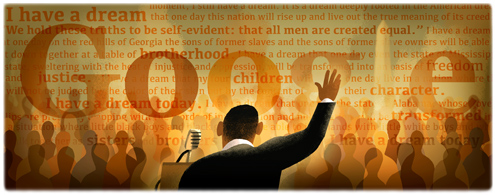
Today is the 50th anniversary of Dr. Martin Luther King’s historic “I have a dream” speech. The excellent Walter Olson of overlawyered.com asks, “Did you know MLK’s ‘I have a dream’ speech is copyrighted?” It is, and it won’t enter the public domain until the year 2038. Nick Gillepsie at drum.com tells the full story here.
prior probability asks a deeper question: do we even need copyright law? Would MLK have decided against giving his ‘I have a dream speech’ if he knew ex ante that such a speech were not protected by copyright law?
Is an illegal tackle a “tort”?
The latest round of rule changes in the National Football League (NFL) has received a lot of commentary on TV and in the blogosphere lately, especially the new rule that now makes it illegal for ball-carriers and tacklers to lead with the crown of their helmets when both players are outside of the tackle box.
If player injuries are such a serious problem in the NFL, what would be the best way to solve to this problem? Should a player be able to sue another player in tort for an illegal hit?