
We will be attending some lectures on “realist jurisprudence and its competitors” by Dr Brian Leiter at the EHESS in Paris, so we will be blogging much less frequently during the next few weeks.

We will be attending some lectures on “realist jurisprudence and its competitors” by Dr Brian Leiter at the EHESS in Paris, so we will be blogging much less frequently during the next few weeks.
The oracles of SCOTUS decided Gamble v. U.S. today (17 June), upholding the nefarious “separate sovereigns” exception by a 7-2 margin. Here are three of our previous posts about this fascinating case:
1. Be like Bayes (part 3) (30 December 2018), in which we build a simple Bayesian model to predict whether the Supreme Court will overturn the “separate sovereigns” exception to the Double Jeopardy Clause when it decides Gamble v. U.S. (Our prediction turned out to be wrong.)
2. Be like Bayes (part 2) (29 December 2018), in which we estimate the base rate or the historical frequency in which a precedent is overturned by the Supreme Court in those cases in which a party is asking the Court to take such an action.
3. Forecasting the forecasts (31 December 2018), in which we describe a method for scoring the accuracy of our Gamble v. U.S. forecast via a simple scoring method that was first proposed by Glenn Wilson Brier, an early advocate of probability forecasting and the use of probability forecasts in decision making.
To my friends–law professor colleagues and students alike–beware! All three of the above posts are somewhat technical and mathematical in nature. In short, instead of focusing on the legal arguments in Gamble v. U.S. or the “merits” of the case (we agree with Brian Leiter, Richard Posner, and other legal realists that law in close cases is indeterminate), we attempt to build a simple Bayesian forecasting model based on the number of amicus briefs submitted by third parties to the Supreme Court.

The wait is over …
More flag day fun, and Happy Father’s Day to all our family and friends …
In honor of Flag Day (14 June), we are reposting our “Flag for Mars” blog post of 5 September 2017.
Why don’t any of the planets or moons in our solar system have their own flags? Calder Hansen proposes a new flag for Mars. More information about this proposed Martian flag is available here. Hat tip: kottke. [Update (14 June 2019): There is some controversy as to the actual origins of the design for the flag for Mars. See the comments section and here.]
 Credit: Calder Hansen
We have been addressing the following question in our last five blog posts: How does law get started? To sum up our Humean answer in two words, law and legal systems are just protection rackets (nothing more, nothing less), at least in their beginning stages, although we could easily extend this protection-racket logic to modern legal systems; after all, what are taxes but a form of legalized extortion? But our protection-racket conception of law raises a whole new set of troubling questions. To begin with, most, if not all, protection rackets are always compulsory, not voluntary, affairs: people are forced to buy “protection,” even if they don’t want to. (Check out the popular culture depictions of mob bosses and racketeers below.) So, realistically speaking, far from solving the forced rider problem, protection rackets make this problem worse. Is there any way around this problem?
Maybe there is an “optimal” number of protection rackets per territory. When there is a market for protection, would-be racketeers and proto-lawmen will have to compete with one another to attract new clients and maintain old ones, so they will have a built-in incentive to provide services of value and to avoid overcharging for their protection services. (Think again of Mancur Olson’s rational profit-maximizing “stationary bandit.”) On this view, the more racketeers the better! Or perhaps the solution resides in the threat of competition. That is, even if there is only one dominant protection racket, as long as new entrants are free to form their own rival protection agencies, this threat alone should curb the dominant agency’s destructive tendencies.
None of these libertarian or Planglossian responses, however, are entirely satisfactory because there is no meta-protection agency to protect independents and forced riders (persons who don’t want to pay for “protection”) or to resolve disputes among the racketeers themselves and their rival protection rackets. Ultimately, then, there is an inherent tension here. On the one hand, some form of law, however crude, is useful to promote cooperation, but at the same time, any legal system or protection racket will inevitably produce abuses of its own. There is thus an optimal level of “protection”–too much protection is no doubt a bad thing, but so is too little! In short, the optimal level is not zero. Seen this way, law is just a trial-and-error method of finding the optimal level of protection.
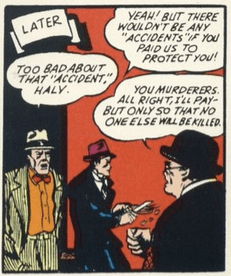

How does law get started? In my previous post “Hume’s meadow” I sketched a possible three-step solution to the group cooperation problem. First, we must think of law not as some rarefied or unique realm but rather as an ordinary run-of-the-mill business or “protection racket” (think of Mancur Olson’s “stationary bandit“). Next, we must find a sufficient number of partners to go into business with, and lastly, we must then find a way of separating ownership (citizenship) and control, either through elections or some other method of tacit consent of the governed. This business-like approach to the origins of law has two virtues: it not only solves the regress problem; it also solves the forced rider problem too!
The forced rider problem is solved (at least at the law’s formation stage) because our “law business” is a voluntary protection racket or “mutual protection association” (to borrow Robert Nozick’s euphemistic phrase). No one who doesn’t want to join or “buy in” the protection association is compelled to, at least not initially. Similarly, the regress problem is solved because the potential expected benefits–both in total and at the margin–of creating a law business should attract a sufficient number or critical mass of “legal entrepreneurs” to overcome the free rider and defection problems that plague any common enterprise. In fact, I would venture to speculate that the problem with my business or partnership model of law is not going to be a lack of “legal entrepreneurs.” The problem is going to be just the opposite. That is, instead of too few protection rackets, we are probably going too have too many! But is this really a problem, and if it is, how should we solve it? I will consider those questions in my next post.

Hat tip: u/Pytheastic (via Reddit)
How does law get started? We presented and critiqued some game theory models of law and cooperation in our previous posts (June 10 and June 11). It turns out that the problem of group cooperation was first illustrated by our intellectual hero David Hume (pictured below) with this memorable example: “Two neighbours may agree to drain a meadow, which they possess in common; because it is easy for them to know each others mind; and each must perceive, that the immediate consequence of his failing in his part, is, the abandoning the whole project. But it is very difficult, and indeed impossible, that a thousand persons should agree in any such action; it being difficult for them to concert so complicated a design, and still more difficult for them to execute it; while each seeks a pretext to free himself of the trouble and expen[s]e, and would lay the whole burden on others.” (Hume’s Treatise of Human Nature, Clarendon Press (2nd edition, 1978), p. 538.) In short, getting a thousand people to drain a common meadow will be just as difficult as getting a thousand people to hire a sheriff or create a common government.
But what if, instead of draining a particular meadow at a particular time, the neighbors want to build a general meadow-draining business? If there are only two neighbors, they could form a partnership or a limited liability company or a privately-owned corporation. But this business firm solution could work even if there are a thousand neighbors! In fact, modern-day business corporations can have thousands–even millions–of shareholders. Corporations thus solve Hume’s metaphorical meadow-draining problem by separating ownership and control–the many (the shareholders) and the few (management). Now, what if, instead of creating a business to drain meadows, the neighbors created a business to produce and enforce laws? Maybe the world of big business–specifically, the legal structure of corporations–provides a clue to solving Hume’s meadow-draining problem. We will explore this ingenious solution in our next post.
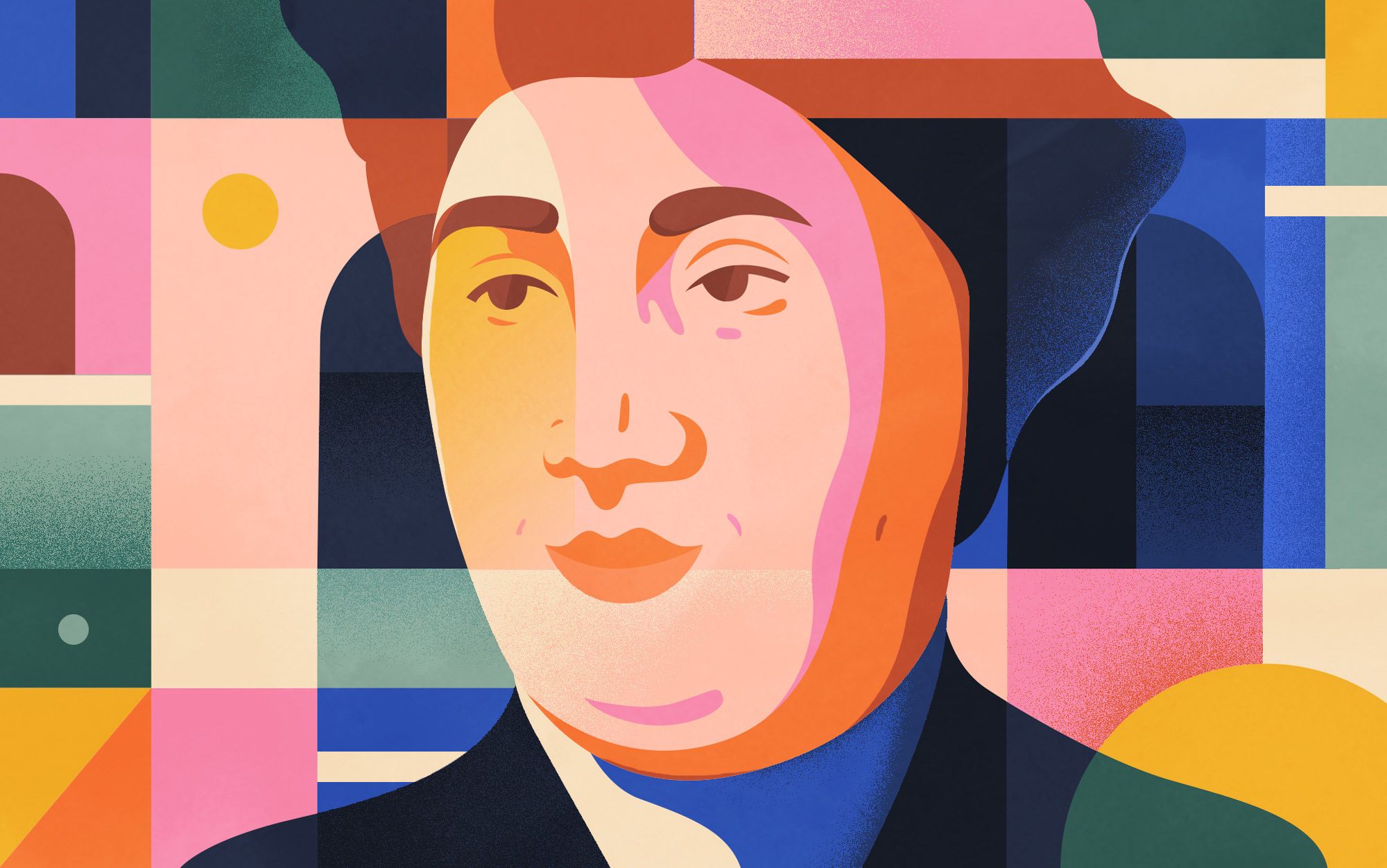
Illustration of David Hume by Petra Eriksson
In my previous post I summarized a popular game theory explanation of group cooperation: collective action. Or in the words of one notable game theorist, “the players beforehand set up a contract, or hire a sheriff, or make a kind of institution whose aim it is to punish [free riders and defectors].” In other words, all we need to do is to create some type of enforcement mechanism that rewards cooperators or punishes defectors. But how? Here, I will identify two big problems with this particular theory of group cooperation:
Notice too that the forced rider and regress problems identified above are actually closely related. How? Because the existence of forced riders implies the possibility of conflict among competing groups! When conflicts occur between groups (not just inside them), how do we resolve such inter-group conflicts without recourse to a higher-level or meta-enforcement mechanism, i.e. without avoiding the regress problem identified above? Stated in game theory terms, even when the benefits of cooperation exceed the costs, defection might still be the best strategy so long as there are a sufficient number of suckers who are willing to pay the costs of cooperation. Could the solution reside in an emotive or Humean theory of natural law? I shall sketch such a solution in my next post.

As we have mentioned in many previous posts (see here, for example), we agree with legal philosopher John Finnis that one of the goals of law is to solve coordination problems and promote human cooperation. But one of the main weaknesses with or blind spots in Finnis’s work is that he doesn’t bother to address the following key question: how can law and cooperation actually get started? Simply put, there is a chicken-and-egg problem here: we need law to punish defectors and promote cooperation, but we need cooperation to have a legal system capable of enforcing contracts and punishing defectors. In a word, cooperation is hard.
For his part, mathematician and game theorist Karl Sigmund describes several solutions to this fundamental puzzle in this fascinating conversation. (The link includes both video and audio of the conversation, along with a complete transcript.) Among other things, Professor Sigmund describes two standard methods for promoting cooperation among two individuals in the absence of law: Humean reciprocity (“tit for tat”) in iterated or repeat interactions and reputation mechanisms (“indirect reciprocity”) in the absence of repeat interactions:
Cooperation is so obviously the secret to success of the human species, and one of the reasons why is reciprocation—tit for tat—and other strategies for sustaining cooperation in a repeated interaction between two players. If you do not have these repeated interactions, you have to look for different mechanisms to support cooperation. One of them would be indirect reciprocity. This works even if the two players meet only once provided that they can have some information about each other. In other words, it works if the players have a reputation that can be assessed by the other players. Then it’s quite obvious that you are inclined to trust someone with a good reputation and to collaborate with them versus someone who has a bad reputation.
What about when n is greater than two? In short, what about groups? In this case, one solution is for members of the group to set up institutions and enforcement mechanisms ahead of time to punish defectors:
There is a much more stable situation that occurs when the players beforehand set up a contract, or hire a sheriff, or make a kind of institution whose aim it is to punish those who eventually will free ride [i.e. defect]. This is a different thing. You set up a kind of police force beforehand. Nowadays, this happens all the time. Whenever you make a collaborative enterprise, you go first of all to a lawyer, you set up some contracts, and if you break these contracts, you are punished. But the interesting thing is that this happens also in situations that are much more elementary.
Professor Sigmund then devotes the remainder of his talk explaining how corruption can undermine cooperation and the rule of law. (For a technical summary and analysis of cooperation, check out Martin Nowak’s excellent paper: “Five rules for the evolution of cooperation.” Here is an ungated version of Nowak’s paper.) For my part, one of the things I like the most about game theory models is that they make difficult problems tractable by simplifying the world around us; for example, game theory reduces choices and actions to two ideal types: cooperate or defect. But broadly speaking, game theory approaches to law and cooperation suffer from several deficiencies. In particular, I will identify and discuss two big problems with such models in my next post.
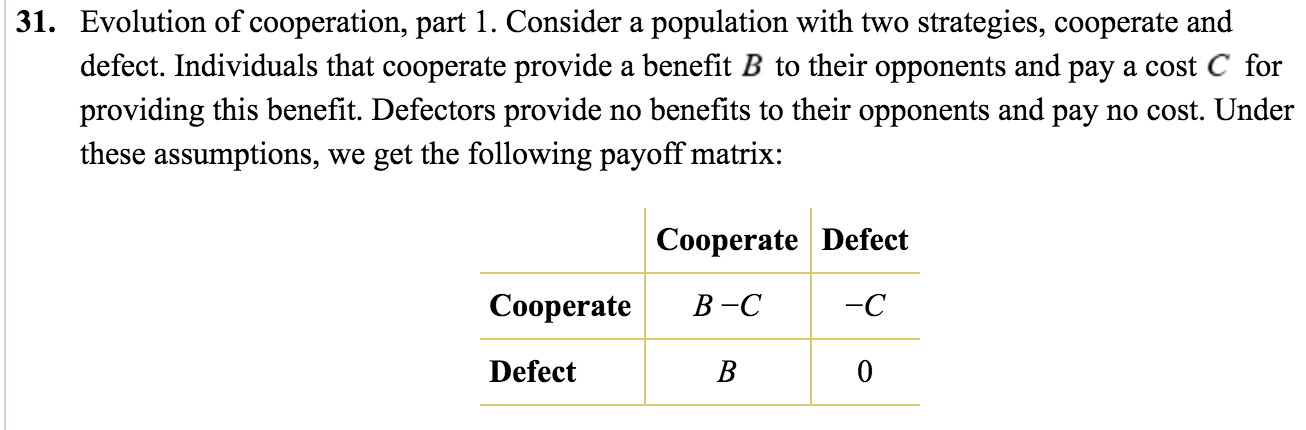
Standard Game Theory Model of Cooperation








Hopefully It’s Interesting.
In Conversation with Legal and Moral Philosophers
PhD, Jagiellonian University
Books, papers, and other jurisprudential things
Ramblings of a retiree in France
BY GRACE THROUGH FAITH
Natalia's space
hoping we know we're living the dream
Lover of math. Bad at drawing.
We hike, bike, and discover Central Florida and beyond
Making it big in business after age 40
Reasoning about reasoning, mathematically.
I don't mean to sound critical, but I am; so that's how it comes across
remember the good old days...
"Let me live, love and say it well in good sentences." - Sylvia Plath
a personal view of the theory of computation
Logic at Columbia University
Just like the Thesis Whisperer - but with more money
the sky is no longer the limit
Technology, Culture, and Ethics
Just like the horse whisperer - but with more pages
Poetry, Other Words, and Cats

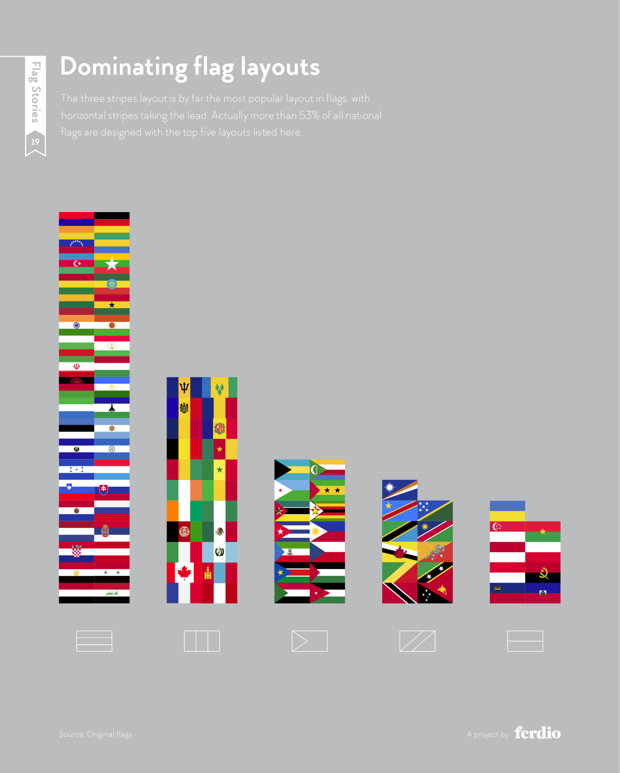 Image credit: Jeppe and Birger Morgenstjerne

 prior probability