Musical and legal interpretation

That is the subject of this beautiful paper by Kevin Toh, a philosopher of law at University College London. (The full title of his scholarly paper is “Authenticity, Ontology, and Natural History: Some Reflections on Musical and Legal Interpretation.”) In addition, Michael B. Coenen, a law professor at LSU in Baton Rouge, has written an excellent review of Professor Toh’s work. As Professor Coenen correctly notes, Toh is not the first to explore the relation between musical and legal interpretation; past and present preeminent legal scholars such as Jerome Frank (“Words and music: some remarks on statutory interpretation“), Richard Posner (“Bork and Beethoven“), and Jack Balkin (“Verdi’s High C“), among many others, have commented on the connection between music and law. But Toh’s extensive research draws from a wide variety of scholars, including literary theorists, philosophers of art, social psychologists, evolutionary biologists, as well as legal theorists. Below the fold is an extended excerpt from Prof Coenen’s masterful review: Continue reading

Posted in Uncategorized | Leave a comment

College Graduation Cap Art

ucf-cap-3ucf-grad-4

ucf-cap-9ucf-cap-11

Check out this incredible and creative collection of some of my favorite college graduation caps from this fall’s commencement ceremonies at the University of Central Florida. (All photos by Carly McCarthy, via UCF Today.) #ChargeOn

Posted in Uncategorized | 1 Comment

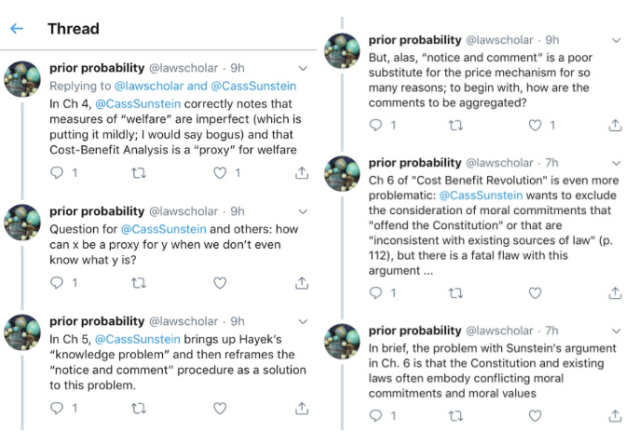
My critique of “The Cost-Benefit Revolution”

Cass Sunstein’s book “The Cost-Benefit Revolution” contains an excellent overview of cost-benefit analysis, so it is a must-read for law students and legal scholars, especially those of us who are interested in the perils and promise of the regulatory state, but without a general theory of harm–i.e. a theory that can tell us which harms should matter in the domains of law and ethics–Professor Sunstein’s cost-benefit approach to regulation is intellectually incoherent.

Screen Shot 2018-12-19 at 1.39.19 AM

Link to my Twitter thread here.

Posted in Uncategorized | Leave a comment

Digital Democracy?

About five years ago, we blogged about Mike Gatto, a California State Assemblyman who had set up the world’s first “Wiki-bill” in order to enable private individuals to help draft an actual law. It turns out that California is not the leader is in this field: Taiwan is! The Republic of China on Taiwan, the official name of the Island of Taiwan, has been experimenting with multiple forms of “digital democracy” since 2016. (The Taiwanese government even has a cabinet-level “digital minister”: Audrey Tang, pictured below.) According to this fascinating and detailed report by Chris Horton, a journalist based in the city of Taipei, Taiwan has used two online discussion platforms to crowdsource some of its laws–one is called Pol.is; the other is vTaiwan. Mr Horton’s report, which was published in The MIT Technology Review on 21 August 2018, explains how these two platforms work, and he also assesses their strengths and weaknesses. In brief, these platforms have generated novel solutions to some intractable problems, such as how to regulate Uber and online alcohol sales, but the recommendations generated by these platforms are not binding on the government. (But is the non-binding nature of these platforms a feature or a bug?)

Image result for taiwan digital minister
Posted in Uncategorized | Leave a comment

Visualization of the frequency of White House press briefings

Hat tip: Tom Wood (@thomasjwood)

Posted in Uncategorized | 1 Comment

How Facebook killed off Vine

Are you still searching for evidence of Facebook’s anti-competitive behavior? Then do I have news for you! A British parliamentary committee conducting an inquiry into Facebook’s anti-competitive business practices recently released a treasure trove of secret Facebook documents, including internal communications from Facebook CEO Mark Zuckerberg and COO Sheryl Sandberg. According to this report by Brian Feldman, “There is not anything particularly outrageous or damning in the emails, but collectively they point to a company whose priorities were self-preservation, revenue generation, and fear of being exposed for dubious privacy practices. It is a far cry from the benevolent, touchy-feely, global-community messaging that Facebook has pushed over the years.” One example of Facebook’s hypocrisy is its treatment of Vine, a once popular video-sharing app that allowed users to share six-second-long looping video clips. According to Feldman’s report, Mark Zuckerberg himself signed off on a measure to destroy Vine: “On the app’s launch day, Justin Osofsky, a Facebook vice president, proposed shutting down Vine’s ability to access Facebook’s friends API [application program interface]. This [tactic] made it difficult for users to find their Facebook friends within Vine, kneecapping the app’s ability to grow–and compete with Facebook. Zuckerberg’s response: ‘Yup, go for it.'”

Image result for facebook destroyed vine
Posted in Uncategorized | 3 Comments

An innocent (almost felon) abroad

That is the title of this short paper by Christopher Balding (@BaldingsWorld) describing a recent low-level but illuminating encounter he had with the Chinese legal system. (Check out Professor Balding’s fascinating Twitter feed here.) Below the fold is one excerpt from Balding’s paper that we found especially poignant: Continue reading

Posted in Uncategorized | Leave a comment

The Economics of Christmas

We’ve blogged about this Yuletide topic on a previous occasion, but now check out the enormously entertaining and enlightening video below in which our friends and colleagues Tyler Cowen and Alex Tabarrok, both of whom teach economics at George Mason University, debate the economics of gift giving:

Posted in Uncategorized | 2 Comments

The Crimes of Michael Cohen

As you may already have heard by now, a federal judge in Manhattan sentenced Michael Cohen, President Trump’s former ad hoc attorney and personal confidante, to three years in “Club Fed.” Mr Cohen had previously pled guilty to four separate criminal charges:

  1. Tax evasion during tax years 2012 to 2016;
  2. Making false statements to a bank in 2015;
  3. Making illegal campaign contributions in support of Mr Trump’s campaign for president in 2016; and
  4. Making false statements to Congress in 2017.

Bonus Questions: (a) What about the way more serious lies John Clapper told to Congress and to the North American public on 12 March 2013? Why isn’t the former Director of the U.S. National Security Agency being charged with the same crime? More bonus questions below the fold: Continue reading

Posted in Uncategorized | 2 Comments

Visualization of USA immigration patterns, 1830-2015

Posted in Uncategorized | 4 Comments