Wales-Sanger Law?

Wikipedia, the free online encyclopedia, was launched on 15 January 2001, and according to this history of Wikipedia (via, where else, Wikipedia, of course!), the English version of this wonderful website (en.wikipedia.org) now contains almost six million articles. (See table below.) If these six million articles were published in book form, they would comprise over 2,500 print volumes of the old-school Encyclopædia Britannica, an imaginary tome of Borgesian proportions! By comparison, the print edition of the actual Encyclopædia Britannica contains only 64,900 articles in 32 volumes, a mere drop in Wikipedia’s proverbial bucket. Also, notice how the number of Wikipedia articles has grown at a fairly constant rate since 2005. When will this growth rate slow down or level off? In the meantime, should we call this constant growth rate “Wales-Sanger Law” in honor of Jimmy Wales and Larry Sanger, the co-founders of Wikipedia?

Source: Wikipedia

Posted in Uncategorized | Leave a comment

Cuba: apartheid for artists

Image result for cuban censorship

Meet the new boss; same as the old boss! Decree 349, one of the first laws signed by Cuba’s new president dictator Miguel Díaz-Canel when he assumed power in April 2018, went into effect on 7 December 2018. (Here is the full text of the law, in Spanish.) Under this draconian decree, all artists are prohibited from operating in public or private without prior approval by the government. Individuals or firms that hire artists without prior authorization can be punished, and artists who work without prior approval can have their materials confiscated or be substantially fined. Below the fold is Amnesty International’s strongly-worded condemnation of this humiliating restriction of artistic freedom in Cuba: Continue reading

Posted in Uncategorized | 2 Comments

Is the future already here?

Science fiction writer William Gibson is reported to have said, “The future is already here–it’s just not very evenly distributed.” Be that as it may, check out the short videos below the fold explaining two futuristic Google projects: a fleet of self-driving cars called Waymo and a self-learning artificial intelligence program called AlphaZero: Continue reading

Posted in Uncategorized | Leave a comment

Kasparov on AlphaZero

Russian chess grandmaster Garry Kasparov has just published a beautiful short essay in the journal Science in which he reviews a new game-playing algorithm called AlphaZero, a chess program that programs itself! Below the fold is an extended excerpt from his excellent essay: Continue reading

Posted in Uncategorized | 3 Comments

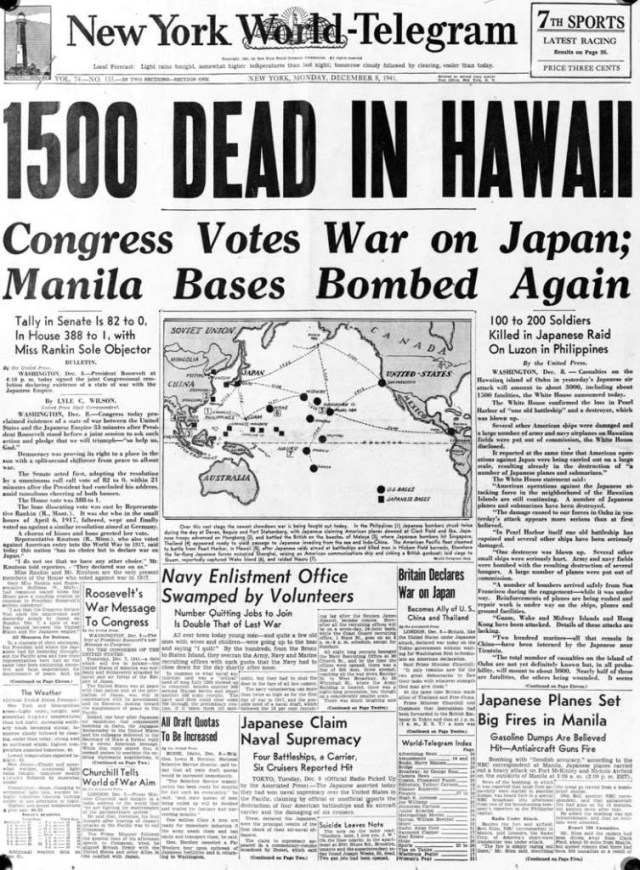
7 December 1941

Today (7 December) is National Pearl Harbor Remembrance Day.

Posted in Uncategorized | Leave a comment

“We traffic in hope …”

That beautiful quote is from “King of the Night” (see video below), a short but poignant documentary about Imad Khachan, the owner of Chess Forum, the last remaining chess shop in New York City. (Hat tip: Kottke.)

Posted in Uncategorized | Leave a comment

Minimalist map of DC traffic circles

Credit: Peter Gorman (check out his work here); hat tip: kottke

Posted in Uncategorized | Leave a comment

Eulogy for the victims of a patrician politician

Sorry to rain on everyone’s H.W. parade, but here is my three-part eulogy for one of the most morally despicable presidents of all time:

  1. Sara Boboltz, via Huff Post: George H.W. Bush White House Once Ordered Drug Buy from Teen for Presidential TV Stunt.
  2. Peter Eisner, via Newsweek: Manuel Noriega, the Invasion of Panama, and How George H.W. Bush Misled America.
  3. Wikipedia: The 1991 Uprisings in Iraq.

H.W. also bequeathed to us the American with Disabilities Act, a law that has generated (and continues to generate) enormous and unnecessary amounts of federal litigation. So, excuse me for asking, but why are we celebrating this disgraced politician, who made so many callous and costly decisions?

Image result for invasion of panama
Posted in Uncategorized | Leave a comment

An intertemporal golden rule: closing thoughts

Note: This post concludes our review of Tyler Cowen’s new book “Stubborn Attachments.”

Although we have expressed deep skepticism about moral discourse (especially utilitarian or consequentialist theories of ethics), we have also taken the position that if we must talk about moral duties towards future generations, we should replace population utilitarianism with an intertemporal golden rule. To sum up our argument thus far, the golden rule combines the best elements of Kantian reasoning (universality) with Humean logic (mutual self-interest). In fact, when it is stripped down to its essential elements, the golden rule can be reformulated in terms of “reciprocal altruism,” a pattern of behavior initially described by Robert Trivers (one of our intellectual heroes) in which an actor (the benefactor) confers benefits on another actor (the recipient) with the expectation that the recipient will repay the benefactor’s generosity in the future. Or in plain English: you scratch my back, and I’ll scratch yours.

But what about our intertemporal golden rule? Can reciprocal altruism work across generations? In our view, the answer is, “It depends.” Specifically, the viability of any form of intertemporal reciprocal altruism will depend on our implicit degree of belief that future generations will also act in the best interests of yet more distant generations. That is, instead of paying us back — a physical impossibility, since we won’t be around in the distant future — we act as if future generations will “pay it forward”! Stated this way, our approach to population ethics resembles the theory of indirect reciprocity in evolutionary biology. (See image below.) There exists an entire body of literature on indirect reciprocity (see here, for example), beginning with Richard D. Alexander’s classic book “The Biology of Moral Systems,” which was first published in 1987, so our idea can’t be too far-fetched. In any case, now that we have laid out our theory of intertemporal reciprocity (i.e. our intertemporal golden rule), we hope that Tyler Cowen and others will one day reconsider their utilitarian approach to population ethics. In the meantime, you should definitely read “Stubborn Attachments” for yourself, for this book is well written and is full of beautiful insights; then be sure to tell us what you think.

Image result for indirect reciprocity

Credit: Martin A. Nowak

Posted in Uncategorized | 1 Comment

Our critique of Stubborn Attachments

Note: This is our penultimate post reviewing Tyler Cowen’s beautiful new book “Stubborn Attachments.”

Thus far, we have focused on only one aspect of Tyler Cowen’s new book: the novel claim that we may owe moral duties to future generations. But we haven’t said anything about Professor Cowen’s overall thesis. According to Cowen, we have a moral obligation to support institutions and pursue policies that promote long-term sustainable economic growth. Stated at this high level of generality, it’s hard to disagree with this thesis. Nevertheless, we now wish to raise three fundamental objections to Cowen’s pro-growth thesis: (a) Cowen’s “sustainability” caveat is an exception that could swallow up his pro-growth rule, (b) Cowen’s ethical theory is superfluous, and (c) if we must talk about ethics or morality, then our proposed “intertemporal golden rule” makes more sense than standard forms of population utilitarianism do. Let’s discuss each of our objections in turn:

(a) Define “sustainable”

Why must Cowen qualify his laudable goal (economic growth) with such vague and slippery concept as “sustainability”? We are certainly not the first to question this oxymoronic concept (see here, for example), but Cowen doesn’t engage or respond to this critical literature. Worse yet, his blind and unqualified insistence on “sustainable” growth condemns his entire project to a pointless exercise in intellectual masturbation. Consider our “excessive” use of fossil fuels. If we continue to use such sources of energy at current rates, there won’t be any fossil fuels left over for future generations to use. So what? Presumably, the sooner we deplete our stock of fossil fuels, the sooner we will create or discover innovative (and cleaner) alternatives to them! In short, either you are pro-growth or you are not.

(b) Spare us your moral lectures

While we agree with Cowen’s overall objective (economic growth), why does Cowen feel compelled to support his economic growth thesis in the metaphysical language of ethics and morality? I am intensely skeptical of most “ethics talk” since I am a moral pluralist, and while I agree with Cowen that we should support institutions and industrial policies that promote economic growth, there is no moral obligation to do so. If there were, we would have a moral duty to condemn hunter-and-gatherer societies and convert them into capitalists.

(c) Just say no (to population utilitarianism)

If, however, we must talk about ethics or morality, then let’s appeal to man’s self-interest instead of trying to create a new man. For the reasons I gave in my previous three posts, let’s return to the golden rule and discard population utilitarianism once and for all. That said, we must still explain how the golden rule could work intertemporally. We will address this key question and conclude our review of Stubborn Attachments in our next post.
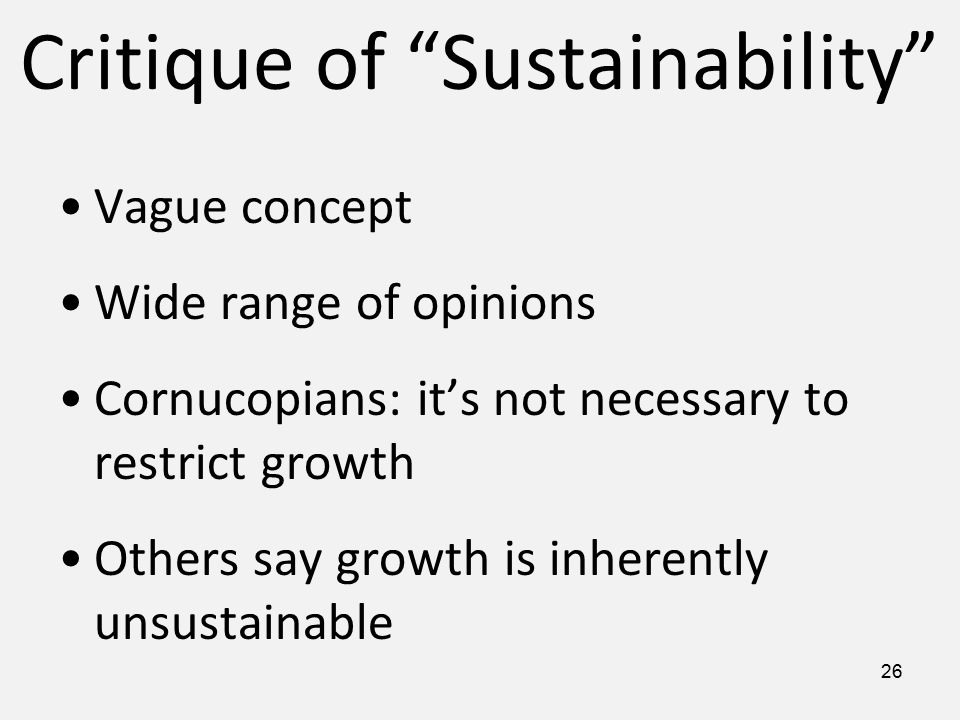
Image result for critique of sustainability

Credit: Abu Khairul Bashar

Posted in Uncategorized | 1 Comment