
This beautiful map of the Florida-Georgia-Alabama line (hand-drawn by Reddit user lemastersg) has made me see my current hometown (Orlando, Fla. — Go Knights!) in a whole new geographical light!
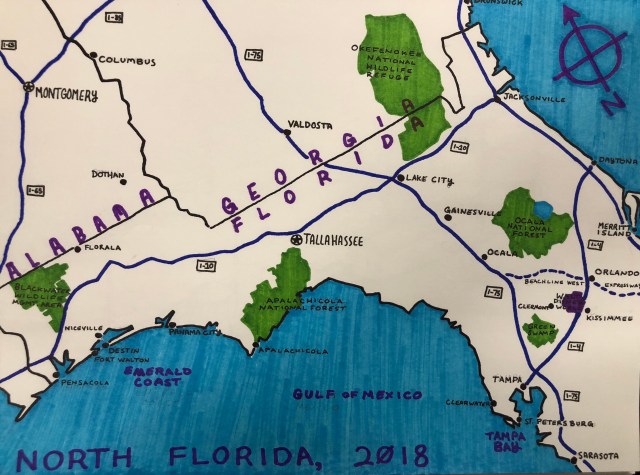
This beautiful map of the Florida-Georgia-Alabama line (hand-drawn by Reddit user lemastersg) has made me see my current hometown (Orlando, Fla. — Go Knights!) in a whole new geographical light!
This is our third and last post on the Wayfair case. In our previous post, we presented a “Coasean critique” of the majority’s rationale in South Dakota v. Wayfair. In brief our critique is: yes, tax loopholes are unfair to certain sectors, but guess what? Getting rid of the loophole would be unfair to others. Today, however, we explore an even deeper problem with the Wayfair case: the majority’s dangerous disregard for the doctrine of stare decisis. Continue reading
Note: this is the second of three blog posts on the Wayfair case. (Our last post will appear tomorrow.)
In our previous post, we patiently restated the facts and identified the main legal and theoretical issues in South Dakota v. Wayfair, Inc., the online sales tax case decided by SCOTUS on 21 June 2018. Today, we will present a Coasean (or is it Coasian?) critique of the majority opinion in this case. To appreciate our analysis, however, we need to back up and say a few words about the late economist Ronald H. Coase, the source of our “Coasean critique.” Continue reading
The U.S. Supreme Court recently decided, by a 5-4 margin, the case of South Dakota v. Wayfair, Inc. (You can read the court’s historic decision for yourself here.) Our analysis of Wayfair will proceed in three parts. First (part I) are the facts and issue spotting: what was this case all about? Next (part II), we will question Justice Kennedy’s fairness-based majority opinion, exposing a fundamental fallacy in his reasoning. Lastly (part III), we will propose a meta-legislative solution (inspired by the work of our colleague Randy Kozel) to strengthen the Supreme Court’s broken stare decisis doctrine. Today, let’s review the facts of the Wayfair case and spot the main legal issues: Continue reading
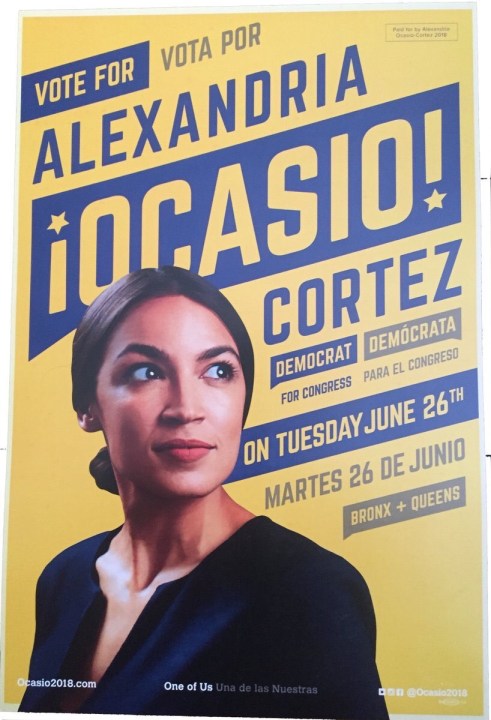
Although we don’t know what to make of her “democratic socialist” politics, we really, really love Alexandria Ocasio-Cortez’s beautiful bilingual campaign poster (pictured below). By the way, will the general election in her district be a good test of the median voter theorem? More fascinating observations about this dark horse candidate here, via hyper-blogger Tyler Cowen (Marginal Revolution).
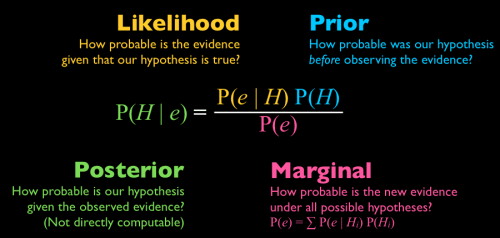
We will be posting our analysis of South Dakota v. Wayfair, Inc., as well as our review of “Finding Law” by Stephen A. Sachs, in the next day or two. In the meantime, given our fascination with all things Bayesian and with the use of probabilistic methods in law, we are adding the following three items (which we will need to print before reading) to our summer reading list:
Source: Emma H. Geller
 Super Eagles on fleek! Via CNBC, Ruth Umoh (@ruthumohnews) reports: “Prior to its official June 1 release date, Nike had already received 3 million pre-orders for the jersey [of the Nigerian National Team] …. That sets a new pre-order record for an African team and even some of the biggest soccer clubs in the world. To put that into perspective, top-three soccer club Manchester United sold the most jerseys globally in 2016, with 2.85 million sales.” (By the way, there is also a thriving market in counterfeit jerseys.) Double hat tip: digg and Vanity Fair.
This is such a beautiful goal, and the Spanish-speaking commentators are the best.
Note: this is our third and last post reviewing Larry Solum’s new paper “Surprising Originalism.”
Thus far, we have assessed the strengths and weaknesses–both “the good” and “the bad”, so to speak–of Larry Solum’s defense of constitutional originalism. Today, however, we survey “the ugly”. Don’t get me wrong. Professor Solum’s “Surprising Originalism” is an excellent paper overall, but he commits a cardinal sin. He neglects to mention the infamous “Three Fifths Compromise” enshrined in the original Constitution [look it up!], a constitutional provision that should give all good faith originalists like Solum some pause. (To his credit, Solum addresses the constitutionally-problematic case of Brown v. Board of Education, the most famous “Living Constitution” case in U.S. history, and his arguments are actually pretty persuasive.) Continue reading
Note: this is the second of a series of posts reviewing Larry Solum’s most recent paper “Surprising Originalism.”
As we mentioned in our previous post, we admire Larry Solum’s Lakatonian spirit–his identification and explication of the most surprising features of constitutional originalist theory. In this post, however, we will identify several problems with Professor Solum’s defense of originalism. Here we go: Continue reading







Welcome to the online home of the IASS
Hopefully It’s Interesting.
In Conversation with Legal and Moral Philosophers
Relitigating Our Favorite Disputes
PhD, Jagiellonian University
Inquiry and opinion
Life is all about being curious, asking questions, and discovering your passion. And it can be fun!
Books, papers, and other jurisprudential things
Ramblings of a retiree in France
BY GRACE THROUGH FAITH
Natalia's space
hoping we know we're living the dream
Lover of math. Bad at drawing.
We hike, bike, and discover Central Florida and beyond
Making it big in business after age 40
Reasoning about reasoning, mathematically.
I don't mean to sound critical, but I am; so that's how it comes across
remember the good old days...
"Let me live, love and say it well in good sentences." - Sylvia Plath
a personal view of the theory of computation
Submitted For Your Perusal is a weblog wherein Matt Thomas shares and writes about things he thinks are interesting.
Logic at Columbia University
Just like the Thesis Whisperer - but with more money
the sky is no longer the limit
Technology, Culture, and Ethics
Just like the horse whisperer - but with more pages
Poetry, Other Words, and Cats

 prior probability