The superfluous legal doctrine of consideration?

Note: This is the third of a series of blog posts in which we review Nate Oman’s new book The Dignity of Commerce: Markets and the Moral Foundation of Contract Law.

As we mentioned in a previous post, Part I of Nate Oman’s book on “The Dignity of Commerce” considers the close relationship between markets and morality, while Part II surveys such specific areas of contract law as the doctrine of consideration, remedies for breach, and contracts of adhesion (i.e. boilerplate contracts). Here, we review Oman’s chapter on the doctrine of consideration, which we consider (pun intended) to be one of the best chapters in the book. Continue reading

Posted in Economics, Ethics, Law, Literature | 2 Comments

Old meets new

We’re soooo late to the La La Land party, but my dear wife and I finally saw this whimsical musical and we absolutely loved it.

Posted in Uncategorized | 1 Comment

Morality distribution channels

Note: This is the second of several blog posts in which we review The Dignity of Commerce: Markets and the Moral Foundation of Contract Law, by Nathan B. Oman.

In our previous post, we introduced Nate Oman’s book on “The Dignity of Commerce.” Professor Oman’s beautiful book is divided into two parts. Part I explores the relationship between markets and morality. Part II then delves into specific areas of contract law, such as the doctrine of consideration, remedies for breach, and boilerplate contracts. We shall review each chapter in Part II in future posts, so here we shall focus on the main idea in Part I: the moral nature of markets. Continue reading

Posted in Economics, Ethics, Law | 1 Comment

Markets and morality (part 1)

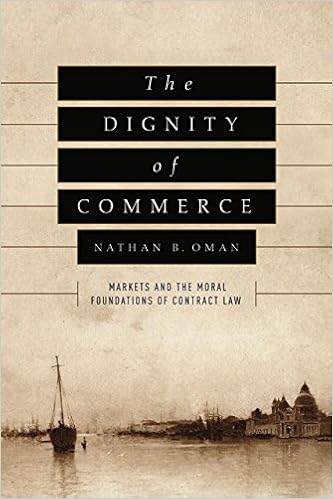
Note: This is the first of six blog posts in which we review Nathan B. Oman’s book The Dignity of Commerce: Markets and the Moral Foundation of Contract Law, University of Chicago Press (2016).

Nate Oman begins his beautiful book on contract law with The Merchant of Venice. At the center of Shakespeare’s classic morality play is a quasi-Faustian pact. A lifeless law professor might describe the voluntary bargain in The Merchant of Venice in dry, analytical terms as follows: S agrees to loan a large sum of money (3000 ducats) to B on the condition that A agree to guarantee repayment the loan. But what makes the simple loan agreement in The Merchant of Venice so memorable is its penalty clause: if the loan is not repaid in full by a certain date, S may elect to obtain a pound of A’s flesh! A Socratic law professor might then pose the following question: why shouldn’t the law enforce this contract? After all, the parties voluntarily and knowingly consented to these terms, however monstrous. (Or, to paraphrase Prince Hamlet: to enforce or not to enforce, that is the question …)

For his part, Oman argues that the formal legal decision whether to enforce the odious agreement between Antonio and Shylock in The Merchant of Venice does not depend on any deep deontological theory regarding moral autonomy or the moral duties of the contracting parties. (Indeed, deep down, we don’t really want the Venetian courts to enforce this wicked promise.) Nor does it matter whether the parties gave meaningful or voluntary consent. (After all, the consensual nature of Shylock’s immortal contract does not detract from its depravity.) More surprisingly, Oman even rejects economic theories such as efficiency or welfare (the holy grail of economic analysis of law) as the legal reason for enforcing voluntary agreements. The legal decision in Shakespeare’s morality tale is not about maximizing the sum total of economic welfare of the Venetian city-state because either wealth is not a value (Ronald Dworkin) or it is but one important value among many others (the rest of us).

There is thus a dramatic tension between our moral intuitions and the mercantile logic of the Rialto in Shakespeare’s play. As Oman observes: on the one hand, the pound-of-flesh contract should not be enforced in the interest of individual justice, but at the same time, the greater good–the integrity of Venetian trade in the future–demands that all commercial bargains be enforced. Oman thus makes an important and insightful observation about the immortal contract in The Merchant of Venice: “In the play, the law enforces contracts in order to make commerce on the Rialto possible” (p. 7). In a word, contract law is about markets, not morality. Why markets and not morality? Oman’s book explores this question in greater detail, and we shall review the rest of his book in future blog posts.

Posted in Economics, Ethics, Law | 1 Comment

Framing effects

Photo credit: F. E. Guerra-Pujol

Posted in Art, Paradoxes | Leave a comment

Happy pi day

Posted in Uncategorized | Leave a comment

Spring break reading list

Here is what we are reading over our spring break:

1. Peter Thiel (with Blake Masters), Zero to one: notes on startups, or how to build the future. We teach business law and are currently writing several chapters of a textbook on “startup law” for the Chicago Business Press, so Thiel’s book is a must-read for us.

2. Nathan Oman, The dignity of commerce: markets and the moral foundations of contract law. This tome can be summed up in four words: “Shylock, meet Adam Smith.” In other words, this beautiful book addresses some fascinating philosophical questions, such as: why does the law enforce (some) promises, and how do markets end up promoting morality? P.S.: We will be blogging about this book in the days to come.

3. Jane Jacobs, Systems of survival: a dialogue on the moral foundations of commerce and politics. This book received some negative reviews (such as this particularly ill-informed and nasty one) when it was first published in 1993, but in our view Jacobs’s thesis is essentially correct. That is, aside from panhandling, there are two ways you can make a living: you can either trade or take.

4. Louise Harmon & Deborah Post, Cultivating intelligence: power, law, and the politics of teaching. At bottom this book, which is billed as the “post-modern version of The Paper Chase,” explores a key question in legal education: is law school just a trade school, or is law school really about the larger world of ideas? (We met Professor Post at a conference in Los Angeles recently, so we are especially looking forward to this read.)

5. Richard Dawkins, Brief candle in the dark: my life in science. This is the second volume of Dawkins’s memoirs. (Will there be more installments, or is Professor Dawkins done for now?) Although we reject Dawkins’s gratuitous and ungracious anti-Islamic asides, we strongly recommend the chapter on “evolutionary economics.”

Image result for spring break

Come read books with us!

Posted in Academia, Bayesian Reasoning, Economics, Ethics, Law | 2 Comments

Happy Daylight Saving Time Day

Not! (Hey, if we can’t get our corrupt and lazy lawmakers to end daylight saving time, then at the very least let’s change the name of Daylight Saving Time Day to “Path Dependence Day.” In the meantime, can you think of any other examples of path dependence?)

Image result for end daylight savings time

Photo credit: Hannah Jane DeCiutiis

Posted in Bayesian Reasoning, History | 2 Comments

Sara Berman’s closet

Among other things, the Metropolitan Museum of Art features 21 period rooms in its American Wing, ranging from a 17th-century colonial interior to an enormous Prairie-style living room by Frank Lloyd Wright, but as Penelope Green reports, “the newest addition [to the Met] … is an unexpected meditation on modern city life: a modest closet from a studio apartment in the West Village, filled with the curious, lovely, and very particular personal effects of Sara Berman, a Belarussian and Israeli émigré …” According to the Met, the artists Maira and Alex Kalman (who are also Berman’s daughter and grandson), inspired by the beauty and simplicity of Berman’s closet, have recreated her closet and its contents as an art installation.

Posted in Art, Culture | Leave a comment

Curious carvings

How do you like them apples? These curious carvings were created by Gaku, an imaginative and inventive Japanese artist whose canvas consists of perishable fruits and vegetables. (Hat tip: Kottke.)

Image result for gakugakugakugakugaku1Related image

Image result for gakugakugakugakugaku1

Posted in Art | Leave a comment