Product placement 101

Matt Thomas just brought this beautiful TV ad to our attention via his blog. The ad in question is composed of a series of movie scenes featuring the iconic Rolex watch. (In several of these classic scenes, the actors actually refer to the brand by name!) Some marketing scholars, however, claim that product placement is an unethical business practice and should be regulated by law. (See here, for example.) We totally disagree with this claim. Whether product placement is ethical or not (i.e. a form of deception), regulating this practice would probably do more harm than good. After all, how could a director shoot a motion picture without placing any products in his film?

Posted in Deception, Ethics, Law | Leave a comment

Close to zero

As we approach the end of the winter season, what are the chances of finding two identical snowflakes? According to physicist Jon Nelson (via Popular Mechanics), the chances are “essentially zero.” Or, to be more mathematically precise, the chances are one divided by 1,000,000,000,000,000,000,000,000,000,000,000,000,000,000,000,000,000,000,000,000,000, 000,000,000,000,000,000,000,000,000,000,000,000,000,000,000,000,000,000,000,000,000,000, 000,000,000,000,000,000,000,000,000,000,000,000,000,000,000,000,000,000,000,000,000, 000,000,000,000,000,000,000,000,000,000,000,000,000,000,000,000,000,000,000,000,000, 000,000,000,000,000,000,000,000,000,000,000,000,000,000,000,000,000,000,000,000,000, 000,000,000,000,000,000,000,000,000,000,000,000,000,000,000,000,000,000,000,000,000, 000,000,000,000,000,000,000,000,000,000,000,000,000,000,000,000,000,000,000,000,000, 000,000,000,000,000,000,000,000,000,000,000,000,000,000,000,000,000,000,000,000,000, 000,000,000,000,000,000,000,000,000,000,000,000,000,000,000,000,000,000,000,000,000, 000,000,000,000,000,000,000,000,000,000,000,000,000,000,000,000,000,000,000,000,000, 000,000,000,000,000,000,000,000,000,000,000,000,000,000,000,000,000,000,000,000,000, 000,000,000,000,000,000,000,000,000,000,000,000,000,000,000,000,000,000,000,000,000, 000,000,000. (The enormous denominator in this fraction is the number of possible snowflake shapes there are: one followed by 768 zeros.) By the way, the image below, via Rian Dundon, is a reproduction of one of the first photographs of a snowflake:

Credit: Wilson Bentley

Posted in Culture, Mathematics, Probability, Science | 4 Comments

The End of Risk-Taking?

Our friend and colleague Tyler Cowen has just published a new book with a catchy title: The Complacent Class. At the risk of over generalization (pun intended), Professor Cowen’s book claims that North Americans are becoming intellectually lazy and spiritually complacent–more willing to settle for small or marginal improvements in existing methods and things and less willing to test risky and revolutionary large-scale ideas and projects. (Really? Sorry Elon Musk!) Professor Cowen is also producing a series of short and engaging lectures on video explaining the main ideas from his book. Although we disagree with Professor Cowen’s gloom and doom thesis, his videos are worth watching. (Self-recommending, as he likes to say!) Here is the first installment:

Posted in Bayesian Reasoning, Economics, History | 2 Comments

Type I or Type II error?

Was this situation a false positive or a false negative?

Image result for oscar mixup

Getty Images

Posted in Bayesian Reasoning, Questions Rarely Asked | 2 Comments

Class No. 7 (Right and Wrong)

Thus far this semester, we have studied sources of law as well as three major areas of private law: contracts, torts, and property. In our next class, by contrast, we will focus on the extralegal domains of ethics and morality: how should we decide between right and wrong? To this normative end, we will consider the following three major theories of moral philosophy, i.e. three competing theories for deciding between right and wrong: (1) consequentialism, an instrumental theory of ethics originating with the great British essayist David Hume, (2) universal moral duties, an influential theory of morality developed by the great German philosopher Immanuel Kant, and (3) the highly original contractarian theory of justice proposed by Hungarian-American economist John Harsanyi as further developed by Harvard professor John Rawls. In addition, we will debate whether the fictional Mark Zuckerberg (as portrayed by the actor Jesse Eisenberg in the movie “The Social Network”) flouted Harvard College’s Honor Code in his dealings with the Winklevoss twins. Also, beyond the narrow walls of the Ivory Tower–i.e. in the broader world of commerce and markets–what does a motto like “don’t be evil” mean?

Image result for don't be evil slogan

Define “evil”!

Posted in Ethics, Law | Leave a comment

Markets and morality

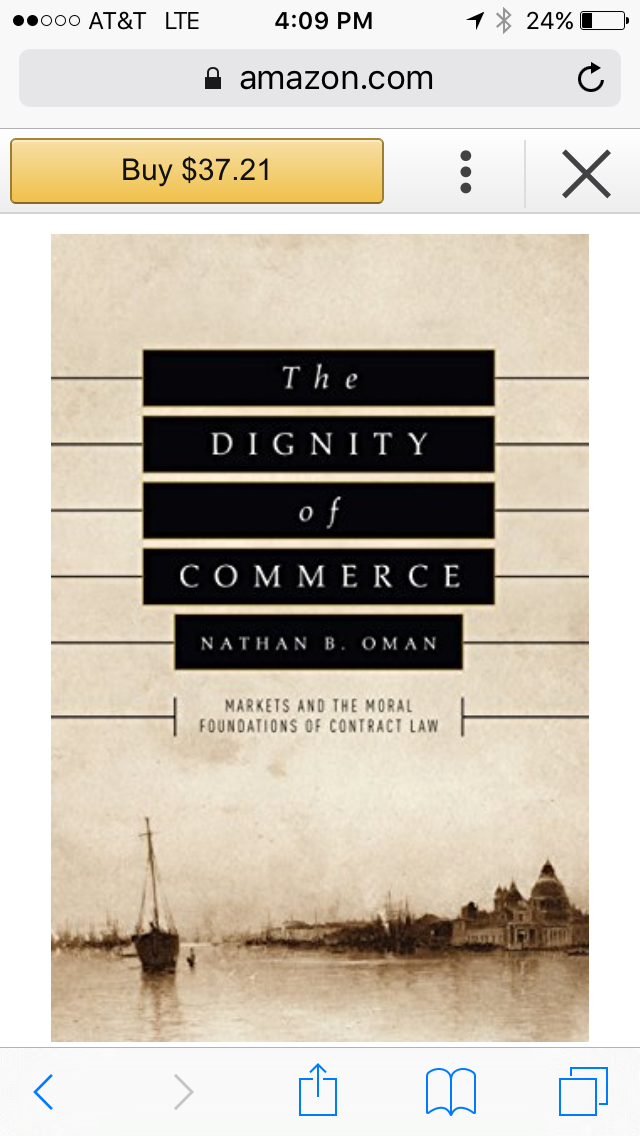
We have been attending the 12th Annual International Conference on Contracts (KCON XII) at Southwestern Law School in downtown Los Angeles this weekend (fun!). One of our favorite talks at the conference was by Nathan Oman, a law professor at the College of William & Mary, who presented his new book The Dignity of Commerce: Markets and the Moral Foundations of Contract Law (U Chicago Press, 2017). In summary, Professor Oman argues that the main purpose of the law of contracts is to promote commerce and well-functioning markets. Moreover, he claims that markets are morally desirable in and of themselves. Why? Because markets not only promote economic efficiency (i.e. the allocation of assets to their highest valued uses); markets also facilitate social cooperation and communal harmony. Specifically, markets enable people to serve the needs of others and cooperate in mutually beneficial ways even in the absence of political, religious, or ideological agreement. (This last point–the ability of markets to meet human needs and bring diverse and self-interested actors together–deserves more attention in the legal academy.) 

Posted in Uncategorized | Leave a comment

Bad Promises

We know that a promise to do something illegal (like cooking and distributing meth) is not legally enforceable, but what moral status does such an illegal promise have? We address this question in our work in progress on Immoral Promises, which we are presenting this morning at Southwestern Law School in downtown Los Angeles.

Posted in Uncategorized | Leave a comment

Gaming the Electoral College

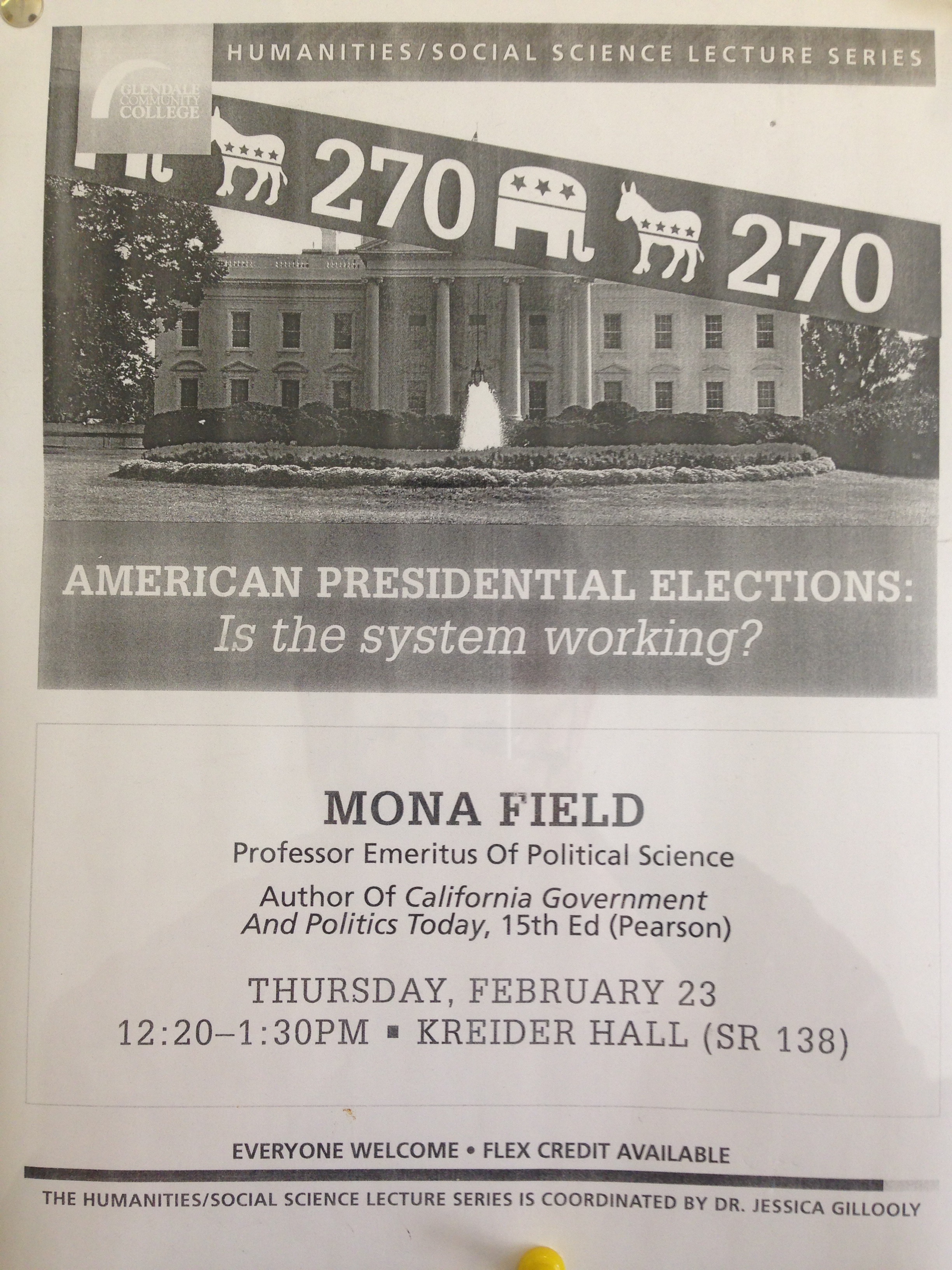
We just attended Professor Mona Field’s guest lecture on “American Presidential Elections” at Glendale Community College (see flyer below). Among other things, Prof. Field talked about the National Popular Vote Interstate Compact. In summary, this novel compact is designed to circumvent the archaic Electoral College system set forth in the Constitution. Specifically, States who join the compact thereby pre-commit to award their respective electoral college votes to the presidential candidate who wins the overall popular vote in all 50 States. Thus far, ten States (and D.C.) have already voted to join the compact, and these States represent 165 Electoral College votes. So, is this novel compact constitutional? Can we change the Constitution without formally amending it?

Posted in Uncategorized | 7 Comments

What is a light-year?

The journal Nature recently published this letter announcing the exciting discovery of seven exoplanets 40 light-years away from Earth: only 235 trillion miles away! Does this mean it would take us 40 Earth years to reach those planets if we could travel as fast as the speed of light? The infographic below says light-years are a measure of distance, not a measure of time. Bonus question: Why can’t we travel faster than the speed of light, or can we?

Credit: niks1rocks, via SlideShare

Posted in Uncategorized | 5 Comments

Why is English the official language of Florida?

We totally understand why such insignificant states like Idaho or Nebraska might want to enact such insular and small-minded legislation. But California and Florida …? 

Hat tip (via Reddit): wildeastmofo

Posted in Uncategorized | 34 Comments