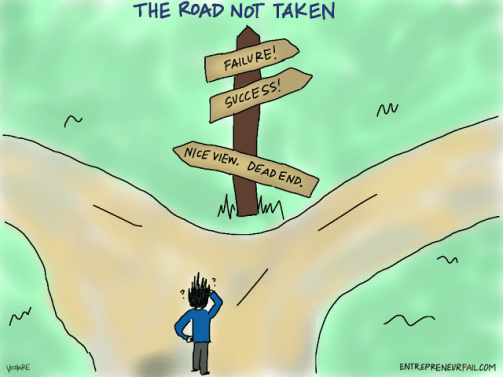
Start-up road map

Check out this fascinating article by BBC Business News reporter

Start-up road map

Posted in Bayesian Reasoning, Maps | Leave a comment

Honor Code (Lessons 8 & 9)

This wasn’t right, damn it. This wasn’t fair.” –Quote attributed to one of the Winklevoss twins in Ben Mezrich, The Accidental Billionaires.

In our next lecture, we are going to re-enact another pivotal scene from the film “The Social Network” (see the YouTube clip posted below), a scene based on chapter 16 of the bestseller The Accidental Billionaires. (Cf. the fascinating prologue in Aaron Greenspan’s book Authoritas (ThinkPress, 2008), a memoir of his years at Harvard.) This scene takes place in the spring of 2004 in the office of Larry Summers, the former U.S. Treasury Secretary and distinguished economist who was the president of Harvard University at the time. In summary, Tyler and Cameron Winklevoss arrange a meeting with the president of Harvard (in real life, they waited in line like everyone else to meet Dr Summers during his monthly office hours), and they are going to accuse a fellow student (sophomore Mark Zuckerberg) of violating Harvard’s Honor Code, which reads as follows:

Members of the Harvard College community commit themselves to producing academic work of integrity – that is, work that adheres to the scholarly and intellectual standards of accurate attribution of sources, appropriate collection and use of data, and transparent acknowledgement of the contribution of others to their ideas, discoveries, interpretations, and conclusions. Cheating on exams or problem sets, plagiarizing or misrepresenting the ideas or language of someone else as one’s own, falsifying data, or any other instance of academic dishonesty violates the standards of our community, as well as the standards of the wider world of learning and affairs.

We will thus need three students to re-enact this pivotal scene: one to play the role of President Summers and two to play the roles of Tyler and Cameron Winklevoss. In the meantime, please think about the following three questions:

1. In your opinion, are the twins right? Did Zuckerberg violate the Honor Code?

2. Does Harvard have “jurisdiction” (i.e. legal authority) to investigate this alleged breach of the university’s honor code?

3. If this dispute is not a matter under Harvard’s jurisdiction, then what court would have jurisdiction to hear the Winklevoss’s allegations, a State court of general jurisdiction or an Article III federal tribunal?

In addition to the technical legal issue of “subject-matter jurisdiction” (i.e. the legal authority of a court to hear a case), we will also discuss the fundamental issue of personal ethics. Simply put, how do you decide between right and wrong?

Posted in Ethics, Law | Leave a comment

Memorial Day

Posted in Art, Bayesian Reasoning, Cooperation, Culture | Leave a comment

Prisoner’s dilemma everywhere: weekend email from your boss edition

As our friends and fellow “forty-something” bloggers at Cheap Talk like to point out, prisoner dilemmas are everywhere. Suppose you are a junior manager at a large Fortune 500 corporation or a junior attorney/accountant at a firm. Your boss sends you an email on a Saturday. Monday is a national holiday. Do you respond immediately, or do you wait until Tuesday morning to reply? We suspect that the answer to this question depends on whether you think your boss has also sent emails out to any of your peers. If you wait until Tuesday to reply to your boss’s email, while your peers respond immediately to theirs, you look bad to your boss. If, however, your peers decide to wait until Tuesday to reply, then you should reply right away to your boss, since you will now look good. In other words, in the parlance of game theory, you should “defect” and respond immediately to emails from your boss in either case, regardless what your peers do.

Posted in Cooperation, Deception, Economics, Game Theory | Leave a comment

Nate Silver gets it; Tyler Cowen does not

Two of our favorite public intellectuals on the Internet (is that an oxymoron?) are Nate Silver (fivethirtyeight) and Tyler Cowen (marginalrevolution). We admire Professor Cowen because he is one of the few economists interested in human nature and culture. He teaches a course in “Law & Literature” and is a voracious reader of Latin American literature. (We studied Latin lit in college, and our academic field is law.) We admire Nate Silver because he has almost single-handedly dismantled the pernicious media monopoly of partisan political commentators or “pundits” in traditional print and TV media. We now admire Silver for his intellectual honesty. Recently, he wrote up a mea culpa titled “How I acted like a pundit and screwed up on Donald Trump“; here is an excerpt (emphasis added; footnote omitted):

Without having a model, I found, I was subject to a lot of the same biases as the pundits I usually criticize. In particular, I got anchored on my initial forecast and was slow to update my priors in the face of new data. And I found myself selectively interpreting the evidence and engaging in some lazy reasoning. Another way to put it is that a model gives you discipline, and discipline is a valuable resource when everyone is losing their mind in the midst of a campaign.

Then there is Tyler Cowen’s highly speculative, over-generalized, and (frankly) insulting cultural explanation of the rise of Trump titled “What the hell is going on?“; here is an excerpt (emphasis and ellipsis in the original):

The contemporary world is not very well built for a large chunk of males. The nature of current service jobs, coddled class time and homework-intensive schooling, a feminized culture allergic to most forms of violence, post-feminist gender relations, and egalitarian semi-cosmopolitanism just don’t sit well with many…what shall I call them? Brutes? Quite simply, there are many people who don’t like it when the world becomes nicer.  They do less well with nice.  And they respond by in turn behaving less nicely, if only in their voting behavior and perhaps their internet harassment as well.

Nice try, Tyler … After all, we understand academics are supposed to speculate about the nature of the world, but one’s speculations should at the very least be insightful and internally consistent. The problem with Professor Cowen’s “brutes” argument is that it is neither. If the world really is such a “nicer” place (how do we measure “niceness,” by the way?), why are so many car bombs going off in the Middle East and commercial planes getting blown up?

Via: quotesgram.com

Posted in Bayesian Reasoning, Current Affairs | Leave a comment

Bank Robbery Map

https://i0.wp.com/i.imgur.com/r88elEo.png

Hat tip: Ramesses_Deux (via reddit)

Posted in Maps, Questions Rarely Asked | 4 Comments

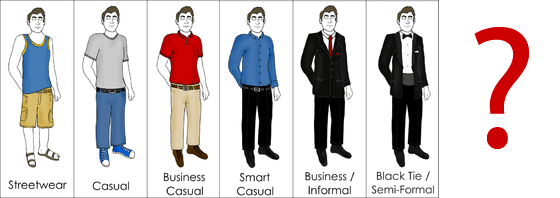
Are employer dress codes illegal?

Vanessa Friedman has written a fascinating short essay titled “The End of the Office Dress Code.” In addition to her insightful interview of Susan Scafidi, a law professor at Fordham University and director of the Fashion Law Institute, Ms Friedman raises many interesting questions about the legality of dress codes at work. She also raises deeper questions about the meaning of such vague terms as “professional” or “business casual,” like this one:

One person’s “appropriate” can easily be another’s “disgraceful,” and words like “professional,” when used to describe dress requirements, can seem so vague as to be almost meaningless. Kanye West wearing ripped jeans and a jeweled Balmain jacket at the Met Gala: cool or rude? Julia Roberts at the premiere of “Money Monster” at Cannes this year in bare feet: red carpet pioneer or a step too far?


Posted in Culture, Law | Leave a comment

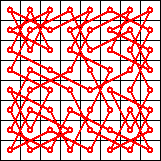
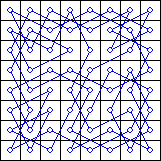
Dmitry Brant solves the knight’s tour problem

According to Wikipedia (emphasis in original; footnote omitted): “A knight’s tour is a sequence of moves of a knight on a chessboard such that the knight visits every square only once. If the knight ends on a square that is one knight’s move from the beginning square (so that it could tour the board again immediately, following the same path), the tour is closed, otherwise it is open.

“The knight’s tour problem is the mathematical problem of finding a knight’s tour. Creating a program to find a knight’s tour is a common problem given to computer science students. Variations of the knight’s tour problem involve chessboards of different sizes than the usual 8 × 8, as well as irregular (non-rectangular) boards.”

Knight’s Tour on an 8×8 board:

Not a Knight’s Tour, but still a solution:

More info here (via DimityBrant.com). Hat tip: Cliff Pickover.

Posted in Mathematics | 3 Comments

Is it too late for Mitt Romney or John Kerry to run as an independent?

Who you got? ‘Crooked Hillary’ or ‘Mein Trumpf’?

Posted in Uncategorized | Leave a comment

The Law of Ideas

I’m thinking we keep it simple and call it the facebook.”

–Harvard sophomore Mark Zuckerberg, as quoted in Ben Mezrich, The Accidental Billionaires.

When Mark Zuckerberg registered the domain name for “thefacebook” and began building his new website in late 2003 and early 2004 (the original Facebook homepage is pictured below), he was potentially creating several valuable forms of intellectual property. But what type or types of intellectual property was Zuckerberg creating? Accordingly, in our next lecture we will study intellectual property rights or the “law of ideas,” including copyrights and trademarks (Lesson 6) as well as trade secrets (Lesson 7). Specifically, we will explore the relation between these major forms of intellectual property and the launching of the original Facebook website on 4 Feb. 2004.

Bonus IP question: By the way, what do you think about intellectual property rights in tattoos? (My former student Talina Santiago posed this problem to me a few years ago in Ponce, P.R., and her question still resonates with me all these years later.) Specifically, can you copyright a tattoo design, and if so, who would own the legal rights to the tattoo design: the tattoo artist or the person who paid for the tattoo? We will consider the 2011 “Mike Tyson tattoo case” (Whitmill vs. Warner Brothers, Case No. 4:11-cv-752), and try to answer these questions in class. Specifically, we are going to re-enact an informal mediation session in our next class, based loosely on the facts in the actual Mike Tyson tattoo case. In summary, tattoo artist S. Victor Whitmill created a face tattoo for boxer Mike Tyson in 2003. As the creator of this world-famous tattoo, he sued Warner Bros. for using his design in one of its films (The Hangover: Part II) without the artist’s express authorization. (In addition, for this exercise, let’s assume that Mike Tyson is also suing the movie studio on the theory that he, not the artist, owns the legal rights to his face tattoo. After all, it’s his face!) Warner Brothers’ position, of course, is that tattoos cannot be copyrighted.

In real life, this interesting case was settled out of court through mediation, so in our next class, we are going to re-enact this mediation session. Accordingly, we will need several volunteers for this activity:

  • Mike Tyson: Your role is to explain why you own the legal rights to your face tattoo.
  • S. Victor Whitmill (tattoo artist): Your role is to explain why you own the legal rights to Mike Tyson’s face tattoo.
  • Kevin Tsujihara (CEO of Warner Brothers): Your role is to explain why tattoos cannot be copyrighted as a matter of law.
  • The mediator: The class as a whole will play the role of the mediator and will vote on what course of action to recommend to the judge in this case.
Posted in Ethics, Law | Leave a comment