Three-player chess vs. 3-D chess

3 Player Large Wood Chess Set

Hat tip: Cliff Pickover

Posted in Culture, Games | Leave a comment

We want one of these!

Check out this short video featuring an assortment of volocopters or lightweight personal helicopters designed and manufactured by the German firm e-volo. Forget drones; we’d rather have our own personal “VC 200” to travel around our home state (Florida). Wow, we are much closer to flying cars than we thought!

Posted in Science Fiction, Web/Tech | 1 Comment

When moral and legal principles collide …

Economist extraordinaire Tyler Cowen poses the following thought-provoking question via Twitter: “Are your views on privacy and consistent? Just asking …” In other words, when two great moral or legal principles are in conflict with each other — such as the “fundamental” right to privacy on the one hand and the equally fundamental right to information on the other — then which principle should give way to the other?

Posted in Ethics, Law | Leave a comment

Geometrical Sand Castles

castle-3

Artist Credit: Calvin Seibert

Posted in Art, Mathematics | Leave a comment

Our favorite research poster 

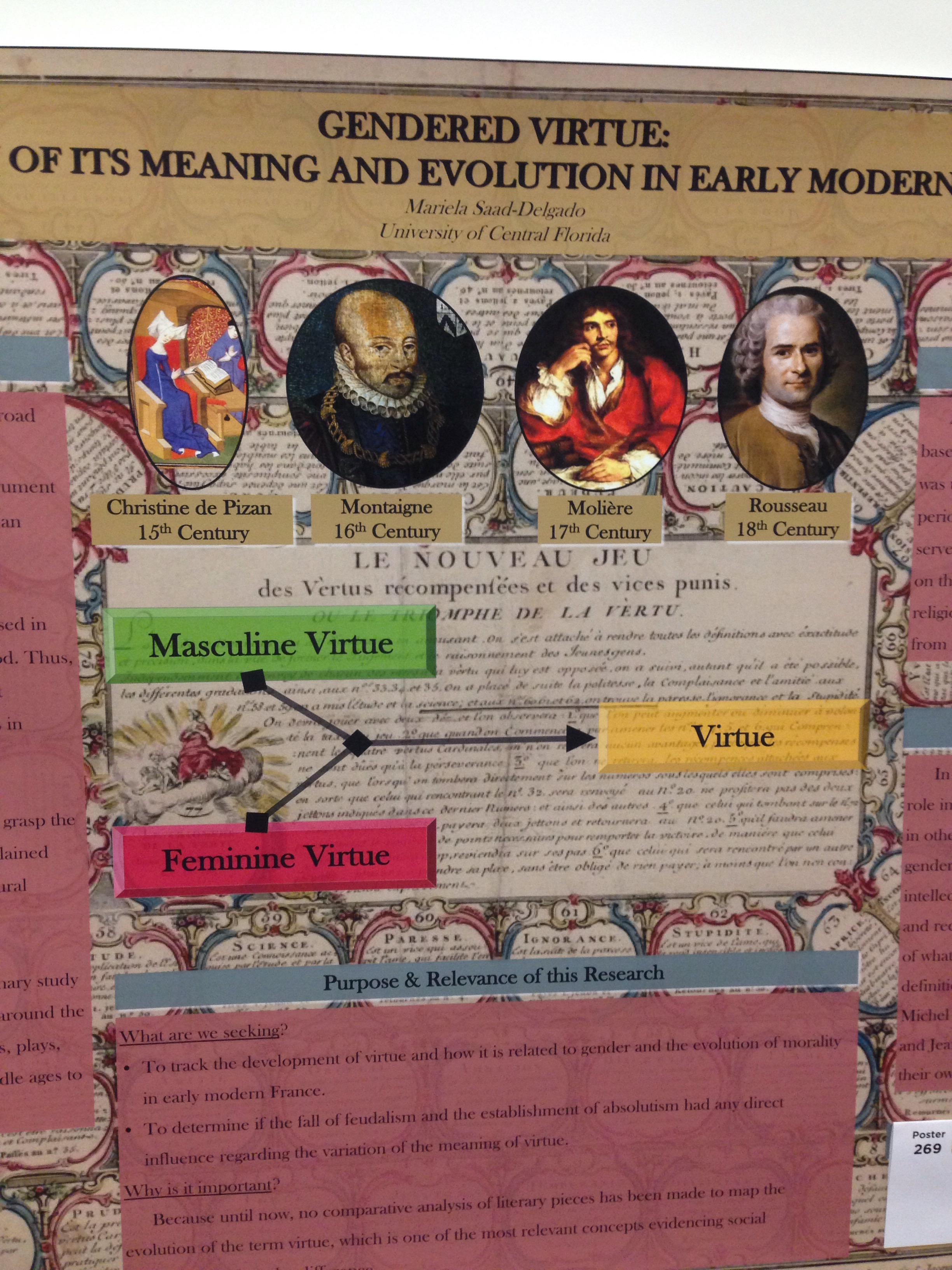
We have been celebrating Research Week at our home institution, the University of Central Florida (UCF). Our Research Week culminated today with the Showcase of Undergraduate Research Excellence, featuring over 300 student poster presentations, representing over 50 majors. One of our favorite research posters from today’s showcase was titled “Gendered Virtue: A Study of Its Meaning and Evolution in Early Modern France” (pictured below). Props to Mariela Saas-Delagado for her research contribution and for preparing such a beautiful poster.

Credit: Mariela Saad-Delgado

Posted in Academia, Art, Culture, Ethics, History, Philosophy | Leave a comment

“You better lawyer up …” (Litigation & ADR)

We’re almost done this semester! For Lessons 18 & 19, we will review the main stages of litigation, including the pleadings stage, discovery, and the decision whether to settle or go to trial. In other words, we will study how our legal system really works in practice when one party sues another. We will also consider several “alternative dispute resolution” or ADR methods (i.e. streamlined alternatives to costly and cumbersome litigation), such as mediation and arbitration.

To illustrate these dispute resolution lessons, we will focus in particular on Mark Zuckerberg’s alleged betrayal of his best friend and business partner — Facebook co-founder Eduardo Saverin — and we will revisit their resulting legal battle. Specifically, in the movie version of the bestselling book The Accidental Billionaires: The Founding of Facebook: A Tale of Sex, Money, Genius, and Betrayal, Eduardo threatens to sue Mark when he finally realizes that his original 30% stake in Facebook has been diluted all the way down to “point zero three percent.” In the most dramatic scene of the movie (pictured below), Eduardo confronts Mark: “You better lawyer-up, asshole, ’cause I’m not coming back for my 30 percent, I’m coming back for everything!” In other words, Eduardo threatens to sue Mark and Facebook for significant monetary damages … But what evidence will Eduardo need to prove his case, and how will he be able to obtain this evidence? To delve into these key questions, we will divide the class up into two opposing camps, Team Saverin and Team Zuckerberg:

  1. Team Saverin (go Brazil!): If you think that Mark breached his fiduciary duty to Eduardo by cheating him out of his original 30% equity stake in Facebook, what evidence will you need to prove Eduardo’s case?
  2. Team Zuckerberg (go nerds!): If you’re are on Mark’s side (if you think Mark did not breach any fiduciary duties and was right to force Eduardo out of Facebook), what evidence will you need to defend Mark against Eduardo’s lawsuit?
Posted in Law | Leave a comment

Blueprints for “The Great Wall of Trump”

An engineer recently drew up a “quick design” (pictured below) of Donald Trump’s proposed USA-Mexico border wall. (You can read the full technical analysis of what it would take to build such a massive project here.) This particular design consists of I-shaped concrete columns spaced at 10 feet on center, with eight-inch-thick wall panels spanning in between them. In this design, the only concrete that would need to be cast on site would be for the foundations of the wall. The columns of the wall would be anchored to the foundations, and the wall panels would be slipped in place from above.


Posted in Current Affairs, Economics, Law, Mathematics, Politics | Leave a comment

How to hide a billion dollars (legally?)

Posted in Cheating, Current Affairs, Law | Leave a comment

A question for Professors Fried & Shiffrin

Charles Fried is best known (among scholars of contract law) for his “contract as promise” thesis, while Seana Shiffrin is widely known for her influential 2007 Harvard Law Review article on the divergence between contract and promise. We too are very much interested in the morality of promising — especially the problem of “illegal agreements” — and we now wish to pose a simple question to Professors Fried and Shiffrin: why doesn’t criminal law apply to breaches of contract? That is, if breaching a contract (or breaking a promise generally) is such a terrible or immoral act, then one might expect to see some overlap between criminal law and contract law, just like we see between some crimes and some intentional torts, like fraud, assault and battery, theft (conversion), false imprisonment, etc.

Our simple question to Professors Fried and Shiffrin (and their kind) is not an exercise in idle speculation. After all, some illegal agreements — such as certain restraints of trade and other monopolistic conspiracies — might generate not only civil but also criminal liability. Here, however, our focus is not on illegal agreements like price fixing or market allocation (or drug sales). Instead, our focus is on run-of-the-mill or garden-variety breaches of contract, for which only “civil” remedies are available, such as (i) the payment of monetary compensation or, in some rare cases, (ii) the remedy of specific performance, but never the criminal sanctions of imprisonment or regulatory fines. In brief, bare breaches of contract are beyond the scope of criminal law. Why?

Image Credit: Audrey Calhoun

Posted in Cooperation, Law, Philosophy | Leave a comment

Old versus new: New Zealand flag referendum update

The old-school flag wins!

Posted in Culture, Current Affairs | 1 Comment