Facebook, Inc. (Lessons 16 & 17)

It wasn’t about two kids in a dorm room anymore.” –Chapter 25 of The Accidental Billionaires.

In our next class, we will revisit two critical events in the founding of Facebook: (i) Eduardo Saverin’s fateful decision to freeze Facebook’s bank account in July of 2004, and (ii) Facebook’s subsequent decision to become a Delaware corporation after venture capitalist Peter Thiel made a $500,000 angel investment in the social network startup. We will also address two important business law questions relating to these critical events:

  • Question #1: Did Eduardo breach any of his fiduciary duties to Facebook when he froze the company’s bank account in July of 2004?
  • Question #2: Why did Facebook, with headquarters in California, decide to become a Delaware corporation?

In addition, we will re-enact another crucial scene from the movie “The Social Network” — the scene in which Mark chastises Eduardo for freezing the bank account — so we will need two volunteers for this activity: one to play the role of Facebook CEO Mark Zuckerberg; the other to play the role of Facebook CFO Eduardo Saverin.

Posted in Law | Leave a comment

Apple is 40 yrs. old today

More here, via kottke. Addendum (4/26): Not April Fools: Apple’s revenues decline for the first time in 13 years. Blame Tim Cook and the pointless Apple Watch? Via The Verge, Ben Popper writes:

Apple posted a year-over-year decline in revenue today, the first time the company’s failed to grow its business in 13 years. It brought in $50.6 billion in revenue for the second quarter of 2016, and $10.5 billion in profits. That compares with $58 billion in revenue and $13.6 billion in profits during this period last year, a drop of 13 percent for the revenue. *** Apple isn’t doing badly, it is still one of the most valuable and profitable companies in the world. In India, iPhone sales were up over 50 percent compared with 2015. But it hasn’t found a new blockbuster product to pick up the slack as iPhone sales have slowed in many parts of the globe. *** The Apple Watch was the last major category of new hardware the company introduced. It quickly became a billion dollar business, but so far hasn’t shown the kind of mainstream appeal that made the iPod, MacBook, and iPhone such massive sellers. The details of Watch sales are still lumped in with “Other Products,” and that was the worst performing piece of Apple’s business this quarter.

Posted in Culture, Web/Tech | Leave a comment

Is Puerto Rico underpopulated?

Here is a real-time example of people “voting with their feet.” We lived in Puerto Rico from 1993 and 2009, and we can tell you that Puerto Ricans are severely overtaxed by their government, regardless of which political party is in power, and since citizens of Puerto Rico are also citizens of the United States, they are free to move to the U.S. without a passport. By the way, the full report about the decline in Puerto Rico’s population is here, via the Pew Research Center. In any case, what is the optimal level of population growth on a small Caribbean island (our home from 1993 to 2009)?

Posted in Current Affairs, Economics, Politics, Questions Rarely Asked | Leave a comment

Kitchen art (Loch Ness serving spoon edition)

Nessie Ladle Nessie Ladle Nessie Ladle Nessie Ladle

Available at Animi Causa — hat tip: Andrew Liszewski, via Gizmodo.

Posted in Art, Culture | Leave a comment

The evolution of computer hardware

Screen Shot 2016-03-28 at 8.39.01 PM

Hat tip: our friends at Deviant Art

Posted in Art, Web/Tech | 1 Comment

Coming soon: Star Trek stamps

Hat tip: Kyle Anderson, via Nerdist.

Posted in Art, Culture, Science Fiction | 1 Comment

Easter egg bot

Posted in Art, Culture, Mathematics | 1 Comment

Should we repeal the Infield Fly Rule?

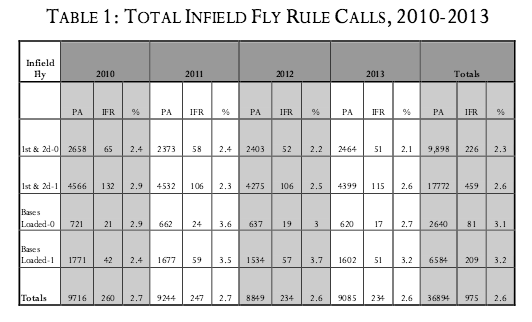
Believe it or not, the infield fly rule in baseball has generated extensive scholarly commentary over the years, beginning with William S. Stevens’ 1975 paper “The Common Law Origins of the Infield Fly Rule.” The most recent contributions to this literature are Andrew J. Guilford and Joel Mallord’s ten-page paper “Time to Drop the Infield Fly Rule and End a Common Law Anomaly” as well as Howard M. Wasserman’s nine-page reply “Perverse Incentives, Cost-Benefit Imbalances, and the Infield Fly Rule.” Both papers are short by law review standards but replete with footnotes. Guilford and Mallord’s paper, for example, has no less than 48 footnotes, while Wasserman’s paper has ‘just’ 33 footnotes. By comparison, in case you’re wondering, Stevens’ classic paper on the infield fly rule consists of eight pages and 48 footnotes. So, if you want to read about the infield fly rule in baseball, expect to wade through about 4.7 footnotes per page on average. (Hat tip: Steven Lubet, via The Faculty Lounge.)

Screen Shot 2016-03-25 at 6.15.16 PM

Source: H. Wasserman, “An Empirical Analysis of the Infield Fly Rule,” Journal of Law, Vol. 4, No. 2 (2014), p. 136.

Posted in Law, Rules, Sports | Leave a comment

Visualization of the “lucky fool syndrome”

Read the full essay by Carl Richards describing the “Lucky Fool Syndrome” (or self-attribution bias) here.
Posted in Deception, Logical Fallacies | Leave a comment

Dropping the “the” from Facebook (Lesson 14)

In fact, the only thing that really bothered [Sean Parker] about the site was the ‘the’ in the name. It wasn’t necessary. He hated unnecessary things.” –Excerpt from Chapter 22 of Accidental Billionaires.

In “The Social Network” (the movie version of the bestselling book Accidental Billionaires), Sean Parker advises business partners Mark Zuckerberg and Eduardo Saverin to drop the word “the” in the company’s original name and web address: “TheFacebook.com.” But there’s an important legal problem that both the movie and the book fail to explore: what if a so-called cybersquatter has registered the domain name “facebook.com” first? In other words, how can a company like Facebook obtain the legal rights to “Facebook.com” if somebody else has already registered that same domain name first? (Also, what happens if a cybersquatter has registered a similar domain name like “face-book.com”?)

Accordingly, in our next class we will address these real-life legal questions by re-enacting an actual private arbitration proceeding conducted under the auspices of the World Intellectual Property Organization (WIPO): Facebook, Inc. v. Fabulous.com Pty Ltd., Case No. D2007-1193. We will need two volunteers for this activity:

I. Legal representative for the Complainant: you represent Facebook. To win this case, you will have to prove the following three elements:

  • Why the domain name “face-book.com” is identical or confusingly similar to “Facebook.com”;
  • Why the Respondent (i.e. the current owner of the domain name “face-book.com”) does not have a legitimate interest in the domain name “face-book.com”;
  • Why the respondent is acting in bad faith.

II. Legal representative for the Respondent: you represent Fabulous.com Pty Ltd., the company that owns the legal rights to the domain name “face-book.com”, and in order to prevail in this case, you will have to persuade the arbitration panel of just one thing:

  • Why the domain name “face-book.com” is not identical or confusingly similar to “Facebook.com,” or
  • Why your company has a legitimate interest in the domain name “face-book.com,” or
  • Why your company is not acting in bad faith.

III. The class as a whole will play the role of the WIPO arbitration panel and will thus decide the outcome of this case.


Posted in Law, Web/Tech | Leave a comment