
FYI, we won’t be blogging over the Fourth of July weekend. We’ve decided to declare our independence from the Internet to spend more time with our family and friends …

Chomp, chomp
FYI, we won’t be blogging over the Fourth of July weekend. We’ve decided to declare our independence from the Internet to spend more time with our family and friends …
Chomp, chomp
Happy Canada Day! Check out this election forecast from our friends at FiveThirtyEight. Is Nate Silver underestimating Trump’s chances again? Or does Clinton really have this locked up?

Source: FiveThirtyEight
Have you ever noticed the fine print on some merchant receipts? Does this example of an agreement within an agreement (i.e. “I promise to keep my previous promise to pay”) make any logical sense? Does it make the original promise any more solemn or any more legally or morally binding?
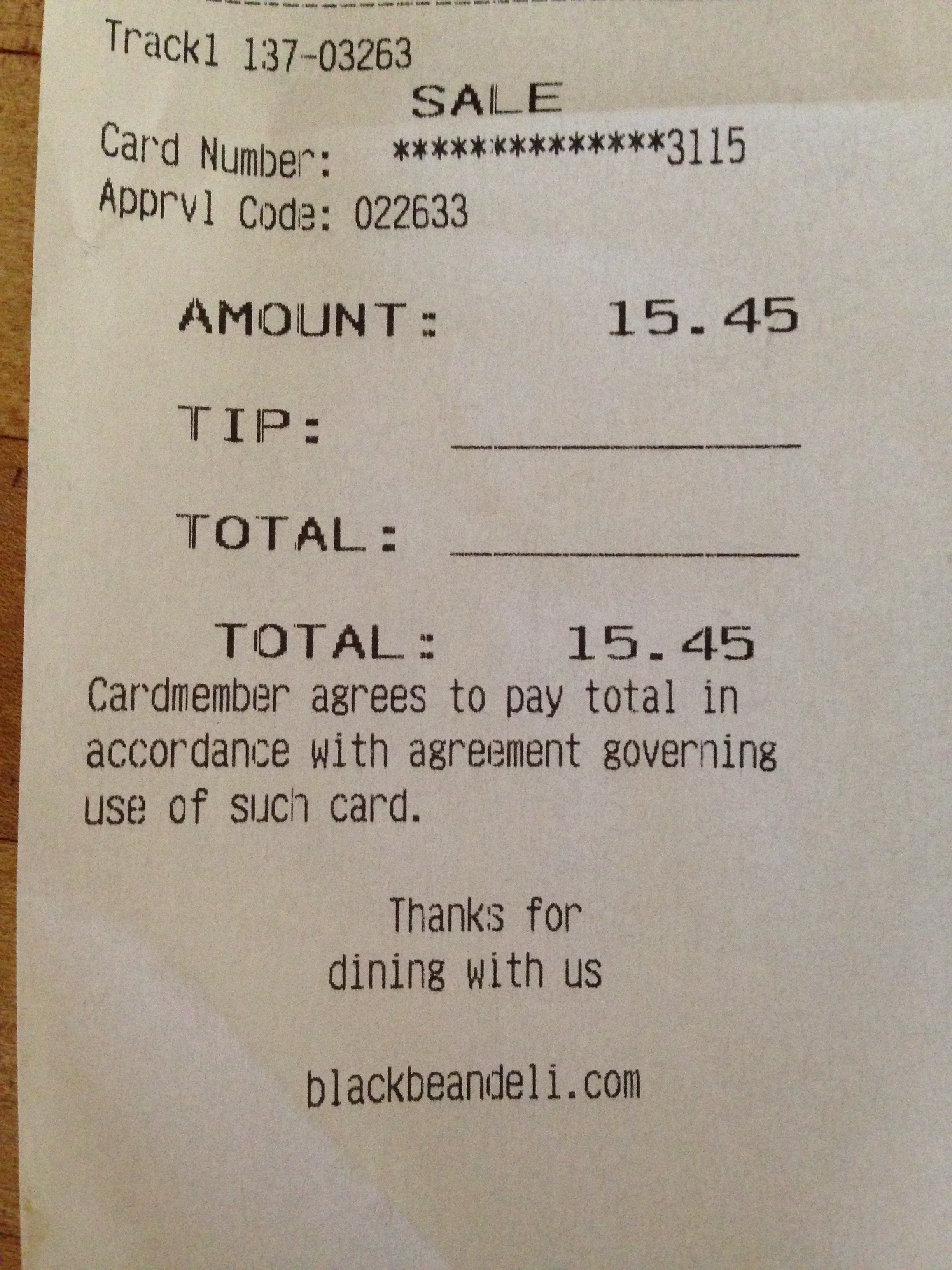
what?
We understand all the fuss over “gun control,” especially after the recent tragic events in our home city Orlando, Florida, but statistically speaking, my fellow Floridians should worry more about pedestrian safety and the level of texting and driving on our roadways. By way of empirical example, see Table 1 of this 2014 road safety report titled “Dangerous by Design”:
|
Rank |
Metropolitan area |
Total pedestrian deaths (2003–
2012) |
Annual pedestrian deaths per 100,000
(2008– 2012) |
| 1 | Orlando-Kissimmee, FL | 583 | 2.75 |
| 2 | Tampa-St. Petersburg- Clearwater, FL | 874 | 2.97 |
| 3 | Jacksonville, FL | 359 | 2.48 |
| 4 | Miami-Fort Lauderdale-Pompano Beach, FL | 1,539 | 2.58 |

Credit: Franco Mattes; Eva Mattes
Richard Craswell, a law professor at Stanford, once posed the following question in his paper titled “Promises and Prices”: why do economists and philosophers who study law differ so greatly in the relevance they assign to price effects. Here is an excerpt:
“… when economists evaluate a proposed change in the law, they will usually want to determine just how many buyers would prefer to pay the higher prices … By contrast, philosophers seem to evaluate legal changes without worrying about the effect on prices …”
This question has haunted us ever since we saw Craswell present his paper five years ago at a 2011 symposium on “The Future of Contract Theory” at Suffolk University in Boston. Let’s consider contract law, for example. When should mere promises by legally enforceable, and what remedy, if any, should the law provide for breach of contract? Broadly speaking, an economist might argue that a world with stronger legal remedies will lead to higher contract prices than a world with weaker legal remedies, all other things being equal.
There are several possible replies to Craswell’s point about price effects. For starters, one could point out that the relation between contract law and price effects can be unclear in the real world (cf. Eric Posner). All other things are rarely if ever equal, so price effects could be indeterminate and thus hard to predict ahead of time. Another reply is to emphasize the “virtue effects” of law, not just price effects. Professor Seana Shiffrin, for example, has argued that the rationale of our legal rules must be acceptable to a virtuous moral agent. At a minimum, the law should not erode our moral characters or make it difficult to develop our moral capacities. But putting aside the fact that there can be conflicting virtues, how would we even begin to measure the level of virtue in a given community?
For this post, however, let’s assume that both price effects and virtue effects can be measured with a high probability of precision. If we were to combine the insights of Professors Craswell and Shiffrin into a single analytical framework, every change in law could potentially produce four possible outcomes:

Notice that B is the ideal outcome: a change in law that leads to lower prices and to higher levels of virtue on average or in total (again, assuming we could really predict or measure these things with any degree of accuracy), while C, by contrast, is the worst possible outcome. But what if we had to choose between A and D: between a change in law that led to higher prices and higher levels of virtue and a change in law that led to lower prices and lower levels of virtue? In any case, doesn’t our analysis reveal the bogus nature of the debate between Craswell and Shiffrin, since price and virtue effects are, in fact, impossible to measure in the real world?
Check out this interview with Drew Houston, the CEO of Dropbox. Among other things, Mr Houston notes that the average human lifespan lasts about 30,000 days … so watch less TV, read more, learn and do new things, and make every day count!

Is European Union starting to fall apart? It looks like parochial voters in England and Wales just outvoted their fellow U.K. citizens in Scotland, Northern Ireland, and Gibraltar to leave the EU. What if the Brexit vote had been held before the Scotland independence referendum of 2014?

Screenshot Credit: BBC

As of 16:50 Eastern Standard Time.
As a public service, let’s translate these betting odds into plain English. If a bettor wagers £10 that a majority of voters in Britain will vote to leave the European Union (“leave”), odds of 6/1 implies that the bettor stands to make £70 total: his initial stake of £10, plus a huge profit of £60. (Notice the amounts here are stated in pounds since this is a British betting site, where gambling on political and sporting events is totally legal.) By contrast, if the bettor wagers £10 that a majority of the voters will vote to remain in the E.U. (“remain”), with odds of 1/7, the bettor will only receive £11.43: his initial stake of £10, plus a relatively miniscule profit £1.43. Notice what this particular betting market is telling us: “remain” is a safer bet than “leave.”
We are big fans of the movie Blade Runner. We even co-authored a scholarly paper titled “Clones and the Coase Theorem” in which we explore the problem of time-scarcity (the limited lifespans of the replicants in Blade Runner) in light of the Tyrell Corporation’s monopoly over the production of replicants. Now, Dave Addey has written up this extensive analysis of the typography and design of Blade Runner (hat tip: kottke). Among other things, he created this beautiful video reconstruction of one of the most enigmatic scenes from the movie:





Welcome to the online home of the IASS
Hopefully It’s Interesting.
In Conversation with Legal and Moral Philosophers
PhD, Jagiellonian University
Books, papers, and other jurisprudential things
Ramblings of a retiree in France
BY GRACE THROUGH FAITH
Natalia's space
hoping we know we're living the dream
Lover of math. Bad at drawing.
We hike, bike, and discover Central Florida and beyond
Making it big in business after age 40
Reasoning about reasoning, mathematically.
I don't mean to sound critical, but I am; so that's how it comes across
remember the good old days...
"Let me live, love and say it well in good sentences." - Sylvia Plath
a personal view of the theory of computation
Logic at Columbia University
Just like the Thesis Whisperer - but with more money
the sky is no longer the limit
Technology, Culture, and Ethics
Just like the horse whisperer - but with more pages
Poetry, Other Words, and Cats


