Art History Graffiti

Hat tip: sirblackhand (via reddit)

Posted in Art | Leave a comment

Vertical history

https://i0.wp.com/28oa9i1t08037ue3m1l0i861.wpengine.netdna-cdn.com/wp-content/uploads/2016/01/1780.jpg

Tim Urban invites us to think about history in vertical terms in this thoughtful blog post. (By the way, we discovered his post via jason kottke, one of our favorite bloggers of all time.) Mr Urban presents a beautiful botanical metaphor (in bold below) in order to compare and contrast “horizontal history” (i.e. familiar timelines of historical events presented in chronological order) and his original conception of “vertical history” (i.e. the vertical visualization of the overlapping lifespans of great historical actors in a given era; see, for example, the table above). Mr Urban writes:

Normally, we learn about history’s storylines in isolation. We might have a strong sense of the history of physics breakthroughs or the progression of western philosophical thought or the succession of French rulers—but we’re not as clear on how each of these storylines relate to each otherIf you think of history like a tangle of vines growing upwards through time, studying one type of history at a time is like following the path of one particular vine while ignoring the other vines around it. It’s understanding history in a vertical sense. * * * Mozart wrote his Requiem the same year the US forefathers were writing the Bill of Rights and that Beethoven had a love-hate relationship with Napoleon—but using the lifespan diagram, you can see both of these stories visually.

Posted in Culture, History | Leave a comment

Is Judge Judy a fraud?

She is the highest paid “judge” in the world. In reality, she’s a private arbitrator who pretends to be a real judge on her famous court TV show, but that is not why she might be a fraud, at least not according to this critical blog post by Alex Mayyasi (via Priceonomics). According to Mr Mayyasi’s Priceonomics post, Judge Judy “reiterates the theme of responsibility and accountability over and over … On her show, she gives a tongue lashing to defendants who make excuses and reprimands victims who exercise poor judgment.” But in reality, after she admonishes guilty defendants and orders them to pay for what they’ve done, it’s the producers of her show who end up paying for those damages. (See the sample letter below the fold.) Nevertheless, we respectfully disagree with Mr Mayassi’s analysis. It’s true that when defendants agree to go on Judge Judy’s TV show, they do so in exchange for avoiding liability in their original court cases. But that said, there is still some positive probability that the defendant in any given case will prevail. Moreover, win or lose, the defendant is still assuming the very real residual risk that Judge Judy will embarrass him or her before a national audience. By accepting this risk (i.e. by willingly subjecting themselves to the possibility of such ridicule and embarrassment from Judge Judy), the defendants are, in fact, assuming responsibility for their actions, at least on some level. What do you think?

Winner of Best Book Title

Continue reading

Posted in Deception, Ethics, Law | 5 Comments

Prime number update

A prime number (or a prime) is a natural number greater than 1 that has no positive divisors other than 1 and itself. The number 3, for example, is a prime number. Now the update: The Great Internet Mersenne Prime Search project has announced the discovery of the largest known prime. It is 2 times 2 times 2 … (repeat this step 74,207,281 times in all) … minus 1, or (2)74,207,281 – 1 in formal mathematical notation. (By the way, in case you’re wondering, the next largest prime is (2)57,885,161 – 1.) Both of these numbers are so-called Mersenne primes, or prime numbers that take the form 2p – 1, where p is also a prime. There are only 49 known Mersenne primes. (Read more about this mathematical discovery here.)


Posted in Mathematics | Leave a comment

Is Senator Cruz a “natural born citizen”?

(P1) Major premise: Article II of the U.S. Constitution categorically states: “No person except a natural born citizen … shall be eligible to the office of President” (emphasis added). This proposition is thus our “major premise” or general principle of constitutional law.

(P2) Minor premise: Senator Rafael Edward “Ted” Cruz was born in Alberta, Canada to an American mother and Cuban father. This proposition forms our “minor premise” or specific set of facts.

(C) Conclusion: Your guess as to the correct conclusion in this case is as good as ours because nowhere does the Constitution define the precise meaning of the term “natural born citizen.” That is, when we try to apply the general principle or rule of law to the facts in this case, it turns out that the meaning of the applicable law is ambiguous or open to interpretation.

Accordingly, when constitutional law scholars consider whether Senator Cruz is a “natural born citizen” or not, they might be asking the wrong question. After all, what makes one scholar’s interpretation of an open-textured term the “true” or correct one? What legal scholars should be asking instead is this: who decides? That is, which branch or which level of government (i.e., the Congress, State legislatures, federal or State courts, etc.) should have the power or legal authority to decide who is a natural born citizen?

Natural born citizens?


Posted in Current Affairs, Language, Law | 1 Comment

Non-random coin toss?

What conditions must a coin toss satisfy in order for it to be truly “random,” and why isn’t this particular coin toss a “random” one … or is it? Perhaps another way of approaching the problem of randomness (assuming no bad faith on the part of the person tossing the coin) is to ask, What is the probability that the number of times that the coin will flip over will be equal to zero?

Posted in Current Affairs, Probability | Leave a comment

Tinder trailer

Questions about Tinder: How does the “Super Like” function described in the video above overcome or solve the problem of cheap talk or false signals? Also, does Tinder improve or reduce the overall level of “welfare” or “utility”–as economists define these imprecise terms? And lastly, would you prefer just one all-purpose Tinder or different sub-types of Tinders, i.e. one for retirees, another for religious devotees, etc.? (Feliz cumpleaños mama!)

Posted in Cheating, Cooperation, Culture, Current Affairs | Leave a comment

Review of Trivers (2016)

We’ve just finished reading Robert Trivers’s strange memoir “Wild Life: Adventures of an Evolutionary Biologist.” But before proceeding with our short review, we must disclose up front that Dr Trivers is one of our intellectual heroes–along with Thomas Schelling, Gordon Tullock, and Ronald Coase. By way of example, Trivers’s collection of path-breaking papers in “Natural Selection and Social Theory” as well as our used copy of his beautiful textbook on “Social Evolution” are two of our most prized possessions on our bookshelf. (As an aside, we admire Trivers in large part for his elegant classification of human (and non-human animal) behavior–altruism, spite, cooperation, etc.–based on the distribution of the costs and benefits of an actor’s behavior.) His ramshackle memoir, however, will not form a trifecta. Alas, although we loved the early chapters of his memoir, especially his fond memories of his mentors Bill Drury and Ernst Mayr, his memoir–or “mixture of recollections” (p. xi) is an incomplete and inconsequential one. Incomplete, for example, because Trivers alludes to yet offers no explanation of his fateful decision to leave Harvard in 1978 (we understand that he was forced out when he was denied tenure in spite of his enormous academic accomplishments in his field), and inconsequential because so much of the book recounts Trivers’ various encounters with the criminal justice system, “just so” legal war stories that, in the scheme of things, are insignificant in comparison to Trivers’s great intellectual achievements. In short, we were expecting more of an intellectual autobiography and less of a rap sheet.

Posted in Law, Science | 2 Comments

Lesson 0 (law & ethics)

This semester, we are teaching a large undergraduate course (as well as an honors section) on “the legal and ethical environment of business.” Specifically, we are using the founding of Facebook–as depicted in the book “The Accidental Billionaires” and in the film “The Social Network”–to explore various areas of business law, including such areas as the law of contracts (think of Facebook’s “terms of use”), choice of business entity (think of Facebook’s evolution from a simple two-person partnership into a Florida limited liability company (LLC) before incorporating in the State of Delaware), and the ethics of Facebook’s privacy policies. Although we personally dislike and distrust social media generally (especially Facebook’s approach to privacy), we think that our focus on the founding of Facebook makes good sense for several reasons. After all, our target audience consists of undergraduates, most of whom use some form of social media to connect with the wider world, and moreover, it was a motley crew of college students who ended up creating one of the most successful Internet platforms in the world today (see below). Mark Zuckerberg literally changed the world, so why not learn from his success–and from his mistakes?

Posted in Ethics, Law | 5 Comments

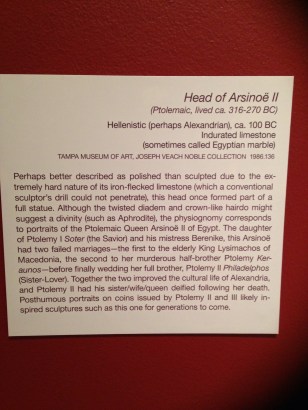
What is art? (Ptolemaic edition)

  
We recently visited the Tampa Museum of Art with our eldest (Adela) and youngest (Adys) daughters. This Ptolemaic piece was our favorite work of art from the museum’s modest collection, but what makes any given object a “work of art” as opposed to just an ordinary one? (Click on either image above to see a larger version.)

Posted in Art, History | Leave a comment