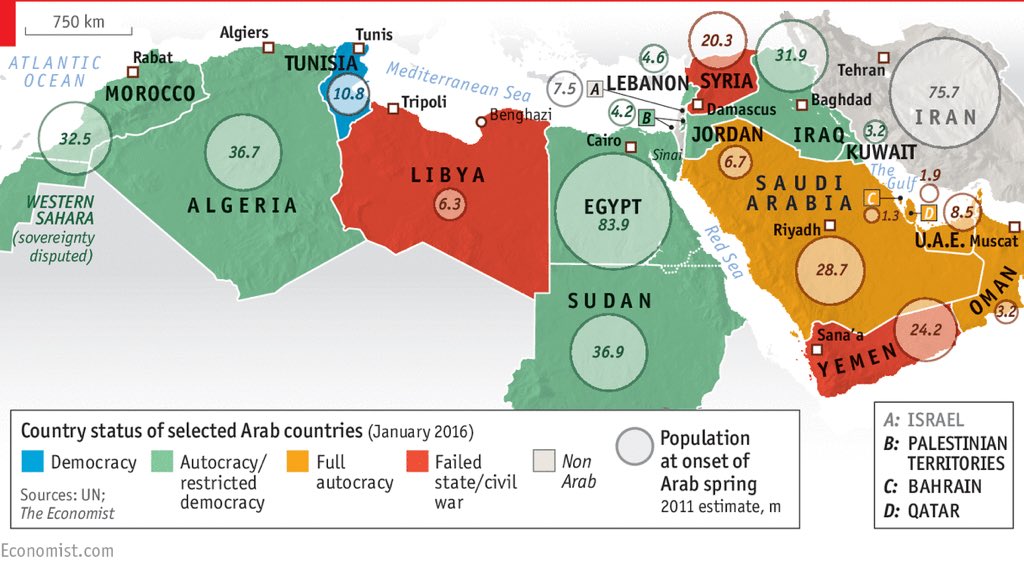
Arab spring or Arab winter?

Embedded image permalink

Posted in Maps | Leave a comment

Mind game …

Embedded image permalink
Posted in Art, Paradoxes | Leave a comment

Do you prefer people or solitude?

Embedded image permalink
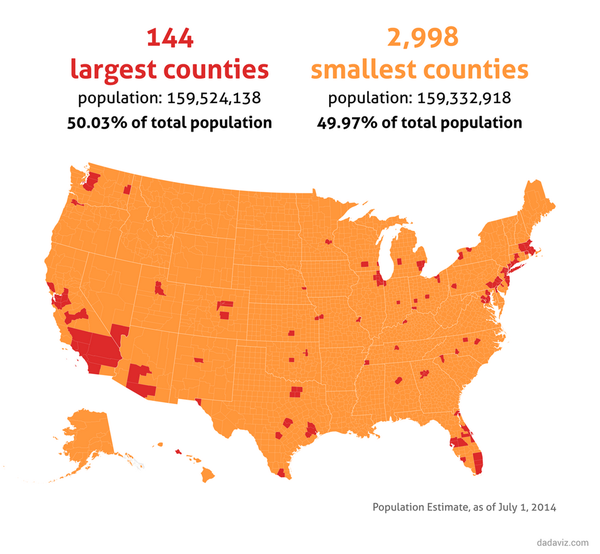
This map purports to show the most populous counties in the United States: half of the U.S. population lives in the red counties; the other half lives in the orange counties. (Hat tip: Conrad Hackett.)
Posted in Maps | Leave a comment

Powerball is a scam

Critical thinking question: If lotteries weren’t a State-run monopoly, would such scams have been shut down long ago under State and federal consumer protection laws? (Mathematical table above via Business Insider.)
Posted in Lotteries, Probability | Leave a comment

Applied game theory (A9 chip edition)

Successful firms tend to employ a wide variety of creative strategies for maintaining their “competitive advantage,” i.e. their dominance in a given market without running afoul of antitrust or unfair competition laws. Apple’s A9 chip for the iPhone 6 is a case in point. According to this insightful essay by Tom Whitwell (para. 51, emphasis in original), for example, we learned that “Apple’s new A9 processor for iPhones devices is … manufactured by two different companies, using two entirely different chip designs.” As Mr Whitwell notes, this dual-sourcing strategy “allows Apple to negotiate incredibly hard on price in future, as each company has invested billions in their plants.” (You can read more about Apple’s dual-sourcing strategy here.) So, if you were one of these suppliers to Apple, what counter-strategy would you employ in order to neutralize or offset Apple’s manufacturing strategy?

Posted in Game Theory | Leave a comment

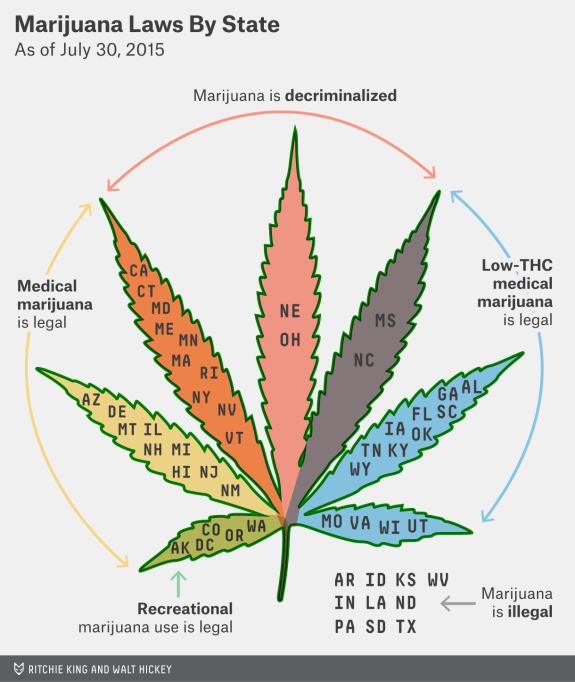
The evolution of public law (cannabis edition)

 
Critical thinking question: Are the drug-policy preferences of the “median voter” in Texas different from those of the median voter in Colorado, or are these legal/policy differences the result of some failure of the political process in those States where marijuana is still illegal?

Posted in Current Affairs, Law | Leave a comment

Happy Three Kings Day

Fray Nicolás Borrás, The Adoration of the Magi
Posted in Culture, History | Leave a comment

Panama Canal Map (pre-canal)

https://upload.wikimedia.org/wikipedia/commons/2/26/Isthmus_of_Panama_24188-050-1AC7A5DB.jpg

Posted in History, Maps | Leave a comment

Type I vs. Type II errors

We’re almost done reading Deborah G. Mayo’s magnum statistical opus Error and the Growth of Experimental Knowledge (University of Chicago Press, 1996), a must-read for anyone interested in the philosophy of statistics.  Her defense of conventional statistics or “Neyman-Pearson” methods in Chapter 11 is valiant, but at one point, Professor Mayo writes (p. 403, emphasis in original):

Consider two smoke detectors. The first is not very sensitive, rarely going off unless the house is fully ablaze. The second is very sensitive: merely burning toast nearly always triggers it. That the first (less sensitive) alarm goes off is a stronger indication of the presence of a fire than the second alarm’s going off.

It turns out that this particular example is a very important one. Why? Because this simple example illustrates Mayo’s larger point about how well-designed or “severe” statistical methods are supposed to minimize Type I errors, i.e. the problem of rejecting a hypothesis as false even when the hypothesis is probably true. In two words, our friendly reply to the fire alarm example is “not necessarily”–that the first, less sensitive alarm goes off is not necessarily a stronger indication of a fire than the second, more sensitive alarm sounding off.

Let’s call the first alarm A and the second alarm B. Since A is not very sensitive, there is a positive probability that it may not sound even when there is a real fire. In statistical terms, A will end up making a lot of Type I errors: it will reject the hypothesis H = fire even when H is true, i.e. even when there is a fire. B, by contrast, will sound even when there isn’t a real fire, i.e. B will make a lot of Type II errors. In colloquial terms, A is overly cautious (sounding only if the house is really on fire), while B is too cautious (sounding at the slightest hint of a fire). Now, if safety is your paramount goal, which alarm would you rather have, A or B; that is, in the context of fire prevention, which type of error is the lesser evil?

By the way, we will present and discuss other standard statistical problems, like the naval shell example and “the lady tasting tea” case, from a Bayesian perspective in future blog posts.

Posted in Bayesian Reasoning, Probability | 3 Comments

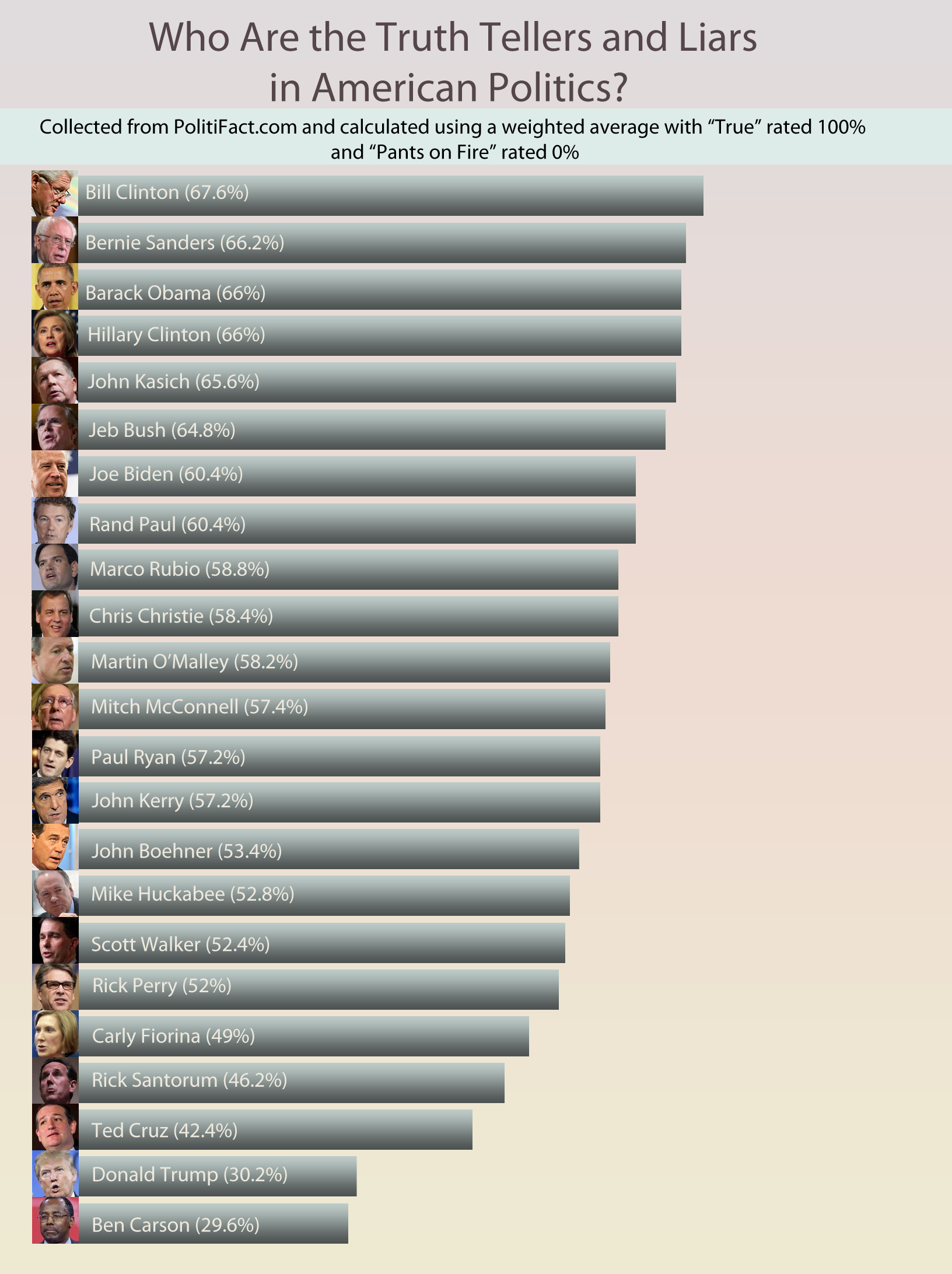
Why do politicians lie so much?

 Is there an “optimal level” of truth telling in politics?

Posted in Cheating, Deception, Ethics, Politics | Leave a comment