The NBA snitch hotline is a terrible idea

While I am on vacation (actually, working on sundry scholarly projects), I am re-posting my 6/18 blog post in which I criticize Adam Silver’s “snitch hotline.” P.S.: Two cheers for Paige Spiranac!

F. E. Guerra-Pujol's avatarprior probability

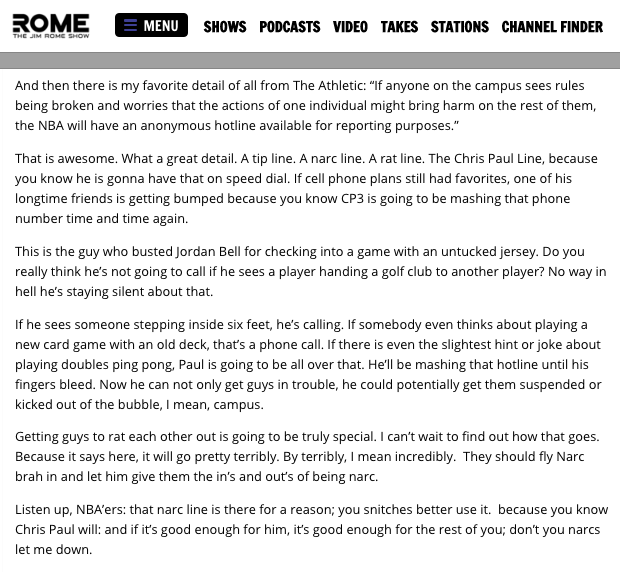
As you may have heard by now, the NBA recently released a 113-page manual in anticipation of the resumption of the 2019-20 season. (Check out this summary of the manual by Ben Cohen for The Wall Street Journal.) The manual contains a whole host of health and safety protocols that basketball players (and coaches, I presume) must follow when the season resumes in Orlando, Florida next month. Among other things, the NBA is setting up a “snitch hotline” to allow anyone to anonymously report a player or coach who is breaking the guidelines. So, who will be the first player to call the new NBA snitch hotline? According to my fellow Gaucho Jim Rome (both of us went to UCSB in the 80s), it will be Chris Paul–check out Rome’s “hot take” below:

Screen Shot 2020-06-18 at 12.05.00 PM Source: jimrome.com

In all seriousness, this anonymous snitch hotline is a terrible idea. Instead of building trust…

View original post 92 more words

Posted in Uncategorized | Leave a comment

The paradox of the anti-progress canon

As promised, I am re-posting part 2 of my review of Matthew Slaboch’s beautiful book “A Road to Nowhere: The Idea of Progress and Its Critics.” Enjoy!

F. E. Guerra-Pujol's avatarprior probability

Review (part 2 of 2) of Matthew W. Slaboch, A Road to Nowhere: The Idea of Progress and Its Critics (U Penn Press, 2018).

In my previous post, I mentioned that the concept of progress might have a cultural or spatial dimension, one of the most important ideas I learned from reading Slaboch’s book on anti-progress. Here, I shall discuss another insightful idea in Slaboch’s book, what I call “the paradox of the anti-progress canon.” Simply put, why should anyone bother to improve man’s lot or change the course of history for the better if the ideal of progress is bullshit?

Slaboch presents this dire paradox in the chapter devoted to Henry Adams (Chapter 3), who attempted to apply the law of physics to the study of history. Briefly, Adams’s view of world history was a pessimistic one (p. 80): social and political collapse are inevitable; all such systems will…

View original post 547 more words

Posted in Uncategorized | Leave a comment

Review of Slaboch (2018)

While I am on vacation working on various scholarly projects, I am re-posting part 1 of my review of Matthew Slaboch’s 2018 book “A Road to Nowhere: The Idea of Progress and Its Critics.” (I will re-post part 2 tonight.)

F. E. Guerra-Pujol's avatarprior probability

Review (part 1 of 2) of Matthew W. Slaboch, A Road to Nowhere: The Idea of Progress and Its Critics (U Penn Press, 2018).

As soon as I heard about Patrick Collison and Tyler Cowen’s recent call for a new field of “progress studies” (Collison & Cowen, 2019, available here), my initial reaction was one of deep skepticism. Simply put, I mistrust our collective ability to discover, let alone implement, a reliable recipe for boosting long-term economic growth or for promoting ever-higher levels of human flourishing generally. But my skepticism poses a deeper, second-order question: is this mistrust warranted, or is it the result of my own Burkean and Humean biases or what Cowen likes to call “mood affiliation”? It turns out that I am not the only one to be skeptical of the concept of progress. Matthew Slaboch, a research fellow at Princeton, has devoted an entire scholarly…

View original post 631 more words

Posted in Uncategorized | Leave a comment

On Vacation

I am re-posting my July 8th vacation post as I need to get off the Internet in order to mourn the death of my friend Carlitos del Valle, refocus on my scholarly projects, and tend to my own garden, so to speak. In the meantime, stay happy and healthy; I will return soon …

F. E. Guerra-Pujol's avatarprior probability

Hello. Because this is a one-man blog, and because I will be taking a vacation for the rest of July and for most of August, I will be blogging much more sporadically, if at all, during the next few weeks. Rest assured, however, that I will present my grand synthesis of Oliver Wendell Holmes’s prediction theory of law and H.L.A. Hart’s internal point of view upon my return in late August or early September. Note: I won’t really be “on vacation” per se; instead, I will be using this time to give talks (via Zoom, of course) at several academic conferences and to complete some other scholarly projects, including a book-length treatment of “Goedel’s Loophole.” (If time permits, I may blog about these other projects in the days ahead.)

View original post

Posted in Uncategorized | Leave a comment

Rear Window via a Coasean lens

“Rear Window” has to be one of the most beautiful films of all time. Yet, if you google “rear window” what you will find is a lot of cutting-edge essays commenting on the themes of voyeurism, the “male gaze”, etc. etc. What these critics fail to see, however, is the reciprocal nature of the voyeurism problem: if you don’t want to be seen, then you should close your window shades!

Posted in Uncategorized | Leave a comment

Hasta siempre, Carlitos

Carlos “Carlitos” del Valle Cruz (8 Jan. 1955 — 11 July 2020)


Posted in Uncategorized | Leave a comment

Carlitos’ Compass

Note: This post is dedicated to the memory of my colleague and kindred spirit Carlos “Carlitos” del Valle, who the world lost on Saturday, July 11, 2020. I am also dedicating this post to all the people who were lucky enough to count Carlitos as a friend.

Earlier this week, I described two of my previous collaborations with my friend, colleague, and mentor Carlitos del Valle, beginning with the time we unwittingly co-authored a Supreme Court amicus brief together in 2004 and proceeding with our first fateful exchange of ideas in person in 2007. Among other things, Carlitos rekindled my love affair with chess and reminded me of the singular importance of stare decisis. But my most significant memory of Carlitos began with a simple question that our mutual friend and colleague Daniel Nina posed during a colloquium in Mayaguez, P.R. in the spring of 2007, a question that continues to haunt me to this day.

As I mentioned in my previous post, this 2007 colloquium was the most memorable conference I have ever attended. It was devoted to the law and ethics of the fictional world depicted in the 1982 movie Blade Runner, and one of the many themes in this beautiful science fiction film noir is the law and ethics of violence. The dystopian world of Blade Runner is a physically violent domain. A band of advanced “off-colony” Nexus-6 replicants–flesh-and-blood automatons who are “more human than human”–resort to physical violence and threats of violence throughout the entire movie in a futile effort to extend their fleeting four-year lifespans, and the police have hired a special agent, Rick Deckard, to track down the illegal replicants. Deckard, a “blade runner” and quite possibly (spoiler alert!) a replicant himself, is lawfully authorized to capture and kill his fellow replicants.

With this background in mind, here is the poignant question that Professor Nina posed to us during the colloquium: when, if ever, is violence legally or even morally justified?  Given the subject of the colloquium, this was not a mere rhetorical question, and Nina did not just let it hang in the air. He posed his question directly to every attendee, and he demanded an answer. I have since devoted several of my scholarly papers to Nina’s question and to the problem of violence and its relation to law generally, beginning with my 2011 paper “Life, Love, and Law“–a paper, by the way, that I dedicated to Carlitos himself. Later, I wrote a chapter (“Buy or Bite?“) for the 2014 book Economics of the Undead, where I explain why vampires must resort to violence to obtain their supplies of blood. (My answer, in two words, is “legal failure,” i.e. our unwillingness to legalize the sale of blood!) More recently, my 2019 paper “Domestic Constitutional Violence” explores the legality of President Dwight Eisenhower’s reluctant use of military force to enforce school desegregation in Little Rock.

But the larger point I want to make here is that all of these papers were in some shape or form inspired by Carlitos’ principled reply to Professor Nina’s colloquium question and by his passionate defense of the principle of non-violence. While all of our colleagues (including myself!), taking our perverse consequentialist theories to their logical conclusion, were more than willing to countenance the use of violence under certain narrow conditions (e.g. to fight apartheid or topple a corrupt regime), Carlitos’s resolute commitment to non-violence remained unwavering throughout our often-heated discussions. To the point, Carlitos’s Kantian moral compass eventually won me over. He changed my mind, and I will never forget that …

Screen Shot 2020-07-16 at 2.47.42 AM.png

Posted in Uncategorized | Leave a comment

My second collaboration with Carlitos

Note: I lost my friend and colleague Carlos “Carlitos” del Valle on Saturday, July 11, 2020. All my posts this week (except this one) are in his honor. May he never be forgotten.

My second collaboration with Carlitos involved a series of informal chess matches in April of 2007. As I explained in a previous post, Carlitos invited me (as well as my friend and colleague Orlando I. Martinez-Garcia) to stay at his home in Mayagüez, P.R. for the duration of a week-long interdisciplinary colloquium devoted to the law and ethics of the fictional world depicted in the 1982 movie Blade Runner. (The conference was called “Blade Runner: Memory, Surveillance, and the Disposable Subject,” and to this day, it was the most memorable academic conference I have ever attended.) After the second day of my stay, when Carlitos finally emerged from his quarters (he was holed up the previous day working on the paper* he was scheduled to give at the colloquium), Carlitos must have noticed me admiring an old wooden chess table tucked away in the corner of his library. Without hesitation, he invited me to a game of chess, but I was reluctant to play.

At this point in my story, I have to digress to explain that I had not played chess since I was a little child. My childhood friend, Carlos Fernandez, had introduced me to the game of kings in grade school (Carlos F., if you are reading this by any chance, thank you!), but truth be told, I had not played chess since we parted ways after the sixth grade. So, as I was saying, I was reluctant to play. But Carlitos insisted, and his Cheshire grin and magnanimous spirit won the day. We ended up playing several hard-fought matches during the course of my stay, during which time he explained to me the algebraic notation used by chess players to record their moves, the subtleties of the opening, the concept of a strategic sacrifice, and other crucial chess tactics. More importantly, this informal collaboration, consisting of hours of playing and talking about chess, not only reintroduced me to the beautiful world of chess; it also inspired me to create the most beautiful paper I have ever written. Let me explain …

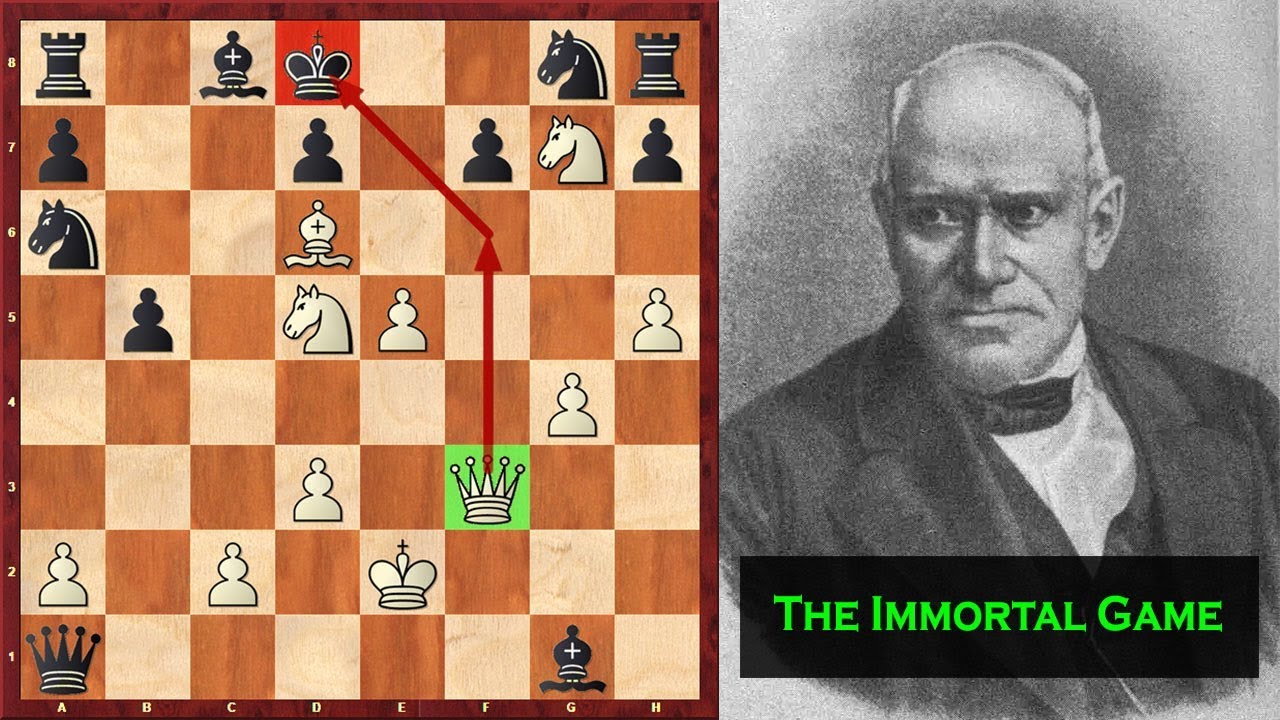
The organizer of the colloquium, the indefatigable Daniel Nina, had scheduled an open-air screening of the film Blade Runner on a Friday night. I will never forget this remarkable occasion, for it occurred in the patio of centuries-old colonial building of the Eugenio Maria de Hostos Law School, and it was the first time I had ever seen the film. Crucially, my hours of chess-play with Carlitos alerted me to and gave me a special appreciation of the last few moves in the pivotal game between the characters J.F. Sebastian and Dr. Eldon Tyrell. The next day, someone (the young Spaniard José Domingo Lázaro Álvarez, if I recall correctly) mentioned to me that the moves played by Sebastian and Tyrell in the movie were based on the “Immortal Game,” a now-famous chess game played by Adolf Anderssen and Lionel Kieseritzky on 21 June 1851 in London.

The rest was history. After the conference had ended, I wrote up a scholarly paper titled “El ajedrez in Blade Runner” (“Chess in Blade Runner”) in which I broke down the Immortal Game into three parts (opening, middle, and endgame) and carefully analyzed the sequence of play. Although others had done this before, my contribution was to establish a direct connection between chess tactics and legal strategy. Specifically, I showed how each individual move in the Immortal Game could be used to illustrate strategic aspects of law and ethics. To this day, it is the only scholarly paper I have ever written in my native tongue Spanish (aside from my honors thesis in college), and I consider it the most beautiful paper I have written to date. Looking back, Carlitos should be listed as a co-author of this paper, for it was inspired by my late-night discussions with Carlitos about chess. Gracias, Carlitos!

But my collaboration with Carlitos did not come to an end with chess. After our initial deep dive into the world of chess in April of 2007, we continued to discuss many other ideas over the years, and one of Carlitos’s ideas in particular would capture my imagination like never before. I will thus describe the third (and alas, last) phase of our two-decades-long collaboration in my next post.

The Immortal Game - YouTube

* Carlitos’ paper was titled “Sobre ovejas electricas” (“On Electric Sheep”), an allusion to the title of the original Philip K. Dick novel on which the movie Blade Runner is loosely based. His paper appears in a beautiful collection of essays edited by Daniel Nina: Blade Runner: memoria, vigilancia y el sujeto desechable” (Ediciones Callejón, 2008).

Posted in Uncategorized | 1 Comment

F*ck the feds (IRS e-file edition)

I just wasted an hour of my day attempting to navigate the Internal Revenue Service’s “free fillable forms” website in order to file an extension on my 2019 tax return. Suffice it to say I ended up just printing the damn form and sending it in via regular mail.

Posted in Uncategorized | 1 Comment

My first collaboration with Carlitos

Note: This post is in honor of my dear friend and kindred spirit, Carlos “Carlitos” del Valle, who died on Saturday, July 11, 2020.

Although (as I explained in a previous post) I did not meet Carlitos in person until April of 2007, it turns out–unbeknownst to me at the time!–that we had collaborated together on a special legal project years before–back in the spring of 2004. The project was an amicus brief in support of a petition for certiorari before the United States Supreme Court. Although the Supreme Court eventually declined to hear our case (Vélez-Ortiz v. Rivera-Torres, 341 F.3d 86 (1st Cir. 2003), cert. denied, 541. U.S. 972 (2005)), I would like to take a moment to reflect on our collaboration.

First of all, how did I not know about Carlitos at this time? Truth be told, I was working on this brief pro bono on behalf of my mentor and friend, Pedro E. Ortiz-Alvarez, a legal giant who was the lead attorney for the Municipality of Sabana Grande, a small town in southwest Puerto Rico, and for Miguel Vélez-Ortiz, the mayor of this town at the time. (As an aside, one of the things this charming town is famous for is its “Pozo del Virgen,” pictured below.) Don Pedro asked me to write an amicus brief in this case, so I went to work. Inspired by the “Brandeis briefs” of yore, I dissected the qualified immunity standard from a “law and economics” perspective. (As as aside, I eventually converted my part of the brief into a traditional law review article titled “An Economic Analysis of the First Circuit’s Qualified Immunity Standard,” published in the Revista de Derecho Puertorriqueño, Vol. 45, No. 2 (2006), pp. 187-196. You can read my paper/brief here.)

Little did I know, however, that Carlitos was also working on part two our brief. In fact, I did not discover Carlitos’ Herculean contribution until Don Pedro sent me the final version of the brief! And lo and behold, it turns out we made an great legal duo. While part one of the brief (my part) was full of facts and figures and economic theories, part two (Carlitos’s part) was a doctrinal tour de force. Carlitos laid out all the relevant caselaw, distinguishing all the previously-decidedly cases that hurt our cause and drawing direct analogies to all the cases that helped us. More importantly, Carlitos unwittingly taught me a decisive lesson about the law. Although theory makes the academic world go around, legal theory needs to work in tandem with legal doctrine if you want to change the law. So, no matter how bad the existing state of affairs in any given area of law is (and the qualified immunity doctrine is a case in point!), judges take stare decisis seriously, and they will base their decisions on previous cases …

Carlitos would go onto to impact my scholarship in many other ways. I will describe those extra-powerful impacts soon. In the meantime, thank you, Carlitos. You will not be forgotten.

Sabana Grande, Puerto Rico. Santuario de La Virgen del Pozo ...
Posted in Uncategorized | Leave a comment