


Review (part 2 of 2) of Matthew W. Slaboch, A Road to Nowhere: The Idea of Progress and Its Critics (U Penn Press, 2018).
In my previous post, I mentioned that the concept of progress might have a cultural or spatial dimension, one of the most important ideas I learned from reading Slaboch’s book on anti-progress. Here, I shall discuss another insightful idea in Slaboch’s book, what I call “the paradox of the anti-progress canon.” Simply put, why should anyone bother to improve man’s lot or change the course of history for the better if the ideal of progress is bullshit?
Slaboch presents this dire paradox in the chapter devoted to Henry Adams (Chapter 3), who attempted to apply the law of physics to the study of history. Briefly, Adams’s view of world history was a pessimistic one (p. 80): social and political collapse are inevitable; all such systems will “grow old and die.” At the same time, Adams deplored the venal nature of American democracy. For Adams (p. 76), politicians are not only corrupt; the citizens they represent are stupid and depraved! But as Slaboch astutely notes, these two positions–one macro (world history); the other micro (American democracy)–are in tension with each other (p. 81): “on the one hand, [Adams] freely castigates American government and society for their decrepitude, while on the other hand … [he] professes the inevitability of such decay.”
In other words, if all social and political systems must eventually “grow old and die,” to borrow Adams’s own formulation, how can one complain when history unfolds just as your theory of history predicts? Worse yet, if decline is inevitable, then any effort to reverse this decline is doomed to fail! Furthermore, this tension can easily be generalized to all critics of progress. Although Henry Adams is easy to dismiss as a crank of a bygone age (after all, who still believes that history is governed by the laws of physics?), the works of Schopenhauer and Tolstoy, by contrast, have withstood the test of time, and if you find either Schopenhauer or Tolstoy’s critiques of the concept of progress to be persuasive (as I do), i.e. if progress is either a futile or dangerous ideal, then what is to be done?
This ominous contradiction reappears in Chapter Four of Slaboch’s book, where the author turns to the leading 20th-century critics of progress: the German historian Oswald Spengler, Soviet dissident Aleksandr Solzhenitsyn, and American cultural critic Christopher Lasch. All three thinkers rejected the idea of progress: Spengler, for example, famously diagnosed “the decline of the West” (p. 89) and predicted the outbreak of war between the forces of liberalism and socialism (p. 95). For his part, Solzhenitsyn emphasized the finite nature of our natural resources, describing the idea of perpetual progress as a “nonsensical myth” (p. 99), and denied that an ideal form of political organization existed (p. 101). Likewise, Lasch lamented Western decadence (p. 106) and believed that Americans are unwilling or unprepared to deal with the future (ibid.).
The problem, however, is that if any of these criticisms are true–if war is inevitable, if resources are finite, if Western culture is materialist and decadent–how are we to avoid the dangers of nihilism? Slaboch acknowledges this danger in his conclusion, and this is why I recommend A Road to Nowhere. Slaboch’s beautiful book is worth reading because it poses and answers two significant questions for us today: why should we be skeptical of the ideal of progress, and how should we act given this skepticism? In the course of addressing these questions, his book makes two important contributions to the anti-progress literature. One is purely historical: Slaboch goes back in time and reacquaints us with the leading 19th- and 20th-century critics of the ideal of progress. The other contribution is at once philosophical and practical. Slaboch identifies a paradox in the anti-progress canon. Simply put, if progress is an incoherent concept or an unattainable goal, to what great purpose or end, if any, should we devote ourselves to in the here and now? Is it even possible, in principle, for a critic of the concept of progress to solve this paradox?

Review (part 1 of 2) of Matthew W. Slaboch, A Road to Nowhere: The Idea of Progress and Its Critics (U Penn Press, 2018).
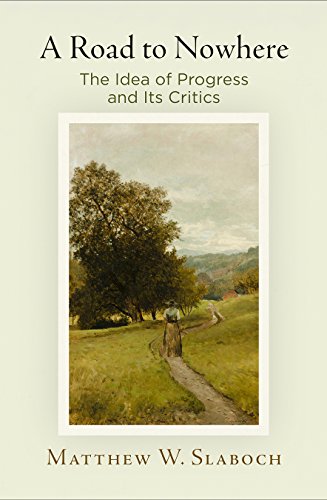
As soon as I heard about Patrick Collison and Tyler Cowen’s recent call for a new field of “progress studies” (Collison & Cowen, 2019, available here), my initial reaction was one of deep skepticism. Simply put, I mistrust our collective ability to discover, let alone implement, a reliable recipe for boosting long-term economic growth or for promoting ever-higher levels of human flourishing generally. But my skepticism poses a deeper, second-order question: is this mistrust warranted, or is it the result of my own Burkean and Humean biases or what Cowen likes to call “mood affiliation”? It turns out that I am not the only one to be skeptical of the concept of progress. Matthew Slaboch, a research fellow at Princeton, has devoted an entire scholarly tome (whose cover art is pictured below) to this question.
As Slaboch explains in his introduction, his book is organized temporally and geographically. Slaboch devotes the first three chapters of his book to the leading critics of progress in the 19th century: the German philosopher Arthur Schopenhauer (ch. 1), the great Russian author Leo Tolstoy (ch. 2), and the New England historian Henry Adams, the great grandson of President John Adams (ch. 3). Next, Slaboch surveys the ideas of a trio of 20th-century anti-progress intellectuals (ch. 4) and then concludes with his own thoughts about the nature of progress. Because Slaboch’s excellent survey is so compact and concise–spanning only four chapters–I will resist the temptation to cover the same ground as previous reviewers of Slaboch’s work, such as Daniel Eisenberg and Inder Marwah. In place of a comprehensive review, I will instead share a few of the most surprising or counterintuitive ideas I learned from Slaboch’s beautiful book, starting with the introduction.
To begin with, when we think of “progress,” we may often have in mind economic or moral forms of progress–the accumulation of material comforts or expanding notions of moral and human rights. Are we not becoming more prosperous as measured by the Economic Holy Grail of GDP; are we not making moral strides in terms of animal rights, gender and racial equality, the prosecution of war crimes, etc.? One of the most unexpected ideas I got from reading the introduction, however, is that we should also think about progress along a spatial dimension. Specifically, is progress a universal concept, an ideal that transcends any particular time and place, or is it a mere Western or cultural construct, inseparable from one’s time and place?
Another powerful idea that appears in Slaboch’s survey is Schopenhauer’s “doctrine of the unceasing will.” (Slaboch presents this idea on p. 18 & pp. 56-57 of his book.) Or, in the immortal words of Schopenhauer himself (p. 18), “we yet always have before us only the same, identical, unchangeable essence.” In other words, people are basically the same, for our wants, needs, and desires are insatiable. Furthermore, even when we’re able to satisfy our human cravings (whatever these sundry appetites may consist of), our happiness will be fleeting, for as Slaboch explains (p. 18), summarizing Schopenhauer’s critique of progress, “almost as soon as a desire is met, boredom arises, and it remains until we have some new end to pursue.” This insight is the foundation of Schopenhauer’s “metaphysical pessimism” (p. 19) and of his philosophical critique of the idea of progress (p. 20): no matter how much material prosperity we might achieve or enjoy, we will always end up wanting more!
Yet another surprising tidbit I learned from Slaboch’s survey is Leo Tolstoy’s admiration of Schopenhauer. In fact, Tolstoy so revered the German philosopher that he hung a portrait of Schopenhauer in his private study. For Tolstoy, however, progress was not only a futile pursuit; it was also a dangerous one. As Slaboch explains (p. 58), summarizing Tolstoy’s critique of progress, “European elites terrorized not only far-off populations, but also exploited their own countrymen in the name of progress ….” To my mind, Tolstoy’s critique of the dangers of progress is still valid today: the pursuit of moral progress often leads to overzealous efforts to shape or mold man’s character, and once progress becomes a public ideal or a political imperative (as opposed to just an individual one), great crimes will inevitably be committed in her name, regardless of who is in charge, i.e. monarchs, revolutionaries, classical liberals, etc.
But perhaps the most original idea I learned from Slaboch’s survey (especially Ch. 3) is what I will call “the paradox of the anti-progress canon.” I will delve into this paradox in my next post …
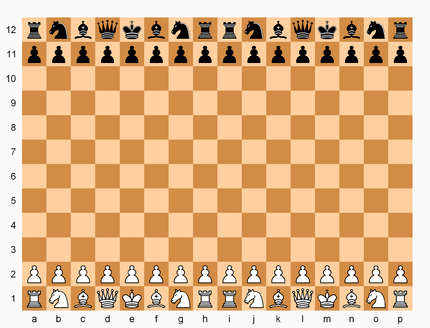
Via Wikipedia (footnotes omitted): “Double chess is a chess variant invented by Julian S. Grant Hayward in 1916. The game is played on a 12×16 chessboard with each player in control of two complete armies placed side-by-side. The rules were published in the January 1929 issue of British Chess Magazine.” (Hat tip: @pickover.)
Now that we have results for 97 percent of Iowa’s precincts, I am reposting my blog post from earlier this week. (What’s the deal with the remaining 3% of precincts, or as David Pakman asks (@dpakman), “So at this point is the claim that they [the Iowa Democratic Party] haven’t COUNTED 100% or that they simply aren’t yet releasing the numbers?“) Also, it’s worth noting that Senator Sanders (an avowed socialist!) won the most votes in the first round of caucusing; first-round results are available here.
Via POLITICO: Each circle represents the difference in votes between the winner and the runner-up in each one of Iowa’s 99 counties. Larger circles indicate a larger gap between the first- and second-place candidates.


Update (2/6): these results are based on 96.94% of all Iowa precincts, or 1711 out of 1765 total precincts; also, the percentage figures above (via Google) reflect the relative number of local delegates allocated to each candidate for Iowa’s statewide political convention (the farthermost column on the right), not the number of votes each candidate received in the Iowa caucuses.
According to this gated paper by Cher Li, an assistant professor of economics at Colorado State University, and Basit Zafar, a professor of economics at Arizona State University, “male students are 18.6 percent more likely than female students to receive favorable grade changes initiated by instructors.” Really? Alas, their paper is gated, so I have no way of assessing the reliability of their methods, but what I would like to know is this: who is more likely to ask for a grade change in the first place, males or females, and does this likelihood in turn depend on the gender of the instructor? More details here (ungated), via IHE. (Hat tip: @AgnesCallard.)
Was it a male student?
Via POLITICO: Each circle represents the difference in votes between the winner and the runner-up in each one of Iowa’s 99 counties. Larger circles indicate a larger gap between the first- and second-place candidates.

| Candidate | Votes | Percent | |
|---|---|---|---|
| Bernie Sanders | 0 | 0.00% | |
| Other | 0 | 0.00% | |
| Michael Bennet | 0 | 0.00% | |
| Tulsi Gabbard | 0 | 0.00% | |
| John K Delaney | 0 | 0.00% | |
| Amy Klobuchar | 0 | 0.00% | |
| Elizabeth Warren | 0 | 0.00% | |
| Joe Biden | 0 | 0.00% | |
| Pete Buttigieg | 0 | 0.00% | |
| Andrew Yang | 0 | 0.00% | |
| Tom Steyer | 0 | 0.00% | |
| Michael Bloomberg | 0 | 0.00% | |
| Deval Patrick | 0 | 0.00% | |
| Uncommitted | 0 | 0.00% |
What is a caucus, you ask? It is a highly interactive and time-consuming method of voting. According to this excellent step-by-step explanation by Dominico Montanaro (via NPR), here is what is supposed to happen in each of Iowa’s 1765 electoral precincts on caucus night:

Image credit: FiveThirtyEight







Welcome to the online home of the IASS
Hopefully It’s Interesting.
In Conversation with Legal and Moral Philosophers
Relitigating Our Favorite Disputes
PhD, Jagiellonian University
Inquiry and opinion
Life is all about being curious, asking questions, and discovering your passion. And it can be fun!
Books, papers, and other jurisprudential things
Ramblings of a retiree in France
BY GRACE THROUGH FAITH
Natalia's space
hoping we know we're living the dream
Lover of math. Bad at drawing.
We hike, bike, and discover Central Florida and beyond
Making it big in business after age 40
Reasoning about reasoning, mathematically.
I don't mean to sound critical, but I am; so that's how it comes across
remember the good old days...
"Let me live, love and say it well in good sentences." - Sylvia Plath
a personal view of the theory of computation
Submitted For Your Perusal is a weblog wherein Matt Thomas shares and writes about things he thinks are interesting.
Logic at Columbia University
Just like the Thesis Whisperer - but with more money
the sky is no longer the limit
Technology, Culture, and Ethics
Just like the horse whisperer - but with more pages
Poetry, Other Words, and Cats


 prior probability