
Via io9, John Bohannon explains how fake science works, specifically, the problem of “p-hacking”: Continue reading
Creative Commons
Blogs I Follow





Via io9, John Bohannon explains how fake science works, specifically, the problem of “p-hacking”: Continue reading
Last year, Donald Trump released a shortlist of conservative jurists he said he would consider as possible U.S. Supreme Court replacements for the late great Justice Antonin Scalia. Recently, our friend, colleague, and fellow blogger Josh Blackman (of seven-screen fame) compiled the somewhat morbid table below calculating the probabilistic life expectancies of the persons on President-Elect Trump’s roster of potential justices. Professor Blackman cautions that “these are utterly uninformed actuarial estimates, which do not account for factors like personal characteristics and family health history.” Instead, these estimates are based solely on each judge’s current age. (You can read Prof. Blackman’s original actuarial post here.)

Credit: Josh Blackman
Alexander Hamilton was born on this day (1/11) in the British West Indies.

Credit: Till Tantau (click on image for template)
As we mentioned in our previous post, we will be presenting our work in progress on “probabilistic interpretation” at this year’s Federalist Society Annual Faculty Conference. Since the conference is in San Francisco, our talk will make reference to the fictional Starfleet Command (from the Star Trek sci fi series): imagine going warp drive and beaming down to “Planet Newgarth” during the tumult over the Case of the Spelencean Explorers, a make-believe murder prosecution professor Lon Fuller wrote about in the late 1940s on Earth. It’s the year 4299 A.D., so why are there no “machine judges” on the Supreme Court of Newgarth? In our talk, we imagine just such a scenario and discuss how a machine might decide (not just predict the outcome of) a close case.

If you happen to be in San Francisco, California this week, and if you’re a fan of this blog (two big “ifs”), yours truly will be attending the 19th Annual Faculty Conference of the Federalist Society, where we will be presenting our work on “Probabilistic Interpretation” on Thursday, January 5. (See my previous blog post for some background about our work in progress.) Come join us for some law professor fun!
FYI: My particular panel will commence at 10:30 o’clock in the morning in the Powell I Room of the Parc 55 Hotel (Union Square), the site of the FedSoc conference. Here is the full lineup: Continue reading
That is the title of our most recent work in progress; one of the research projects we were working on while we were on sabbatical. (Part 1 of the paper will be published in the University of LaVerne Law Review this spring and is available here.) Part 2 presents Lon Fuller’s “Case of the Speluncean Explorers,” one of the most famous thought experiments in legal studies. In our paper (part 2), we imagine an alternative system of voting by appellate judges, a bayesian or cardinal voting system in which judges assign a score to their preferred judicial outcome. Appellate courts generally use an ordinal system of voting (i.e. one judge, one vote) to decide cases. By contrast, we propose a simple cardinal voting system for deciding appellate cases, using Fuller’s hypothetical case to illustrate how our simple system of cardinal voting would work in practice.
Image credit: Wikimedia Commons
Via Chris Rodley: “A runaway trolley is about to create five trolley problems. Do you pull the lever and divert it, so it only creates one?”

Here’s a listing of our three most popular/most visited blog posts over the last three years:
1. Probabilistic business hours (2016)
2. Consumer surplus: “Print Wikipedia” art edition (2015)
3. Chess piece survival rates (2014)

Happy New Year
The great Charles Darwin visualized a tree of life (pictured below) consisting of separate species springing from a distant ancestor, but what if many of these “separate species” still share significant amounts of the same genetic material? Check out, for example, this recent report by Elizabeth Pennisi titled “Shaking up the tree of life” published in the journal Science, vol. 354 (18 Nov 2016), pp. 817-821. Here is one excerpt (p. 818): “Biologists long ago accepted that microbes can swap DNA, and they are now coming to terms with rampant gene flow among more complex creatures [such as interbreeding birds and butterflies]. ‘A large percent of the genome is free to move around,’ notes Chris Jiggins, an evolutionary biologist at the University of Cambridge in the United Kingdom. This ‘really challenges our concept of what a species is.’ As a result, where biologists once envisioned a tree of life, its branches forever distinct, many now see an interconnected web.”
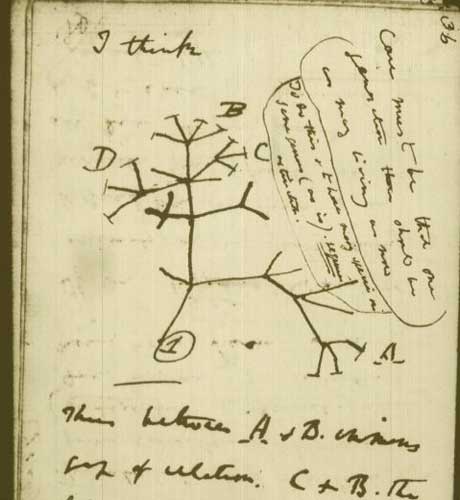
Darwin’s tree of life.


Welcome to the online home of the IASS
Hopefully It’s Interesting.
In Conversation with Legal and Moral Philosophers
PhD, Jagiellonian University
Books, papers, and other jurisprudential things
Ramblings of a retiree in France
BY GRACE THROUGH FAITH
Natalia's space
hoping we know we're living the dream
Lover of math. Bad at drawing.
We hike, bike, and discover Central Florida and beyond
Making it big in business after age 40
Reasoning about reasoning, mathematically.
I don't mean to sound critical, but I am; so that's how it comes across
remember the good old days...
"Let me live, love and say it well in good sentences." - Sylvia Plath
a personal view of the theory of computation
Logic at Columbia University
Just like the Thesis Whisperer - but with more money
the sky is no longer the limit
Technology, Culture, and Ethics
Just like the horse whisperer - but with more pages
Poetry, Other Words, and Cats


