Panama Canal Map (pre-canal)

https://upload.wikimedia.org/wikipedia/commons/2/26/Isthmus_of_Panama_24188-050-1AC7A5DB.jpg

Posted in History, Maps | Leave a comment

Type I vs. Type II errors

We’re almost done reading Deborah G. Mayo’s magnum statistical opus Error and the Growth of Experimental Knowledge (University of Chicago Press, 1996), a must-read for anyone interested in the philosophy of statistics.  Her defense of conventional statistics or “Neyman-Pearson” methods in Chapter 11 is valiant, but at one point, Professor Mayo writes (p. 403, emphasis in original):

Consider two smoke detectors. The first is not very sensitive, rarely going off unless the house is fully ablaze. The second is very sensitive: merely burning toast nearly always triggers it. That the first (less sensitive) alarm goes off is a stronger indication of the presence of a fire than the second alarm’s going off.

It turns out that this particular example is a very important one. Why? Because this simple example illustrates Mayo’s larger point about how well-designed or “severe” statistical methods are supposed to minimize Type I errors, i.e. the problem of rejecting a hypothesis as false even when the hypothesis is probably true. In two words, our friendly reply to the fire alarm example is “not necessarily”–that the first, less sensitive alarm goes off is not necessarily a stronger indication of a fire than the second, more sensitive alarm sounding off.

Let’s call the first alarm A and the second alarm B. Since A is not very sensitive, there is a positive probability that it may not sound even when there is a real fire. In statistical terms, A will end up making a lot of Type I errors: it will reject the hypothesis H = fire even when H is true, i.e. even when there is a fire. B, by contrast, will sound even when there isn’t a real fire, i.e. B will make a lot of Type II errors. In colloquial terms, A is overly cautious (sounding only if the house is really on fire), while B is too cautious (sounding at the slightest hint of a fire). Now, if safety is your paramount goal, which alarm would you rather have, A or B; that is, in the context of fire prevention, which type of error is the lesser evil?

By the way, we will present and discuss other standard statistical problems, like the naval shell example and “the lady tasting tea” case, from a Bayesian perspective in future blog posts.

Posted in Bayesian Reasoning, Probability | 3 Comments

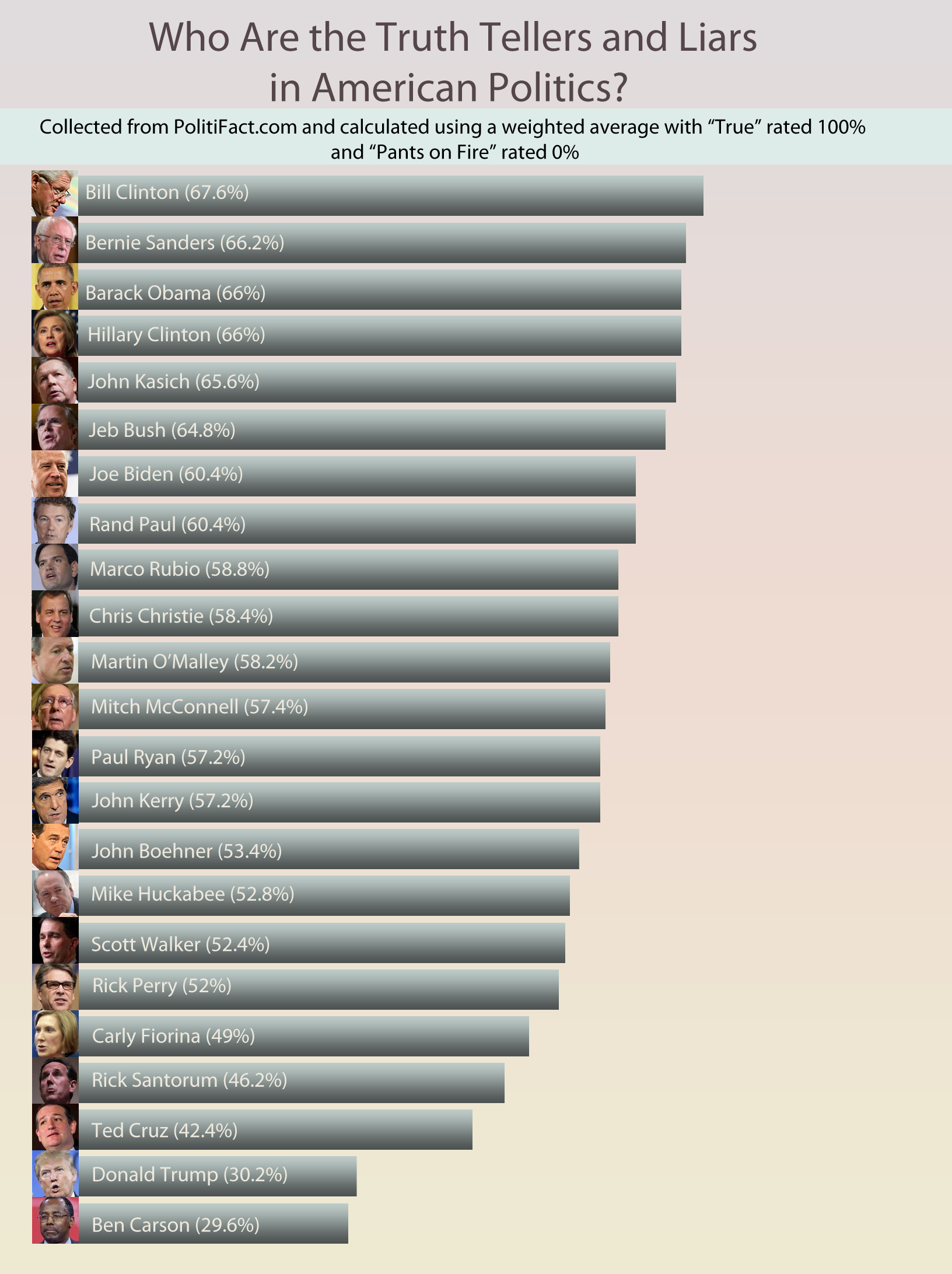
Why do politicians lie so much?

 Is there an “optimal level” of truth telling in politics?

Posted in Cheating, Deception, Ethics, Politics | Leave a comment

“Shortest paper ever published in a serious Math Journal”

The one-page paper is titled “Can n2 + 1 unit equilateral triangles cover an equilateral triangle of side > n, say n + ε?,” authored by John H. Conway and Alexander Soifer, and you can find it here, along with annotated comments by other academics on the left-side margin of the original paper (via Fermat’s Library) … Happy New Year!

Posted in Mathematics | Leave a comment

Satellite Traffic (1957-2015)

Posted in History, Probability, Science | Leave a comment

Are Star Wars fans anti-Bayesian movie-goers?

Does the theory of price elasticity of demand apply to cultural artifacts, like movies? On this question, we strongly recommend Harrison Searles’s in-depth movie review of the latest Star Wars flick The Force Awakens–a review we found via Marginal Revolution (link #1), by the way. What we liked most about this particular review is the introduction, which presents an intriguing analysis of the non-Bayesian preferences of a certain class of movie-goers: specifically, movie-goers who will pay to see a franchise film like “The Force Awakens” regardless of its quality:

Whatever may be the quality of the movie, The Force Awakens is still under the Star-Wars brand and is therefore a must-watch for a sizable portion of the population. Reviewing this movie from the point of view of providing spoiler-free advice about whether a movie-goer at the margins should spend her time and money to go see it is therefore largely an exercise in futility. Those margins scarcely exist. Much like how the Force is divided into the light side and the dark, we live in a world in which the population is divided between those who will go see any Star-Wars film, even if it were led by Jar Jar Binks, and those who care nothing for the franchise.

Posted in Bayesian Reasoning, Science Fiction | Leave a comment

End of year review: 2015

It’s that time of year again … In addition to my regular teaching duties, here is what we were working on (outside the classroom) during the previous year (2015):

(a) Research fraud as tort, Science, Vol. 349, No. 6255 (25 Sep 2015), pp. 1459-1460.

(b) Why don’t juries try range voting?, Criminal Law Bulletin, Vol. 51, No. 3 (2015), pp. 680-692.

(c) Reply to Orin Kerr, SSRN working paper (20 June 2015).

(d) Misappropriation and The Old Man and the Sea, SSRN working paper (25 Feb 2015).

Read in isolation, these papers appear to have very little in common, but in fact, they are part of larger projects we have been working on since our early days at the Pontifical Catholic University of Puerto Rico. Our revisionist reading of Hemingway’s Old Man and the Sea, for example, is part of a larger project in which we explore hidden intersections between law and popular culture, while our “Reply to Orin Kerr” presents a  thought experiment, a method of analysis we have used many times before. (It’s a ridiculous thought experiment, to be sure, but our larger purpose is to demonstrate the utility of thought experiments in law, even crazy ones.) Likewise, our 2015 “range voting” paper, which proposes a novel solution to hung juries, is a sequel to our 2012 “Turing Test” paper. Lastly, our recent letter to Science on the legal implications of research fraud is not our last word on this subject, as we continue to research and write on the possibility of civil liability for research misconduct in the social sciences.

Posted in Academia | Leave a comment

Good vs Evil (legal citation edition)

https://twitter.com/DrRimmer/status/681988034603036672

Hey there … We just found out–via James Creedon and Matthew Rimmer (above)–that two of our colleagues (professors C.J. Sprigman and Carl Malamud, to be more exact) are working on an open source (i.e. free) version of legal citation rules tentatively titled BabyBlue. (Copyright infringement, anyone?) As far as we’re concerned, however, the existing rules of legal citation set forth in the venerable “Bluebook” are so cumbersome and convoluted that we can’t wait for BabyBlue to be released to the public … In the meantime, we are in the process of writing up our own set of simple and rational rules for legal citations called “A Stylebook for Law,” one that gets rid of “supras” and “infras” and replaces footnotes with bibliographies.

Posted in Academia, Law | Leave a comment

Visualization of Gerrymandering (Florida edition)

Welcome to Florida’s 5th Congressional District

Posted in Cheating, Politics | Leave a comment

Bookcase/Staircase

 Happy birthday, Sydjia! Hat tip: Spicebar (via imgur).

Posted in Culture, Literature | Leave a comment