If you are looking for more evidence that so-called “judicial conservatives” are every bit as politically-motivated and results-oriented as “judicial liberals,” then look no further to Randy Barnett, a professor of constitutional law at Georgetown University. In a recent blog post [*] at the Volokh Conspiracy (one of the best blogs about law, by the way), Professor Barnett belittles the political process, argues that administrative agencies are both unresponsive and unaccountable to private citizens, and then poses a rhetorical question (lawyers and law professors just love rhetorical questions, since it’s so much easier to smuggle your normative conclusions into your factual premises than be intellectually honest): “So tell me a story about how an individual denied the right to braid hair without an expensive and time consuming cosmetology license can get her right [to do business] vindicated in ‘the legislative process.‘” (Note the unintended irony in this question: you also need a license to be a lawyer, after all.) Continue reading
When computer programs break the law
Check out this recent report by Daniel Rivero with the provocative title “Robots are starting to break the law and nobody knows what to do about it.” Mr Rivero describes the “robot” in question–an automated computer program called “Random Darknet Shopper” and poses a unique question: Continue reading
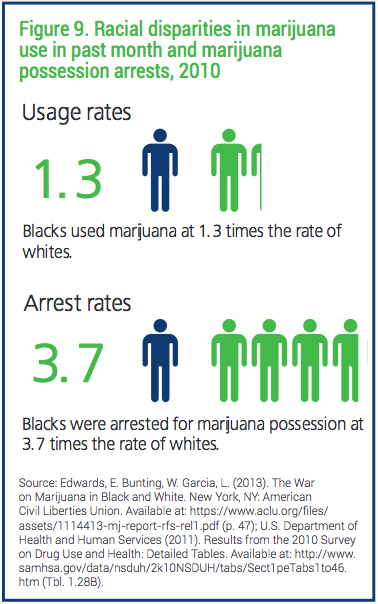
Fair or foul? (Marijuana law enforcement edition)

Via Vox, more evidence that the “war on drugs” is a racist war.
Shadow externalities on Central Park South (before and after skyscraper development)
Should there be property rights in sunlight? The shadow maps below are courtesy of the Municipal Art Society of New York:

Paper boats in the rain
Courtesy of snappiness (via imgur).
An open letter to our frequentist friends
We have had to sit through a countless number of mind-numbing social science presentations and empirical papers during our academic career, most or all of which have relied on standard frequentist methods. We are writing today to request a favor. Why can’t we just admit that subjective priors are unavoidable in any field of inquiry? After all, we must necessarily begin with our priors when deciding what set of problems to solve and how to solve them. Why pretend otherwise? (By the way, all of you are smart people. Many of you have PhD’s and have many years of book learning and practical experience in your various fields. If any group of individuals is likely to have well-informed priors or good hunches about well-defined research problems, it’s you!)
Many of our colleagues, however, continue to reject Bayesian methods. You cling to an idealized conception of science. You equate “science” with standard frequentist methods, that is, with the ad hoc and easily manipulable statistical methods of Fisher, Pearson, and others. But this view of science is too narrow, too static. Science is ultimately about discovery, not about p values. Furthermore, all knowledge is contingent, including scientific or experimental knowledge. Nothing is certain. Thus the Bayesian notion of “degrees of belief” provides a realistic understanding of how our knowledge actually evolves over time. To discover, one must be willing to update one’s priors (whatever their source or level of subjectivity) in light of new evidence. Bayesian updating is an ongoing and never-ending process.
Where have we gone wrong?
Yours truly,
Prior Probability
“On Constitutional Disobedience”
That is the title of this thought-provoking book by Louis Michael Seidman, a professor of constitutional law at Georgetown University. In summary, Professor Seidman’s thesis is that the Constitution of 1787 is not binding on us. While a strong case can certainly be made that Supreme Court interpretations of the Constitution are not binding on the other branches of the national government, you can go ahead and file Seidman’s work under “stupid sh*t law professors say.” In politics, as in any other human activity, we must have rules–as well as an entity who is willing and able to enforce the rules. Without a set of rules, how can we play?
Monday morning quarterbacks and the limits of game theory
Our colleague Justin Wolfers has written an excellent essay defending the indefensible–Coach Carroll’s controversial play call on 2nd down with 26 seconds remaining in the 4th quarter of Super Bowl XLIX, the disastrous (in hindsight) play call that led to his team’s gut-wrenching defeat in the final seconds of the championship game. In particular, Professor Wolfers takes a well-known solution concept from game theory–the idea of a “mixed strategy“–and applies it to the game of football. Briefly, the idea is that a team on offense should randomly choose between rushing the football and passing the football in order to maximize its probability of scoring … Continue reading



