Remember Watson, IBM’s Jeopardy-winning supercomputer? According to this report in LTN (Law Technology News), IBM is developing Watson Debater, a computer that can synthesize rules and cases and argue different sides of a legal issue. Robert C. Weber, Senior Vice President of Legal & Regulatory Affairs and General Counsel at IBM United Kingdom, thinks that Watson is already able to pass any State’s bar exam. Mr Weber also notes that Watson is “developing the ability to put forth arguments in a logical way,” which could have “implications in the law.” (You don’t say?) What about for politics? (Hat tip: Ray Campbell, who blogs regularly at The Faculty Lounge.)
The Mission Playground Incident
Does this four-and-one-half-minute video depict a Tragedy of the Commons? Does it falsify or confirm the main tenets of the Coase Theorem? After all, “transaction costs” are low, yet we don’t we see any Coasean bargaining in this situation, or do we …? At last count (12 noon, 15 October 2014), this video has elicited over 450 comments on this San Francisco website (Uptown Almanac) and has been viewed over 321,000 times on YouTube. For our part, we agree with this comment from “VT Prof” (edited for clarity): Continue reading
Nobel Prize 2014: Jean Tirole
Hola! We are reblogging an excellent post (see below) from Kevin Bryan, a professor of strategy at the University of Toronto Rotman School of Management, summing up some of the work of the most recent recipient of the Nobel Prize in Economics, Jean Tirole. (Professor Bryan’s blog, a favorite of ours, is called A Fine Theorem.) The blog post below explains Jean Tirole and Eric Maskin’s work on “incomplete contracts.” Notice how the economic approach to contracts differs from the legal or doctrinal approach.
A Nobel Prize for applied theory – now this something I can get behind! Jean Tirole’s prize announcement credits him for his work on market power and regulation, and there is no question that he is among the leaders, if not the world leader, in the application of mechanism design theory to industrial organization; indeed, the idea of doing IO in the absence of this theoretical toolbox seems so strange to me that it’s hard to imagine anyone had ever done it! Economics is sometimes defined by a core principle that agents – people or firms – respond to incentives. Incentives are endogenous; how my bank or my payment processor or my lawyer wants to act depends on how other banks or other processors or other prosecutors act. Regulation is therefore a game. Optimal regulation is therefore a problem of mechanism design, and we now have mathematical tools that…
View original post 1,413 more words
#EconomicsInThreeWords
Is Economics deserving of its own Nobel Prize*? Is Literature? In honor of Jean Tirole being awarded the 2014 Sveriges Riksbank Prize in Economic Sciences in Memory of Alfred Nobel — previous recipients include our intellectual heroes Ronald Coase, John Nash, and Thomas Schelling — we are reposting the following Twitter thread titled #EconomicsInThreeWords. Here’s our contribution: “Markets require rules.” Below are a few other exemplars from this series:
https://twitter.com/acoyne/status/518775100313579520
*By the way, for what it’s worth, the Nobel Prize for Economics is not a “real” Nobel Prize, i.e., it’s not one of the original Nobel Prizes created through Alfred Nobel’s will, which specified that his annual prizes should go to people whose work has “conferred the greatest benefit on mankind.” The Economics prize, by contrast, was created (and funded) by the Swedish Central Bank in 1968 “in memory of Alfred Nobel.”
Music Monday: Mexican Coke
Triple hat tip to Erin Geiger Smith for writing up this in-depth report about Mexican Coca Cola in the Sunday Times and for bringing this hard-core Mexican Coke song and this cool thing to our attention. Here is an excerpt from her report (emphasis ours): Continue reading
Who pays?
Eve Moneypenny and James Bond appear to commit a number of civil torts in this dramatic opening scene of the 2012 film Skyfall (filmed on location in Istanbul, Turkey). Is their employer, MI6, not liable to the various victims for any of the resulting damages under the common law principle of respondeat superior? Doesn’t the answer to this liability question, in turn, depend on whether Bond and Moneypenny are employees or independent contractors?
#LetGurleyPlay
The University of Georgia Athletic Association made $98.9 million in revenues during the 2013 fiscal year, according to this revealing report in the Athens Banner-Herald. The University of Georgia Athletic Association’s main income sources included $21.2 million in direct football revenue, $23.2 million in ticket contributions from football season ticket buyers, and $18.2 million in TV income through the NCAA and SEC. Yet Todd Gurley, their star running back and Heisman-trophy candidate, isn’t allowed to make a few hundred dollars off his own likeness. The monopolistic NCAA and the greedy University of Georgia Athletic Association are pure evil, and Todd Gurley’s teammates should refuse to take the field today against Mizzou in solidarity with their brother. In short, let the man play, or no one plays.
Who will be college football’s Lech Walesa?
The paradox of “assholism”
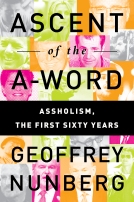
This is Professor Geoffrey Nunberg’s crude neologism, not ours. Dr Nunberg, a professor of linguistics at UC Berkeley, delves into “the moral logic of assholism” in his 2012 book Ascent of the a-word: assholism, the first sixty years. (We spent the better part of yesterday afternoon reading Dr. Nunberg’s quirky tome.) In the words of Dr Nunberg, this moral logic justifies rudeness on one’s part when someone else is rude in turn: “Put simply, you have a right to treat assholes as assholes because the assholes have it coming.” But as the Professor explains in his a-word book, this moral logic poses a paradox or puzzle, for calling someone an “a-hole” is itself an a-hole move, is it not? By way of example, if we were to call the Todd Gurley snitch an “a-hole” (no doubt a deserving epithet in this particular case), we would then be acting like a-holes ourselves. This paradox of contradiction is aptly captured by the familiar expression “two wrongs don’t make a right.” (In Spanish, we would say: “Lo cortés no quita lo valiente.”) Is this really true? Is there a solution to this paradox? (Note: This blog post was revised on 11 October 2014.)
The paradox of automation
Our student Mike Hildebrandt recently brought this mesmerizing essay (with the mysterious title “The Human Factor”) to our attention. The author of the essay, William Langewiesche, describes the last moments of doomed Air France Flight 447 in riveting detail, and he also makes the larger point that as automation makes commercial aviation safer, the possibility of pilot error becomes more likely in those rare instances in which an unforeseen event occurs mid-flight. In the words of Mr Langewiesche:
To put it briefly, automation has made it more and more unlikely that ordinary airline pilots will ever have to face a raw crisis in flight—but also more and more unlikely that they will be able to cope with such a crisis if one arises. Moreover, it is not clear that there is a way to resolve this paradox. That is why, to many observers, the loss of Air France 447 stands out as the most perplexing and significant airline accident of modern times.
So, does this particular paradox have any feasible solution? Also, what is the “optimal” rate of technological automation? (Diagram below courtesy of Aaron and Hsinya Lin.)
Grade the Professor
We are teaching “Intro to Business Law” at UCF this semester, and now that we are half-way through the semester, we would like some feedback from our students. (At last count, 1009 students are enrolled in Introduction to Business Law or BUL 3130.) You have one week to “grade the professor,” so vote early and vote often, for this pithy poll expires on 16 October. Comments are especially welcome, especially responses to the following two questions:
1. What do you like most about the Professor’s Intro to Business Law class? 2. What do you like the least, i.e. what would you like the Professor to do differently?