Annals of recursion

The students in my textbook are holding the textbook they are modeling for

Hat tip: LargeCoinPurse, via reddit.

Posted in Paradoxes, Philosophy | Tagged | Leave a comment

Infinite regress, bias, and the Coase theorem

In their paper “Motive attribution asymmetry for love vs. hate drives intractable conflict,” Adam Waytz, Liane Young and Jeremy Ginge appear to extend the logic of the Coase Theorem into the domain of politics. Specifically, Waytz, Young, and Ginge study the problem of “motive attribution asymmetry,” i.e., the belief that people who disagree with you have motives that are bad. Among other things, they found that “offering Democrats and Republicans financial incentives for accuracy in evaluating the opposing party can mitigate this bias …” This is an exciting and promising research agenda, but if we can pay people to be less biased, couldn’t we also pay people to be more biased as well? Consider, in addition, this hypothetical scenario, courtesy of Sandeep Baliga (emphasis by us): Continue reading

Posted in Economics, Law, Philosophy, Politics | Tagged , , | Leave a comment

Chess piece survival rates

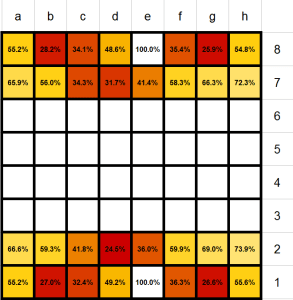
Someone on digg posted a variant of this question on Quora: “What are the chances of survival of individual chess pieces on average.” In reply, Oliver Brennan, a chess aficionado and computer programmer, posted this answer:

image

Image credit: Oliver Brennan

Update (25 Oct. 2014): The excellent Ada Swanson interprets this probabilistic chess board as follows (emphasis ours):

The kings have the highest survival rate … because they can’t be taken. Rooks also tend to be hardy because they spend a lot of time at the back of the board and are generally more active in endgames. The knights and central pawns have the lowest survival rates. Many popular openings involve d and e pawns undertaking suicide missions, which are sometimes counter-attacked with c pawns. The wing pawns have a higher survival rate, prompting one forum user to comment …, “If you can’t be the king, be the little guy hiding in the corner.”

Posted in Probability, Questions Rarely Asked | Tagged , | 20 Comments

But can it solve Bayesian equations?

Pocket Calculator, Meet the “PhotoMath” App: Complements or Substitutes?

Posted in Web/Tech | Tagged | 2 Comments

Multiple Comparisons and the Law

Deborah Mayo recently reblogged and commented on Nathan Schachtman’s blog post titled “Courts Can and Must Acknowledge Multiple Comparisons in Statistical Analyses.” (Mr Schachtman is not only a lawyer; he is also a lecturer at Columbia Law School and an expert on scientific evidence.) Moreover, because Mr Schachtman’s blog post and Dr Mayo’s comments on Schachtman’s post touch on an area we care about — the role of probability theory in law — we are re-reblogging both items below and shall comment on them in a future post.

Update (22 October 2014): We read Schachtman’s post on the multiple testing problem in law (see below), and we also read Dr Mayo’s comments to his post (ditto), and we were left scratching our heads. We’re not sure where they disagree. After all, isn’t it true that “data trolling” is bad science? And, if so, shouldn’t trial judges retain the discretion to exclude expert testimony based on multiple comparisons?

Mayo's avatarError Statistics Philosophy

NAS-3 .

The following is from Nathan Schachtman’s legal blog, with various comments and added emphases (by me). He will try to reply to comments/queries.

“Courts Can and Must Acknowledge Multiple Comparisons in Statistical Analyses”

Nathan Schachtman, Esq., PC * October 14th, 2014

In excluding the proffered testimony of Dr. Anick Bérard, a Canadian perinatal epidemiologist in the Université de Montréal, the Zoloft MDL trial court discussed several methodological shortcomings and failures, including Bérard’s reliance upon claims of statistical significance from studies that conducted dozens and hundreds of multiple comparisons.[i] The Zoloft MDL court was not the first court to recognize the problem of over-interpreting the putative statistical significance of results that were one among many statistical tests in a single study. The court was, however, among a fairly small group of judges who have shown the needed statistical acumen in looking beyond the reported p-value or…

View original post 2,543 more words

Posted in Bayesian Reasoning, Law, Philosophy | Tagged , | Leave a comment

Martian Monday

We like drmickhead’s comment: “The fact that we have robots on another planet that will be photographing this event makes [us] inordinately happy.

Posted in Science | Tagged , , | Leave a comment

“The possibility of a general theory of emergency”

That is the subtitle of this fascinating paper — the full title of the paper is “Exception and Necessity: The Possibility of a General Theory of Emergency” — written by our colleague William Vazquez-Irizarry, a law professor at the University of Puerto Rico. In his paper, Professor Vazquez-Irizarry compares and contrasts the state of exception doctrine in public law with the doctrine of necessity in private law and develops a “general theory of emergency” common to both areas of law. The idea of a general theory of emergency is intriguing and original, but there is no reference in this paper to the work of Ronald Coase or John Rawls. That is, what would happen if rulers and the ruled could bargain with each other, either ex ante behind a Rawlsian veil of ignorance or ex post (assuming, of course, zero transaction costs)? In either case, what rules or principles would we agree to for dealing with public and private emergencies? Would the rules for private emergencies be the same as the ones for public emergencies?

This is just a test …

Posted in Economics, Law, Philosophy | Tagged , , , | Leave a comment

John Suh is not a lawyer

He is, however, a graduate of the Harvard Business School and the CEO of LegalZoom. So, will new business models like LegalZoom and new technologies like Watson Debater make lawyers and law firms obsolete? We’ve just read Susan Beck’s excellent report “Emerging Technology Shapes Future of Law.” Among the things in her report that caught our attention was this particular passage (edited for clarity): Continue reading

Posted in Economics, Law, Questions Rarely Asked | Tagged | Leave a comment

Zombie Hunting Permits

What is the optimal number of zombies? Our friend Glen Whitman makes the case why this number might be greater than zero.

Glen Whitman's avatarEconomics of the Undead

The city of Clarendon Hills, Illinois, has begun issuing zombie hunting permits.  A permit system is typically used to limit the amount of something.  Which raises an intriguing question:  why does Clarendon Hills want to reduce the amount of zombie hunting?  Apparently, there must be too few zombies!

This is not as absurd as it sounds.  As Michael O’Hara argues in Chapter 16 of Economics of the Undead, “Zombies as an Invasive Species,” one potential solution to a zombie infestation is to encourage people to hunt zombies for sport.  Initially, while the zombies are numerous and out of control, you wouldn’t want to limit this activity.  But if zombie hunting became popular enough, then the zombies could be hunted into extinction — which would mean the death of a popular and enjoyable pastime.  To prevent the overhunting of the zombie population, you would need to establish private zombie-hunting preserves (as O’Hara…


View original post 142 more words

Posted in Uncategorized | Leave a comment

“I am a Liberian, not a virus”

Check out  and this report by Yesha Callahan. Thanks to Shoana Cachelle for her video.

Posted in Culture, Justice, Science | Tagged | Leave a comment