Explain this …

Here is NFL referee Clete Blakeman explaning why the penalty at the end of last night’s game between the New England Patriots and the Carolina Panthers was not in fact a penalty:

So it was determined at that point in time that when the primary contact occurred on the tight end that the ball, in essence, was coming in underthrown and in essence it was [immediately] at that point intercepted at the front end of the end zone. So there was a determination that, in essence, uncatchability, that the ball was intercepted at or about the same time the primary contact against the receiver occurred.

But wasn’t Tom Brady’s pass, in essence, “uncatchable” precisely because of the defensive player’s interference with the tight end?

Posted in Uncategorized | Tagged , , | 4 Comments

Justice Posner?

It’s remarkable that the most prolific and most cited legal scholar of the 20th century–Judge Richard A. Posner–has still not been appointed to be a Justice of the US Supreme Court … and probably never will be given his age and his caustic criticisms of the political nature of the High Court. As Judge Posner notes in a recent interview with Noah Charney of The Daily Beast,

Well, I don’t like the Supreme Court. I don’t think it’s a real court. I think of it as basically … it’s like a House of Lords. It’s a quasi-political body. President, Senate, House of Representatives, Supreme Court. It’s very political. And they decide which cases to hear, which doesn’t strike me as something judges should do. You should take what comes. When you decide which case to hear it means you’ve decided the cases ahead of time.

prior probability agrees with Judge Posner about the nakedly political nature of the Supreme Court, but not for the reason Posner gives. In essence, Posner is arguing that the Supreme Court is a political court because it gets to choose which cases to decide. But what other method of case selection could the Supreme Court use to allocate the hundreds, if not thousands, of appellate cases presenting federal questions? Also, don’t all courts, even lowly trial courts, get to control their dockets to a large extent through ad hoc application of the well-pled complaint rule, the standing doctrine, and other procedural devices?

Hat tip to Tara Colon
Posted in Uncategorized | Tagged , , | Leave a comment

*Mincome*

Why don’t governments just give poor people cash with no strings attached–a minimum income or mincome–instead of in-kind benefits such as food stamps and housing vouchers? True, some recipients would choose not to engage in productive work, spending their time at strip clubs or the horse track. But so what? Others would use the security of a minimum income to create new businesses and follow their dreams. As an added bonus, a “mincome” system would reduce the size of government bureaucracy by replacing such in-kind and paternalistic programs as unemployment benefits, legal aid, food stamps, and public housing. (Perhaps this possibility explains why governments still prefer to give in-kind benefits over cash.)

For more on the pros and cons of mincome, see this report in the Sunday Times about an upcoming Swiss referendum essentially proposing to pay people for being alive. In summary, every single Swiss citizen would receive a monthly income from the government, no strings attached. Regardless of the outcome of this referendum, why hasn’t any wealthy country (so far) adopted such a radical and truly-effective anti-poverty program?

Posted in Uncategorized | Tagged | 2 Comments

Why don’t we get rid of *time-outs* in sports?

One of the things prior probability likes about soccer is the simplicity of its rules–there are just 17 simple rules in soccer (*)–and especially the fact that there are no “time-outs” and thus no manipulation of the game clock in the beautiful game.  The final seconds of a basketball or football game, by contrast, suck to watch because of the way players and coaches try to extend the game artificially by manipulating the game clock in various ways. So why don’t basketball and football just get rid of time-outs and simply extend the time of play to 45 NON-STOP minutes per half like soccer–yes, 45 minutes per half WITHOUT STOPPING THE CLOCK FOR ANY REASON, whether a team scores, is fouled, or steps out of bounds. A non-stop game clock would reduce all the strategic manipulation of the game clock and add more excitement to basketball and football games. What say you?


* Shout out to Carlos Reyes for this bit of information.

Posted in Uncategorized | Tagged , , , | 2 Comments

“You don’t like the old-time bikes, huh?”

Could this be the reason why Facebook doesn’t have an “Unlike” button?

Posted in Uncategorized | Tagged , , | 2 Comments

Torts midterm

Here is prior probability‘s torts midterm from last month. (Yes, the exam simply consisted of a TMZ video depicting an altercation at LAX involving Kanye West and a photographer.) Can you spot and discuss the relevant legal issues?

Posted in Uncategorized | Tagged , , | Leave a comment

Query

Why does one player get off with a slap on the wrist (an undisclosed monetary fine), …

… while another player gets “suspended indefinitely” for essentially committing the same offense?

True, the second guy’s racial slur was directed toward a teammate (a highly-paid teammate, we might add), while the first guy’s slur (the same slur!) was directed toward an ordinary (i.e. lowly-paid) private citizen. But from a moral or ethical perspective, is third-party bullying somehow “less worse” than bullying among friends or co-workers?

Posted in Uncategorized | Tagged , , | 2 Comments

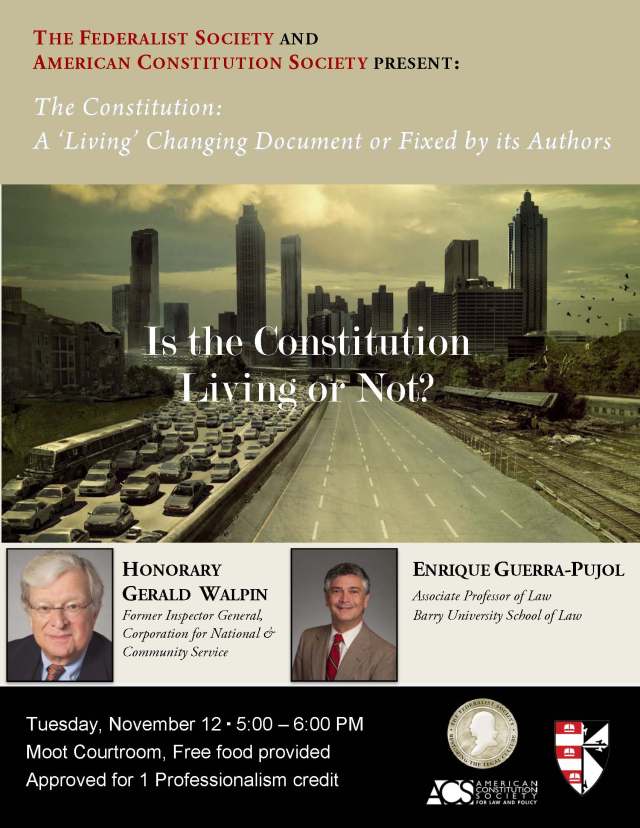
Is the Constitution “living”?

prior probability and Gerald Walpin will be discussing originalism and “the living Constitution” tomorrow at 5pm at Barry Law School

Posted in Uncategorized | Tagged , | 1 Comment

Can Twitter be monetized?

Enough people seem to think so, if Twitter’s rising share price is any indication. But is the market “wrong” on this one? After all, if given a choice, who really wants to waste time following “sponsored” (i.e. paid) tweets?

The larger question is this: is there an effective and “cool” way of solving the inherent tension between the need to commercialize or monetize nominally “free” websites like Twitter and Facebook on the one hand and a website’s level of hipness and utility to its users on the other hand?

prior probability, for one, still remains skeptical, though Google and gmail are good counter-examples.

Posted in Uncategorized | Tagged , , , , | 3 Comments

Prior probability 101

Here are the opening lines of Wikipedia’s excellent entry for the Bayesian concept of prior probability:

… a prior probability distribution, often called simply the prior, of an uncertain quantity p (for example, suppose p is the proportion of voters who will vote for the politician named Smith in a future election) is the probability distribution that would express one’s uncertainty about p before the “data” (for example, an opinion poll) is taken into account. It is meant to attribute uncertainty rather than randomness to the uncertain quantity.

In other words, the “prior” is a value that measures one’s level of uncertainty about a given event. Also, notice that by openly acknowledging one’s uncertainty about events in the world, the prior serves as a useful starting point (not an end point) towards knowledge.

In future posts, we will explain the process of “updating” one’s priors and how Bayesian methods might apply to law and the legal process.

Posted in Uncategorized | Tagged , | Leave a comment