Orlando, our city, in our hearts and prayers

Tel Aviv city hall tonight

Tel Aviv City Hall (via reddit)

Posted in Uncategorized | 2 Comments

Light pollution map

Via imgur (h/t glowdirt). Click on the map to enlarge.

Posted in Bayesian Reasoning, Maps | Leave a comment

The law of the law of the law of interpretation?

As we mentioned in our previous blog post, William Baude and Stephen Sach recently posted on SSRN an 85-page magnum opus titled “The Law of Interpretation.” (By the way, on the bottom of each page of their article, there is an obnoxious disclaimer stating “Draft–please use caution before citing or quoting.”) We decided to write up a formal reply to their article, though whether we used sufficient “caution” in quoting from their article, we can’t say. Here is an excerpt from our reply (footnotes omitted):

To their credit, Baude and Sachs eventually anticipate our regress objection toward the end of their [85-page] article. Nevertheless, their last-ditch though no doubt sincere effort to salvage their newborn theory is too little, too late. Although they concede that “there can be uncertainty or disagreement” about their second-order legal system, they then conjure up out of thin air the existence of (third-order?) “closure rules.” According to Baude and Sachs, these meta-magical closure rules can be either procedural or substantive, but alas, their lengthy article does not specify what these “closure rules” consist of or where judges can go to find them. Worse yet, Baude and Sachs end up conceding that their so-called closure rules are themselves contested and open to ambiguity. As a result, they also posit a set of (fourth-order?) “authority rules” for resolving disputes about the closure rules. Yet the existence of meta-meta-magical rules of authority compounds the regress problem with a tautology. Why? Because the rules of authority are simply arbitrary rules that answer the question “who decides?” in the final instance. But telling us who has the last word in matters of interpretation does not solve the problem of interpretation. Again, we are back to where we started …

So, where does this leave us regarding the problem of legal interpretation? Back to the proverbial drawing board, we’re afraid to say.

Posted in Law, Logical Fallacies, Philosophy | Leave a comment

The law of the law of interpretation

William Baude (University of Chicago) and Stephen E. Sachs (Duke University) recently posted on SSRN an important paper titled “The Law of Interpretation.” (How important? Their paper will be published in the Harvard Law Review–that important!) Law professors like Baude and Sachs and their kin have killed millions of trees writing papers and whole books about legal interpretation (the Baude & Sachs paper, for example, is 85 pages and contains 372 footnotes) because interpretation is so central to what courts do in deciding hard cases, especially cases involving constitutional law. Specifically, courts must resort to various theories of interpretation when there are gaps in the law or when the applicable law consists of conflicting rules or legal principles. For their part, Baude and Sachs claim that “legal interpretation … is deeply shaped by preexisting legal rules. These rules tell us what legal materials to read and how to read them. Like other parts of the law, what we call ‘the law of interpretation’ has a claim to guide the actions of judges, officials, and private interpreters — even if it isn’t ideal. We argue that legal interpretive rules are conceptually possible, normatively sensible, and actually part of our legal system.” In other words, the authors claim that there are rules of legal interpretation and that these rules comprise a second-order legal system.

Nevertheless, although we don’t want to be “that guy,” we are obliged to point out a fundamental logical flaw in their argument, a blind spot that destroys their entire theoretical edifice in a single blow. Specifically: what happens when there are gaps in these second-order interpretative rules themselves, or when the rules in this second-order system are themselves in conflict? Is there a third-order law (i.e. a law of the law of interpretation) to help us interpret the second-order interpretation rules, or do we have an infinite regress? (Addendum: we have posted a formal reply to Baude & Sachs on SSRN.)

Posted in Law, Logical Fallacies, Philosophy | 8 Comments

Most stolen books

Posted in Bayesian Reasoning, Cheating, Culture, Economics | Leave a comment

Where do we place our bets?

Posted in Bayesian Reasoning, Current Affairs, Law, Politics, Racism | 2 Comments

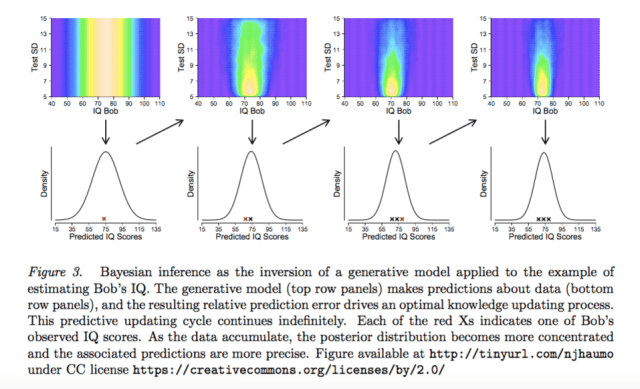
Bayesian models as predictions

Our friend and colleague Jeremy E.C. Genovese recently brought this short theoretical paper to our attention. The paper, which was written by Eric-Jan Wagenmakers, Richard D. Morey, and Michael D. Lee, is titled “Bayesian benefits for the pragmatic researcher,” and we strongly recommend it. In brief, their paper explains how we can use Bayesian methods to answer to practical but non-experimental questions that standard statistical methods are unable to answer, e.g. is there any correlation between the box office success and the quality of Adam Sandler movies? What we liked most about the paper, however, is the authors’ Popperian discussion about the role of prediction in Bayesian models. Here is an excerpt (emphasis in original):

For a Bayesian, the crucial task is to specify [his] model generatively, before it has made contact with the observed data. In the other words, the model needs to be specified in such a way that it generates data and thereby makes predictions. Without making predictions, a model cannot be tested in a meaningful way.

Screen Shot 2016-06-06 at 10.16.56 AM

Credit: Eric-Jan Wagenmakers, Richard Morey, and Michael Lee

Posted in Bayesian Reasoning, Probability | Leave a comment

“Respondeat Superior” (the Law of Agency)

Because of the ubiquity of principal-agent relationships in the business world, we will spend an entire lecture on the law of agency in our next class. Also, although we have been focusing mostly on the founding of Facebook this semester, let’s take a “time out” from social media, and let’s instead consider the fictional world of secret agent #007 James Bond.

In legal terms, Mr Bond works for the British secret intelligence service, known as “MI6” for short. Mr Bond is thus the AGENT, while MI6 is the PRINCIPAL. Whenever we see a principal-agent relationship, an important legal question that often arises is this: When is the principal legally liable for the acts committed by its agents? Under the legal doctrine of respondeat superior, the answer depends in large part on whether the principal’s agents are employees or whether they are independent contractors.

Consider, by way of example, the opening car chase sequence in the film “Skyfall,” in which James Bond and fellow secret agent Eve Moneypenny chase some bad guys and appear to inflict various harms against merchants of the Grand Bazaar, a huge market located in Istanbul, Turkey (pictured below), where this car chase sequence takes place. Now, let’s imagine what would happen if the owner of the Grand Bazaar were to sue MI6 in tort on behalf of its merchants for the negligent acts of MI6’s agents James Bond and Eve Moneypenny. Would MI6 be legally liable under the law of agency — specifically, under the doctrine of respondeat superior — for the property damage caused by secret agents Bond and Moneypenny in the course of their mission? To answer this question, we will re-enact a hypothetical legal proceeding in our next class: Grand Bazaar vs. MI6. We will need several student volunteers for this in-class assignment:

  1.  Barrister-at-law* for the Grand Bazaar: Your mission, should you decide to accept it, is to argue why MI6, the principal, is legally liable for the torts (property damage) caused by its secret agents James Bond and Eve Moneypenny during the car chase scene in the Grand Bazaar.
  2. Barrister-at-law for MI6: Your mission is to argue why MI6, the principal, is not legally liable for the tortious act of its secret agents James Bond and Eve Moneypenny.
  3. Barrister-at-law for the secret agents: Your mission is to argue why your clients James Bond and Eve Moneypenny did not commit any torts, i.e. are not themselves directly responsible for the property damage that occurred during the car chase.
  4. The Jury: The class as a whole will play the role of the jury.
[*] Note: A barrister is how a trial lawyer is referred to in England.
Posted in Ethics, Law | Leave a comment

The Greatest of All-Time

In addition to the video below of Muhammad Ali’s greatest moments in the ring, we want to share this loving memory of Ali by our friend and colleague, the poet/writer Luanne Castle. Here is an excerpt:

When I was a little kid, there were two big celebrities whose names swirled around me on a weekly, if not daily, basis: Marilyn Monroe and Cassius Clay … For me, the name Cassius Clay itself was memorable, as was his personality and his reputation. He was a bit of a P.T. Barnum, bellowing and insisting upon attention and admiration. He was talented, and he knew it. He was handsome, and he knew it. He had the “IT” factor, and he knew it. He was also willing to stand up for himself and didn’t hold himself back, furthering civil rights by engendering in my generation the notion that OF COURSE all people should be equal. He did that with his expectations.

Then he converted, changed his name, and avoided the draft–and stirred up even more attention for himself. At that point, he tested the sympathies of middled-aged middle America. But for my generation, he showed that you don’t have to accept things just because the government says it is so. You can fight against what you feel is wrong. He showed that some things are worth fighting for. Whether you agreed or not with his political stance, it was impossible not to recognize that he was a FORCE and a TEACHER. We were young. We were blank slates. We learned so much from him.

Posted in Bayesian Reasoning, Current Affairs, History, Truth | 2 Comments

Math Clock

Courtesy of Geek Alert (hat tip: who else? Cliff Pickover)

Posted in Culture, Mathematics | 3 Comments