The paradox of automation

Our student Mike Hildebrandt recently brought this mesmerizing essay (with the mysterious title “The Human Factor”) to our attention. The author of the essay, William Langewiesche, describes the last moments of doomed Air France Flight 447 in riveting detail, and he also makes the larger point that as automation makes commercial aviation safer, the possibility of pilot error becomes more likely in those rare instances in which an unforeseen event occurs mid-flight. In the words of Mr Langewiesche:

To put it briefly, automation has made it more and more unlikely that ordinary airline pilots will ever have to face a raw crisis in flight—but also more and more unlikely that they will be able to cope with such a crisis if one arises. Moreover, it is not clear that there is a way to resolve this paradox. That is why, to many observers, the loss of Air France 447 stands out as the most perplexing and significant airline accident of modern times.

So, does this particular paradox have any feasible solution? Also, what is the “optimal” rate of technological automation? (Diagram below courtesy of Aaron and Hsinya Lin.)

Posted in Bayesian Reasoning, Economics, Paradoxes | Tagged | Leave a comment

Grade the Professor

We are teaching “Intro to Business Law” at UCF this semester, and now that we are half-way through the semester, we would like some feedback from our students. (At last count, 1009 students are enrolled in Introduction to Business Law or BUL 3130.) You have one week to “grade the professor,” so vote early and vote often, for this pithy poll expires on 16 October. Comments are especially welcome, especially responses to the following two questions:

1. What do you like most about the Professor’s Intro to Business Law class? 2. What do you like the least, i.e. what would you like the Professor to do differently?

Posted in Academia, Bayesian Reasoning | Tagged | 21 Comments

Music Monday

More details here.

Posted in Music | Tagged | 1 Comment

The problem of reclining airplane seats

We forwarded our 3 October blog post “The Right to Recline?” to several scholars, including our gentle friends Terry Anderson, Christopher Buccafusco, and Chris Sprigman. (By the way, Professors Buccafusco and Sprigman, in particular, had previously published this thoughtful essay on airplane seat reclining.) In summary, we had argued in our 3 October blog post — and we continue to argue — that property rights aboard commercial airlines are unclear. Some of our interlocutors, however, replied to us that the recliner should have a default right to recline since most airplane seats are reclinable in the first place. Here, for example, is one representative response to our 3 October blog post:

To me, the right appears to belong to the recliner, at least as a default. Seats recline, and people recline mostly without asking or notice. I know some people think that’s rude, but that doesn’t mean there isn’t a property right.

Nevertheless, we are not fully persuaded by this line of reasoning for two reasons. First, why can’t the “default rule” be in favor of the reclinee? After all, the reclinee is allocated a limited amount of legroom before takeoff, so he could easily argue that, at a minimum, he is entitled to that minimum amount of legroom during the entire duration of the flight. Secondly and more importantly, we would argue that just because someone has a property right to x, this does not mean that he has the right to use x in such a manner as to impose external costs on third parties. For example, I have a property right to my 1993 Jeep Wrangler, but I don’t have the right to park my Jeep on my neighbor’s driveway without my neighbor’s permission. Or to take one of Ronald Coase’s classic examples — the problem of cattle trespass — just because a rancher owns a herd of cattle doesn’t mean he is not liable to neighboring farmers when his cattle trespass on their land and destroy their crops.

In short, returning back to our airplane seat problem, what we have here are two competing and reciprocal sets of property rights: (a) the recliner’s right to recline and (b) the reclinee’s right not to be reclined upon. Until the airlines make it explicitly clear which set of property rights is to prevail — a or b — disputes between recliners and reclinees are unlikely to go away.
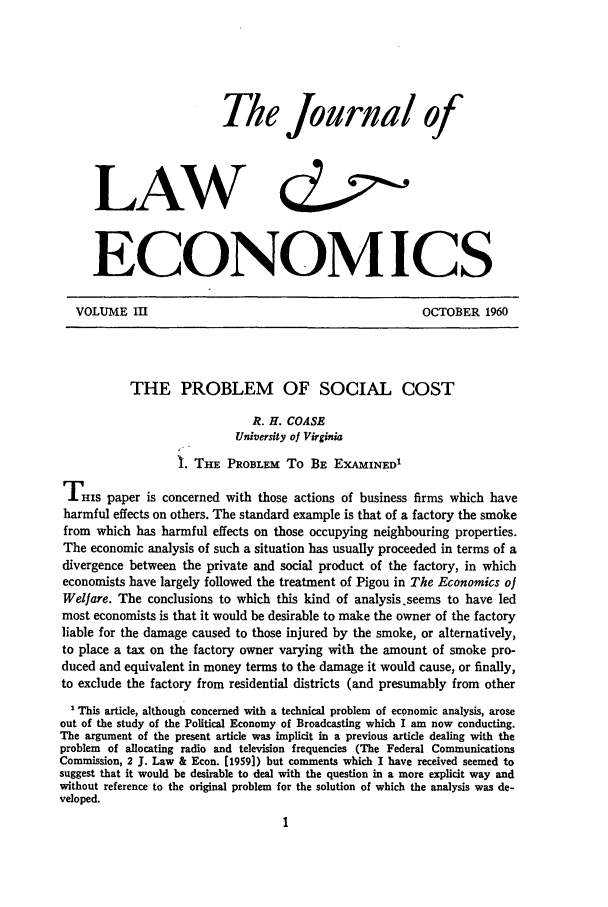
Social costs are bad.

Posted in Current Affairs, Economics, Property Rights | Tagged , , , | 2 Comments

Should academic papers be published anonymously?

David Wood, a professor of accounting at BYU, recently gave a thoughtful talk at our home institution (UCF*) comparing and contrasting academic publishing across various fields, including accounting, economics, finance, psychology, and the natural sciences. (For its part, The Economist recently wrote up this review essay about new developments in academic publishing.) Without getting into all the details of The Economist’s report or Professor Wood’s talk, suffice it to say that many academics are not satisfied with the publishing process in their fields for a wide variety of reasons, but foremost among these reasons is the high rejection rate by the top journals across all fields. This begs the question, however, of what, if anything, should we do to fix this “problem” (assuming, of course, that this state of affairs represents a real problem worth solving), short of increasing the number of academic papers accepted for publication? On the one hand, we could continue to tweak the existing system, or we could adopt a revolutionary approach by creating a specialized journal willing to publish academic papers on an anonymous basis. Such a journal could thus focus on publishing short papers with highly original or innovative ideas, independently of who wrote such papers. What do you think?

*Go Knights!

Posted in Academia, Game Theory, Questions Rarely Asked | Tagged | 1 Comment

Cable TV Pop Quiz

What’s your favorite cable TV show or channel? Ours is NFL RedZone. We get to see “every touchdown from every game” without commercial breaks. (Bonus question: What is the NCAA waiting for?) For the record, we have no financial or family interest in the NFL Network. We just love sports … and detest most forms of advertising, including the little ads that WordPress foists upon our blog from time to time.

Thanks Scott Hanson.
Posted in Uncategorized | Tagged , | 1 Comment

Should “The House” always win?

To be more precise, should casinos be able to use the law of negotiable instruments to get around the law of contracts? Or should gamblers be able to use the law of contracts to get around the law of negotiable instruments?

Why do we pose this question? In brief, many courts have held and continue to hold that the judicial system is not available to resolve gambling debts, or drug deals for that matter. The rationale for these decisions is that the courts will not enforce private wagers or drug deals because the object or purpose of such agreements is illegal in most States. (By the way, why should such purely consensual transactions be illegal?) At common law, when an illegal end (such as gambling or the sale of drugs) must result from performance of the contract itself, such an agreement is deemed illegal and is thus not enforceable in courts of law.

Casinos in Las Vegas, however, have devised a very clever way to get around this pesky legal doctrine. Casinos grant credit to their best customers (otherwise known as “high-rollers”) through “casino markers” and, moreover, such markers are generally considered valid negotiable instruments (like bank checks and drafts) under Revised Article 2 of the Uniform Commercial Code as long as such markers meet the conditions set forth in Art. 2; i.e. are in writing, are signed, are payable to the order of the casino and payable at a definite time, etc. (See the case of Las Vegas Sands v. Nehme for an egregious example of this clever strategy in action.)

But as Professors Denis Rudd, Louis Swartz, and David Lovejoy – all of whom are affiliated with Robert Morris University – explain in this short paper aptly titled “An overview of the enforceability of gambling debt”, the problem of unpaid gambling debts has become a matter of national concern with the proliferation of casinos from their traditional home base in Nevada to at least 38 other States (counting Indian casinos). So, how should the courts respond? Should “The House” always win?

The House always wins.

Posted in Economics, Law | Tagged , , | 2 Comments

The right to recline?

Professors  and  describe their ingenious Coasean experiment (which at last count has garnered over 1500 comments!) to test how much people value the “right to recline” on airplane seats. Their findings? People’s valuation of reclining vs. not being reclined upon depend entirely on which party — i.e. the recliner or the reclinee — holds the initial ownership of the legal right, i.e. the right to recline or the right not to be reclined upon. Professors Buccafusco and Sprigman thus conclude:

… we still don’t have any meaningful guidance about whether a “right to recline” or a “right not to be reclined upon” is the better rule … Whatever the answer, though, we are left with the puzzle of why people seem unwilling to bargain over a resource that at least some people are willing to fight over. Ultimately, it seems like there are lots of situations when people fail to negotiate over reclining when doing so would make both parties better off.

Is this really a puzzle, though? As our good friend Terry Anderson likes to point out, bargaining won’t work when property rights are unclear, a situation we call “legal failure.” Disputes over the “right to recline” on airplanes provide a textbook example of a situation involving unclear or contested property rights. If property rights were clearly assigned to either party (the recliner or the reclinee), then we would expect to see more Coasean bargaining. But in the absence of clear or well-defined property rights (the current situation on commercial airplanes), we would expect to see more conflict. (By the way, we previously modeled this conflict as a Prisoner’s Dilemma: who will be the first to defect? What do you think?) In any case, the lesson here is clear. If we wish to reduce conflict (and promote Coasean bargaining), all the airlines need to do is to clearly assign the right to recline or the right not to be reclined upon to one party or the other.

Posted in Economics, Law | Tagged , | 2 Comments

Research at Facebook

Research about research? We are reblogging Facebook’s official (and self-serving) statement in defense of its non-consensual and possibly unlawful research methods. Among other things, Facebook states that “our own research … indicat[es] that people respond positively to positive posts from their friends.” Duh? Aren’t these research results trivial or obvious?

Posted in Law, Science, Web/Tech | Tagged , | Leave a comment

If philosophy is a game …

… who are the umpires?

Created by Landon Schurtz.

Posted in Games, Logical Fallacies, Philosophy, Uncategorized | Tagged , | Leave a comment

