Cowen’s questions

As I mentioned in my previous post, my colleague Tyler Cowen presented a provocative thesis during his Kenneth Arrow lecture at Stanford last month. In brief, Cowen’s thesis is that the well-being, happiness, and welfare of future generations should count just as much as the well-being of current generations. To his credit, however, Cowen spent most of his lecture identifying several blind spots in his thesis. These blind spots can be reformulated as a series of five questions as follows:

1. When? How far into the future should we gaze? (This question can be formulated in different ways: What is the cut-off point? How many generations into the future should we take into account today?)

2. How? Is there a tried-and-true recipe for maximizing human happiness or well-being or “social welfare”? Also, how should we define these highfalutin values? Which takes us to the next question …

3. What? Even if we were able to define these values and discover a reliable recipe for maximizing them, what should we be maximizing–total or per capita human well-being? That is, should we try to maximize the total or aggregate amount of social welfare, or should we instead try to maximize the welfare or well-being of each individual member of a given society?

4. Who? Who are the members of this “given” society? Should we, for example, include animals in the social-welfare function?

5. I will conclude this post with an additional question of my own: Where? Where in the Devil should all this definitional and maximizing work take place? In one’s local city hall? At the State or federal level? At the United Nations?

For his part, Cowen’s humble reply to these thorny questions is, “I don’t know.” In other words, Cowen still has a lot of work to do …

Related image
Posted in Uncategorized | Leave a comment

Review of Cowen’s Arrow lecture (part 1)

In this post I shall summarize the three most original ideas or premises that my friend and colleague Tyler Cowen (George Mason University) presented during his thought-provoking Kenneth Arrow lecture on economics and ethics last month:

  1. According to Professor Cowen, the social discount rate (SDV) should be zero. That is just a fancy way of saying that the well-being and happiness of future generations should count just as much as the well-being of current generations. (A formal statement of SDV is pictured below.)
  2. At the same time, Cowen concedes that the optimal discount rate depends on one’s time horizon. The longer your time horizon is, the lower the discount rate should be, and conversely, the shorter your time horizon is, the higher the discount rate should be. (For example, if the world were to end tomorrow, we should throw a big party and enjoy ourselves today.)
  3. As a result, for Cowen the key question in economics and ethics is the same: what is the relevant time horizon? To me, the most original idea in Cowen’s lecture was this statement: “The application of your moral argument is time dependent.” In other words, what is moral or ethical depends on your time horizon!

In addition, Cowen spent most of his lecture identifying the shortcomings or problems with his approach to economics and ethics. I will summarize these problems in my next blog post.

Image result for social discount rate

Source: Sanket Suman

Posted in Uncategorized | Leave a comment

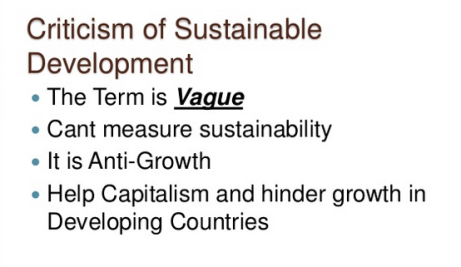
Is sustainable growth an oxymoron?

In response to Tyler Cowen’s recent Kenneth Arrow Lecture at Stanford, I am reposting below my eight-part review and critique of Cowen’s important 2018 book Stubborn Attachments:

  1. What moral or legal duties do we owe to future generations? (27 Nov. 2018);
  2. Cowen’s axiom (28 Nov. 2018);
  3. Cowen’s hedge (29 Nov. 2019);
  4. An intertemporal golden rule (29 Nov. 2019);
  5. Cowen’s six critical issues (part 1 of 2) (30 Nov. 2019);
  6. Cowen’s six critical issues (part 2 of 2) (3 Dec. 2019);
  7. Our critique of Stubborn Attachments (4 Dec. 2019);
  8. An intertemporal golden rule: closing thoughts (4 Dec. 2019).

Cowen is one the most original economists and public intellectuals of our time, so I will have a lot more to say about Cowen’s recent lecture in my next few blog posts.

Screen Shot 2019-12-02 at 11.10.20 PM

Image credit: Gaurav Awasthi

Posted in Uncategorized | Leave a comment

Progress or hubris?

Following up on our previous post, check out this op-ed by Patrick Collison and Tyler Cowen explaining why we need a new science of progress. According to Mssrs Collison & Cowen, “there is no broad-based intellectual movement focused on understanding the dynamics of progress, or targeting the deeper goal of speeding it up.” But what is “progress”? Collison & Cowen define progress broadly as that “combination of economic, technological, scientific, cultural, and organizational advancement that has transformed our lives and raised standards of living over the past couple of centuries.” (What motivates their fetish with recent history? What about those advancements that occurred prior to 1800 AD?) File under: “hubris”?

Image result for hubris
Posted in Uncategorized | Leave a comment

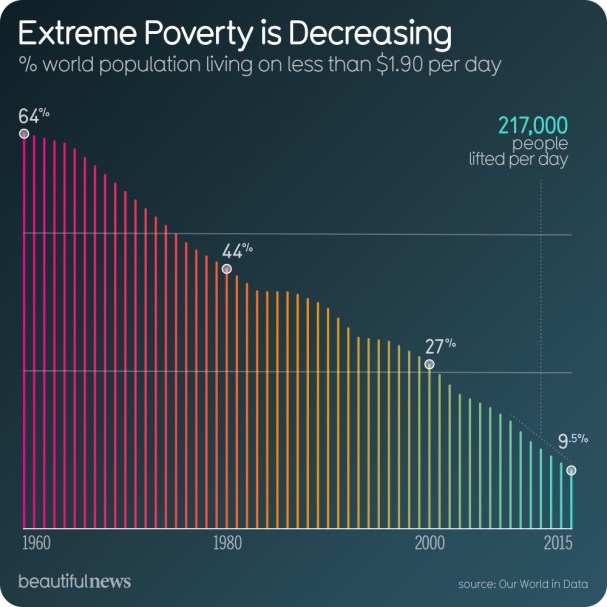
Visualization of progress

Check out the website “Beautiful News Daily” for additional infographics. (Hat tip: @kottke.)

Posted in Uncategorized | Leave a comment

Self-portrait

My cousin Natalia Renee Mastache, a graphic designer & illustrator from Miami, painted the self-portrait pictured below. Check out more of her work here.

Posted in Uncategorized | Leave a comment

Sólo Quédate en Silencio

One of my favorite Spanish pop songs of all time, the song “Sólo Quédate en Silencio” was officially released 15 years ago on 2 December 2004 by the now-defunct band RBD. Below is the “WalMart Soundcheck Version,” which was released in 2006:

Posted in Uncategorized | Leave a comment

Random boarding, anyone?

Given that millions of people will be boarding commercial aircraft this holiday season, we have compiled below three of our previous blog posts that may be of interest to the flying public:

  1. What is the fastest way to board an airplane? (7 August 2013).
  2. Why are airline boarding procedures so inefficient? (29 April 2014).
  3. The science of aircraft boarding (24 July 2014).

Also, check out the bonus video below:

Posted in Uncategorized | Leave a comment

Happy Thanksgiving?

Let me be clear, I am on the side of the Native Americans (see here, for example), but that said, let me recount the five things I am most thankful for:

1. I am grateful for my mother and father–Oilda Antonia & Francisco Florentino–who taught me that love has no limits and who made so many great sacrifices so that I would receive a decent education. May we one day return to a free and prosperous Cuba!

2. I am grateful for being blessed with four extraordinary children–Adela, Aritiza, Adys, and Kleber–who are all healthy, smart, and full of potential. May we one day all be reunited in our beloved Puerto Rico!

3. I am grateful for my wife Sydjia, for her love and loyalty. May we one day renew our vows in my adopted home of Jamaica!

4. I am grateful for La Catolica in Ponce, PR and UCF in Orlando, FL, for providing me the opportunity to teach. May you one day grant me tenure!

5. Last but not least, as a scholar of constitutional law, I am thankful for our enduring Constitution. May she last another 130 years!

Image result for indian thanksgiving
Posted in Uncategorized | Leave a comment

Ten-year challenge (game theory edition)

During the last ten years (2009-2019), I authored or co-authored the following ten papers in which I applied the methods of game theory (i.e. strategic decision-making) to a wide variety of legal and political questions:

1. A game-theoretic analysis of public-private contracts in the water sector (2009). I presented this paper at the National University of Singapore in July of 2009.

2. El caso de Puerto Rico: a game-theoretic analysis of the Puerto Rican status debate (2010). I presented this paper at a LatCrit conference at American University in October of 2010.

3. Modelling the Coase Theorem (2012). This was my second peer-reviewed research article, which was published in Volume 5, Issue 2 of The European Journal of Legal Studies.

4. Evade or comply? (2014). This work in progress models the strategic decision whether to evade or comply with the law.

5. The evolutionary path of the law (2014). This paper reviews Ullica Segerstråle’s beautiful biography of evolutionary biologist W. D. (Bill) Hamilton.

6. Does the prisoner’s dilemma refute the Coase Theorem? (2014). This paper, co-authored with my friend and colleague Orlando Martinez, relaxes some assumptions about the prisoner’s dilemma in order to allow Coasian bargaining between the prisoners.

7. The poker-litigation game (2015). This paper presents a simple game-theoretic model of litigation.

8. Law is a battlefield: the Colonel Blotto litigation game (2016). This draft paper presents a more complex game-theoretic model of litigation.

9. Condorcet’s Paradox and Puerto Rico Status (2019). This draft paper models the Puerto Rico status debate as a voting paradox.

10. So long suckers: bargaining and betrayal in Breaking Bad (2019). This is my most recent game theory paper. It presents a four-player bargaining game called “So long suckers” in order to model strategic negotiations and unenforceable agreements.

If you want to look “under the hood” and learn about the nuts and bolts of game theory, check this online course on “Game Theory” led by Professor Ben Polak (Yale) or this online course on “Model Thinking” led by Scott Page (Michigan). Suffice it to say I am grateful for the opportunities I have had to learn about game theory and build my own simple game-theoretic models. Enjoy!

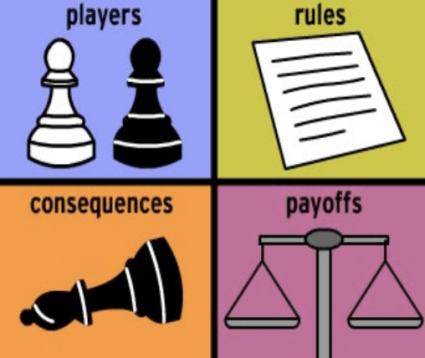
Screen Shot 2019-11-27 at 3.54.41 PM

Source: Jesus Rodriguez, via Medium.

Posted in Uncategorized | Leave a comment