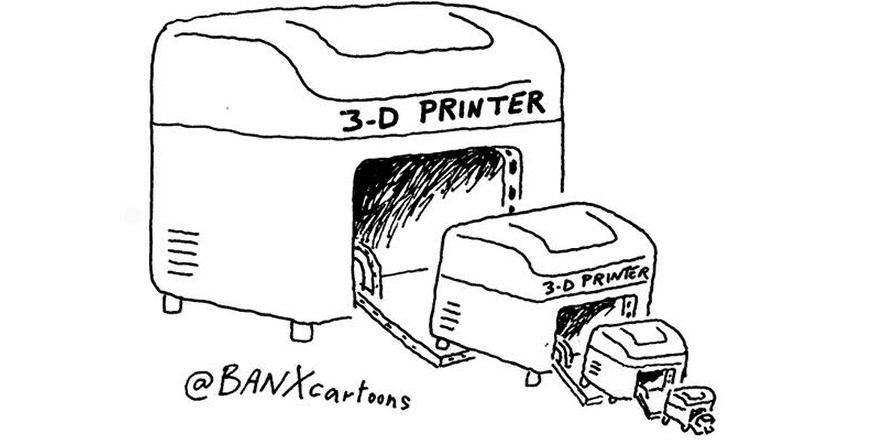
Infinite 3D printer regress

Posted in Questions Rarely Asked, Science Fiction | Leave a comment

Class No. 6 (The Law of Ideas)

During the previous two weeks, we have surveyed two major areas of business law: contracts and torts. In summary, the law of contracts tells us when our promises are legally enforceable, while the law of torts tells us when we are legally liable for someone’s else injuries. In our next class, by contrast, we will survey a third major area of the common law — the law of property — and we will focus in particular on intellectual property or “the law of ideas.” Although Anglo-American law does not create property rights in ideas per se, intellectual property law does allow you to protect the expression of your ideas, if certain legal requirements are met. By way of example, Harvard sophomore Mark Zuckerberg may have created several valuable forms of intellectual property when he registered the domain name for “www.thefacebook.com” in January of 2004 and began building the prototype of his Facebook website (pictured below), which he launched from his dorm room on February 4, 2004. But what type of intellectual property did Zuckerberg create? In addition, we will also debate in class whether Zuck “stole” any intellectual property from the Winklevoss twins, who gave Zuckerberg access to the computer code for a similar website they were developing at the time, or from Aaron Greenspan, who claims that he founded Facebook a few months before Zuckerberg did.

Image result for original facebook homepage

Credit: Mark Zuckerberg

Posted in Ethics, Law, Web/Tech | Leave a comment

I have another reason for hating Microsoft

We have been using Google’s gmail service since 2006, so we have always hated the hideous Microsoft Outlook (see here, for example) by comparison. Last week, my home institution switched over to “Microsoft Surface,” an even more complicated and cumbersome operating system than the previous versions of Microsoft. By way of example, it used to take me one simple step to access my university email account. Now, it takes four separate steps (see below) to log in. Seriously?

Step 1

Step 2

Step 3

Step 4

Posted in Uncategorized | 4 Comments

Social network playlist (part 1)

If you have been following this blog, then you know that we have been using the movie “The Social Network” (and the book “Accidental Billionaires” on which the film is based) to teach our business law course. What you may not be aware of, however, is our “Social Network” music playlist: the songs we play at the beginning of each lecture (while we are setting up our slides and surveys) to set the tone for that class. So, as we approach the halfway point of this spring semester, here is our playlist thus far:

Class #1: Atticus Ross & Trent Reznor, “Hand covers bruise” (social network theme song)

Class #2: 50 Cent, “In da club” (instrumental) (#1 song of 2003, i.e. the year the opening of the movie is set)

Class #3: Beyoncé featuring Sean Paul, “Baby boy” (#1 song of November 2003, i.e. during the Facemash fiasco)

Class #4: Drake, “Back to back” (instrumental) (because in this class we consider the legal consequences of Mark’s back-to-back promises, first with the Winklevoss twins, then with Eduardo)

Class #5: Drake, “Fake love” (instrumental) (because we discuss the law of fraud in this class)

Class #6: Usher, “Yeah!” (instrumental) (#1 song of February 2004, the month Zuckerberg launched “thefacebook”)

Happy Valentine’s Day, Sydjia!

Posted in Culture, Music | 1 Comment

Why are abstracts of law review articles so damn long?

Years ago, we blogged on the state of legal scholarship by posing the following question: why are modern law reviews so dull, tedious, and boring? The problem is that most law review articles today are way too long and have far too many footnotes for their own good. (As an aside, we are certainly not the first to rail against stodgy and tiresome scholarship in legal academia: check out this this blog post from 2006 or Fred Rodell’s classic essay “Goodbye to Law Reviews” published in 1936!) This troublesome trend is now spilling over into the domain of abstracts. Most law professors upload their papers on SSRN (the Social Science Research Network), which requires authors to post a short abstract of their work. But we have noticed that many of these so-called “abstracts” are quite lengthy and tedious themselves, often approaching a 1000 words or more, with multiple paragraphs. By way of example, the abstract of this fascinating work in progress by Nicholas R. Parrillo (Yale Law School) is over 600 words and takes up five separate paragraphs. But then again, I suppose 600+ words is not too bad, especially when compared to 91 pages and 478 footnotes–the total number of pages and footnotes in Professor Parillo’s paper!

Image result for average number of footnotes in law review articles

Credit: Douglas A. Berman (note: HLR = Harvard Law Review)

Posted in Academia, Bayesian Reasoning, Game Theory, Law | 3 Comments

Emancipation Proclamation

In honor of Honest Abe’s birthday today (2/12), we pose the following essay question regarding the Emancipation Proclamation, one of the most famous executive orders of all time. Was President Lincoln’s historic proclamation constitutional? That is, did Lincoln have the constitutional or legal authority to liberate the slaves without direct authorization from the Congress?

Related image
Posted in History, Law | Leave a comment

Square-Mile Street Network Visualization Project

As part of his PhD dissertation in urban planning, Geoff Boeing has developed a computer program that visualizes one-square mile of the road network of any major city in the world. (Check out his cool website here.) By way of example, below are the square-mile street network visualizations of midtown Manhattan, the central Place de l’Étoile in Paris, the medina quarter of the ancient city of Tunis in North Africa, and downtown Atlanta:

OSMnx: Figure-ground diagrams of one square mile of Manhattan New York, Paris France, Tunis Tunisia, and Atlanta Georgia shows the street network, urban form, and urban design in these cities with Python in the style of Allan Jacobs Great Streets and Nolli maps

Image Credit: Geoff Boeing

Posted in Art, Culture, History, Maps | 2 Comments

Black History Data Visualization

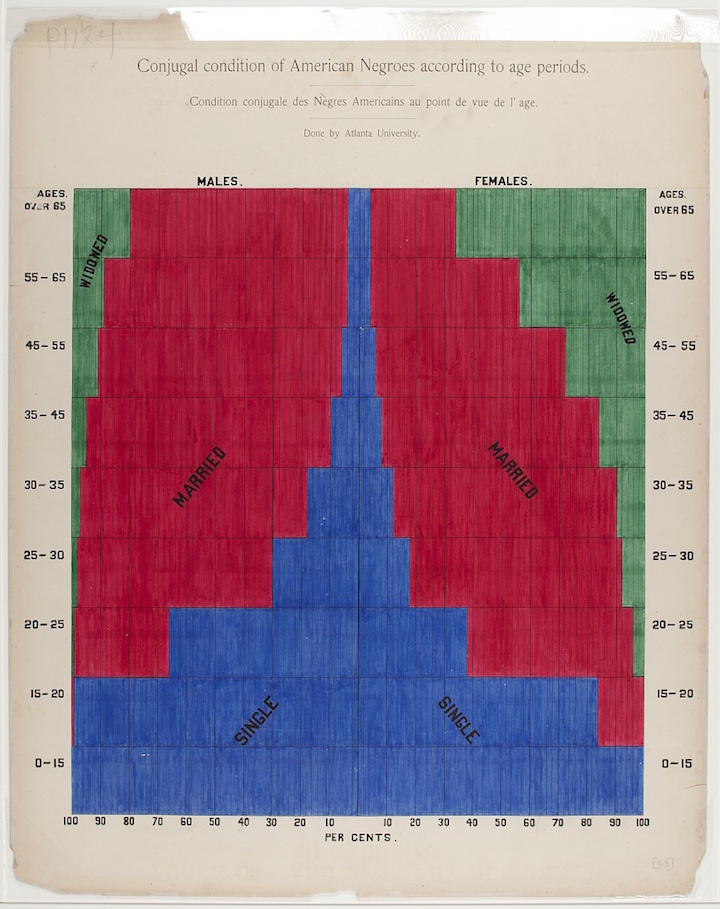
In honor of Black History Month, we are reposting this hand-drawn visualization of demographic data created by W. E. B. Du Bois in the year 1900. You can find more such turn-of-the-century data visualizations here. (Hat tip: digg.)

33915v

Credit: W. E. B. Du Bois

Posted in Culture, Economics, History, Science | 2 Comments

Class No. 5 (Lies and Deception)

When was the last time you were lied to, or when was the last time you told a lie? In our next class, we will study the law and ethics of deception. Generally speaking, it is morally wrong to tell a lie, but when does deceit in our daily interactions or in our business affairs cross the line of legal liability? Specifically, when does deception constitute the tort of deceit or fraudulent misrepresentation? (After all, most business deals and arms-length contract negotiations often involve some level of bluster and bluffing.) For example, in the movie “The Social Network,” does the fictional version of Mark Zuckerberg engage in unfair competition or commit business fraud (i.e. the tort of fraudulent misrepresentation) by pretending to be working on the Harvard Connection website when, in fact, he is really working on his own new facebook website? For what it’s worth, the common law defines the tort of deceit/fraud rather narrowly–see below for a complete listing of all the legal elements a plaintiff must prove in order to establish a case for fraud.

Continue reading

Posted in Ethics, Law | Leave a comment

Visualization of a “design arms race” (soda can edition)

Why do the designs of the Dr Pepper and Squirt soda cans change less frequently (i.e. are more stable over time) than the designs of Pepsi and Coke cans?

Hat tip: Michael Sandberg

Posted in Economics, Game Theory | 3 Comments