Shadow prediction markets?

In our previous post (see Fate of Flight 370 … below), we quixotically called for the creation of a single-event prediction market in order to (1) bypass all the rampant speculation regarding the ill-fated Malaysia Airlines flight, which has been missing since 8 March 2014, and (2) determine more rigorously the truth values (i.e. probabilities) of the various conjectures and conspiracy theories surrounding this perplexing mystery. In the absence of an actual prediction market, however, would it be possible to recreate a “virtual” or “shadow” market, one based on, say, the number of tweets, Facebook posts, or Reddit entries in support of a given theory or conjecture? Although this alternative would be crude and would require some automated method for aggregating and sorting through an enormous statistical population consisting of millions of data points, what other rigorous options are there?

Posted in Uncategorized | Tagged , , , | 1 Comment

The fate of Flight 370? An urgent call for single-event prediction markets …

A single-event prediction market might make it easier to determine more rigorously the probabilities of what really happened to Malaysia Airlines Flight 370. Presently, a wide variety of conjectures and conspiracy theories are swirling around (especially on CNN) about what might have happened to Flight 370, including such possibilities as sabotage, pilot error, a meteor strike, and (perhaps the most likely culprit) mechanical failure caused by an electrical fire. But without a prediction market, how can we know which of these theories or conjectures is most likely to be true?

By contrast, if prediction markets were legal in the US, thus allowing people to openly place monetary bets on their favorite missing-airplane theory (conspiracy or otherwise), Hayekian logic teaches us that, with a sufficient number of bets, we would be able to test which theory or conjecture is the one that is most likely to be true.  So, what theory would you bet on, and how much money would you be willing to wager?

Addendum: since the US is most likely unwilling to legalize prediction markets anytime soon, perhaps another jurisdiction (like the People’s Republic of China or even Macau, a semi-autonomous city-state in China with a large casino industry) could step in to fill this legal void.

Posted in Uncategorized | Tagged , , | 2 Comments

What’s the best* way to find a missing Boeing 777?

a.  Police — call up the FBI, INTERPOL, etc. to pursue all possible leads and conduct a formal police investigation of the passengers, crew, and cargo aboard the missing jet.

b.  Military — call up the commanding officers of the US Navy, NATO, and other military powers to conduct a large-scale military search and rescue mission by land and sea.

c.  Science — call up the engineers at Google, Microsoft, etc. to create a probabilistic or Bayesian statistical computer program projecting the airplane’s most likely travel path.

d.  Cash Reward — call up the Treasury Secretary or the leaders of the airline industry to offer a hefty reward or bounty (say, $1 million USD), payable to whomever finds the missing airplane first.

(*) By “best” we mean the fastest and cheapest method of solving this puzzle.

Next question: Why hasn’t choice (d) been tried yet?

Posted in Uncategorized | Tagged , , , | 1 Comment

Death penalty affirmative action?

death_penalty_race

In other words, death penalty justice is not blind.  Hat tip to Ian Millhiser for compiling the data and preparing the above diagrams.

Posted in Uncategorized | Tagged , | 2 Comments

Who researches the researchers?

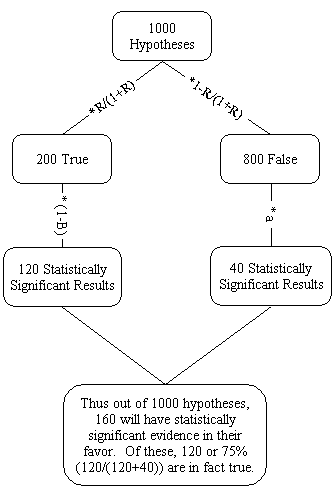
John Ioannidis does, that’s who. His 2005 paper “Why most published research findings are false” created quite a stir in academia, and now Dr Ioannidis is at it again with a new large-scale research project, the Meta-Research Innovation Center, at Stanford University. According to this report dated 15 March 2014 in The Economist,

METRICS, as the new laboratory is to be known for short, will connect enthusiasts of the nascent field in such corners of academia as medicine, statistics and epidemiology, with the aim of solidifying the young discipline. Dr Ioannidis and the lab’s co-founder, Steven Goodman, will organise conferences at which acolytes can meet in the world of atoms, rather than just online. They will create a “journal watch” to monitor scientific publishers’ work and to shame laggards into better behaviour. And they will spread the message to policymakers, governments and other interested parties, in an effort to stop them making decisions on the basis of flaky studies.

Sounds good. But what if most published research about published research is also false?

Truehypo_3

Also, what about a “journal watch” for work in economics and psychology, two fields rife with notoriously unreliable research findings? In any case, double hat tips to Professors Tyler Cowen and Alex Tabarrok for the initial pointer and for the diagram.

Posted in Uncategorized | Tagged , , , | Leave a comment

The most important date in history?

On March 12, 1989, the same year the Berlin Wall fell, Tim Berners-Lee, a researcher at CERN, wrote up and distributed a revolutionary proposal to improve information flows among computers: “a ‘web’ of notes with links between them.” (See diagram below from Berners-Lee’s proposal.) A few years later, CERN declared that the WWW technology developed by Tim Berners-Lee would be free, open, and available to all, without payment of royalties or other legal restrictions. In the words of Berners-Lee:

This decision (to keep the Internet free and open) enabled tens of thousands to start working together to build the web. Now, about 40 percent of us are connected and creating online. The web has generated trillions of dollars of economic value, transformed education and healthcare and activated many new movements for democracy around the world. And we’re just getting started. How has this happened? By design, the underlying Internet and the WWW are non-hierarchical, decentralized and radically open. The web can be made to work with any type of information, on any device, with any software, in any language. You can link to any piece of information. You don’t need to ask for permission. What you create is limited only by your imagination.

Notice the role (or should we say, non-role) that intellectual property rights played in the development of the Internet.

A circles and arrows diagram relating concepts discussed in the paper

Posted in Uncategorized | Tagged , , , | 2 Comments

Foxes versus hedgehogs

Have you heard the ancient proverb: The hedgehog knows one big thing; the fox, many little things …?

Nate Silver sure has. Mr Silver is relaunching his FiveThirtyEight blog this Monday, 17 March 2014, with this old proverb in mind. For those of you who can’t wait until Monday (like us), here is Mr Silver (in this recent interview) on the importance of empirical data and his scathing critique of hedgehog-like pundits in the moribund world of print and TV journalism:

Plenty of pundits have really high IQs, but they don’t have any discipline in how they look at the world, and so it leads to a lot of bullshit, basically … We take a foxlike approach to what data means. It’s not just numbers, but numbers are a big part of this. We think that’s a weakness of conventional journalism, that you have beautiful English language skills and fewer math skills, and we hope to rectify that balance a little bit. * * * We think the first step in using data is that you have to collect data, you have to organize it, and you have to explain the relationships …

Moreover, Mr Silver is willing to name names:

… the op-ed columnists at the New York Times, Washington Post, and Wall Street Journal are probably the most hedgehoglike people. They don’t permit a lot of complexity in their thinking. They pull threads together from very weak evidence and draw grand conclusions based on them. They’re ironically very predictable from week to week. If you know the subject that Thomas Friedman or whatever is writing about, you don’t have to read the column. You can kind of auto-script it, basically.

We love Nate Silver’s point-blank critique of such self-important op-ed pundits. The analyses of these pundits are indeed highly predictable, unoriginal, non-rigorous, and stale. But we would add the following two comments to Silver’s critique:

1. First, we think the main problem with pundits is not so much their hedgehog-like devotion to a single idea. After all, some of the greatest thinkers in science were hedgehogs (like Charles Darwin or Karl Popper). No, the main problem with pundits is their inability or refusal to update their ideological and normative priors.

2. Furthermore, notice that Mr Silver’s critique of pundits (and bullshit generally) applies not just to TV or op-ed pundits but also to traditional legal scholarship, except for the “beautiful English language skills” part.  That is, most legal scholars not only have super-strong ideological or normative priors, priors which they are loathe to reevaluate or update; worse yet, most legal analysis is written in bad English, cluttered with footnotes and an obscure and archaic citation style, as Yale professor Fred Rodell noted many years ago in his classic essay Goodbye to Law Reviews.

Posted in Uncategorized | Tagged , , | Leave a comment

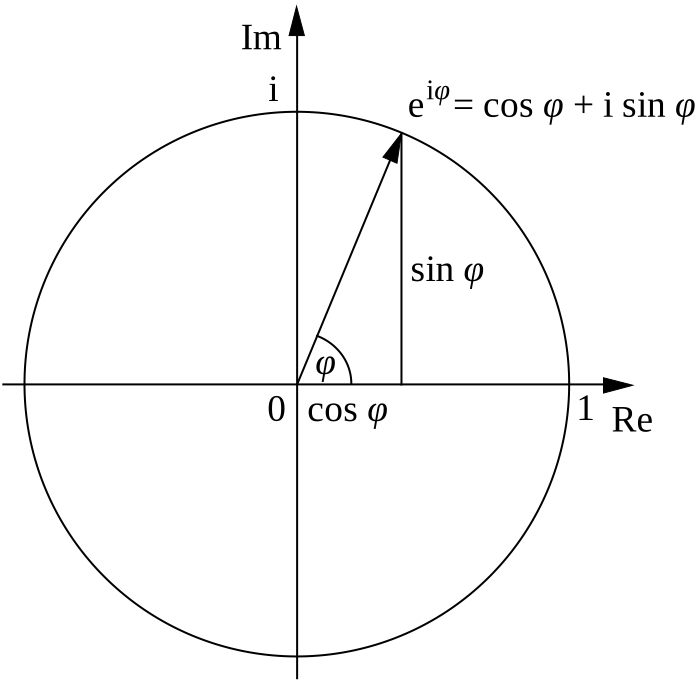
3.1415926535 8979323846 2643383279 5028841971 6939937510 5820974944 5923078164 0628620899 8628034825 3421170679 …

The enigmatic irrational number π … to 100 decimal places. While you contemplate this strange and infinite number, do you detect a pattern, or is all you see pure randomness?

File:Circle Area.svg

File:Euler's formula.svg

Happy National π Day! Go celebrate with your favorite π product. (Hat tip to beautiful Sydjia. Diagrams from Wikipedia.)

Posted in Uncategorized | Tagged | 2 Comments

Argument by analogy

If the executive branch of the US government — starting with President Nixon — has declared a federal “war on drugs” as US national policy, aren’t all lower-level federal officials who carry out this stupid war the equivalent of “war criminals”, including federal police agents (who investigate and arrest people for drug crimes), federal prosecutors (who instigate federal charges for the commission of drug crimes), and federal judges (who impose harsh sentences for drug crimes — see, for example, the table in yesterday’s post below), especially when you consider that a large fraction of drug offenders just “happen” to be black or Hispanic?

Of course, these lower-level federal officials could argue that they are just “following orders”, but if this defense did not work for lower-level Nazi war criminals, why should it work for them?

Posted in Uncategorized | Tagged , | Leave a comment

Federal Prison Population

Posted in Uncategorized | Tagged , | Leave a comment